
How to Remove Orange Tomato Stains from Plastic Containers
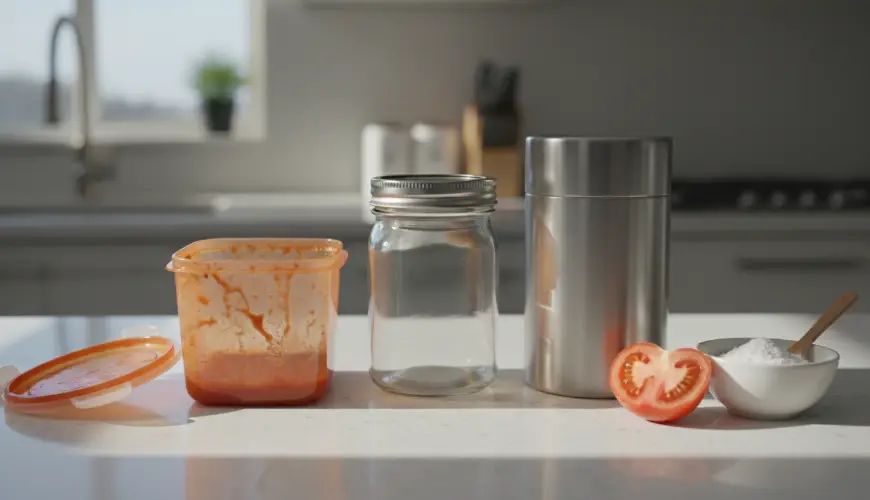
Anyone who has ever stored homemade Bolognese sauce or leftover sautéed tomatoes in a plastic container knows the unpleasant sight that awaits the next morning. The lid comes off, the contents go into a pot—and a prominent orange or red stain remains on the bottom and sides of the container, as though it has soaked right into the plastic. A quick rinse won’t help, ordinary handwashing or a trip through the dishwasher won’t solve the problem, and the stain simply stays put. This is neither unusual nor bad luck—it is a perfectly common chemical phenomenon that affects virtually every household.
Understanding why this staining happens in the first place is the first step toward doing something about it. And as it turns out, the solutions are surprisingly accessible and often literally close at hand.
Try our natural products
Tomato versus plastic: why stains form
The substance behind the characteristic orange to brick-red discoloration is called lycopene. It is a natural pigment belonging to the carotenoid family that gives tomatoes their distinctive color. Lycopene is also a powerful antioxidant, which is why tomatoes are so often discussed in connection with healthy eating—research has repeatedly shown that regularly consuming tomatoes and tomato products may help reduce the risk of certain chronic diseases. Indeed, the World Health Organization considers carotenoid-rich vegetables to be key components of a balanced diet.
The problem arises when lycopene comes into contact with plastic. Most common plastic containers are made from polyethylene or polypropylene—materials that are slightly porous and nonpolar at the molecular level. Lycopene is also a nonpolar molecule, and according to the basic chemical principle that “like dissolves like,” it readily binds to the plastic’s surface and penetrates its microscopic structure. Add heat—when hot sauce is placed in a container, for example—and the pigment soaks into the plastic even more deeply and quickly. The result is those notoriously stubborn orange stains that ordinary cleaning products simply cannot wash away.
Interestingly, cooked tomatoes cause this problem far more than fresh ones. Cooking releases lycopene from the cell walls and makes it more available—and therefore better able to penetrate plastic surfaces. That is why Bolognese sauce or tomato soup is far more hazardous to plastic containers than a chopped fresh tomato in a salad.
How to remove the stains and what actually works
There are many ways to tackle orange stains on plastic containers, and not all of them are equally effective. Much depends on how long the stain has been sitting in the container, how deeply the pigment has soaked in, and what type of plastic the container is made from.
One of the most frequently recommended household methods is sunlight. It may sound surprising, but UV radiation really can bleach lycopene and similar pigments. Simply dampen the container, put it in direct sunlight, and leave it there for several hours—ideally all day. Many people swear by this method and claim that stains that survived repeated dishwasher cycles virtually disappeared after a day in the sun. It is also completely chemical-free, effortless, and free of charge.
Another tried-and-tested method is to use baking soda combined with dish soap or another detergent. Baking soda acts as a mild abrasive that mechanically helps lift the pigment from the plastic’s surface, while the detergent cuts through grease. The process is simple: add a tablespoon of baking soda to the container, along with a little detergent and water, mix everything together, and leave it to work for at least an hour, ideally overnight. After a thorough scrub with a sponge or brush and a rinse, the result is usually noticeably better than with ordinary washing.
An oxygen-based bleach, such as sodium percarbonate, works in a similar way. It is dissolved in water, the container is left to soak, and oxygen bubbles gradually lift the pigment from the surface. This method is especially popular among people who prefer more environmentally friendly alternatives to chlorine bleach—sodium percarbonate breaks down into water, oxygen, and sodium carbonate, making it considerably gentler on the environment.
For particularly stubborn stains, some people recommend lemon juice or vinegar. The acidic environment helps break the bond between the pigment and the plastic, although this method tends to be less effective than the combinations mentioned above. It works best as part of a broader approach—for example, soaking the container in a vinegar solution, then scrubbing it with baking soda and finally exposing it to sunlight.
Stains are a problem, but plastic is a bigger one
Orange stains are unpleasant, but they point to a deeper question: how long, and under what conditions, is it appropriate to use plastic food containers at all? If tomato pigment can soak into plastic, the natural question is whether something from the plastic can in turn get into the food.
And the answer is not entirely reassuring. Research published in journals such as Food Chemistry has repeatedly warned that plastic containers—especially those that are old, scratched, or exposed to high temperatures—can release various chemicals into food. This is particularly relevant when hot food is stored in plastic containers or when plastic containers are heated in a microwave. Acidic foods such as tomato sauces accelerate this process further because the acidic environment makes it easier for substances to migrate from the plastic into the food.
This brings us to a question that interests more and more people: is it time to switch to other materials? Glass containers, stainless steel containers, and containers made from natural materials simply do not have these problems. Glass does not stain or absorb odors or pigments, can withstand hot food and the dishwasher, and, with proper care, lasts for decades. Stainless steel is even more durable—it is practically indestructible, hygienic, and requires no special care.
Switching to glass or stainless steel containers does not mean you have to throw away all your plastic containers at once. A gradual approach is sensible—start by no longer using plastic containers for hot and acidic foods, such as tomato sauces, and gradually replace them with higher-quality alternatives. As British sustainable design pioneer William McDonough says: “Waste is just a resource in the wrong place.” And an old plastic box with orange stains can easily find a new use as a container for screws in the garage or small items in the workshop.
An illustrative example from everyday life is the experience of Markéta from Brno, who used to cook a large pot of tomato soup for the whole family every Sunday. She stored the leftovers in plastic containers, and after a few months the containers were so discolored that guests thought they were dirty, even when they had just been washed. When she switched to glass jars with plastic lids, the staining problem disappeared—and as a bonus, she found that the soup stayed fresh longer in glass because glass does not allow odors or microorganisms through as easily as worn plastic.
Container care and prevention as the best solution
The best way to deal with orange tomato stains is, of course, to prevent them from forming in the first place. A few simple habits can significantly extend the life of plastic containers while reducing the need for intensive cleaning.
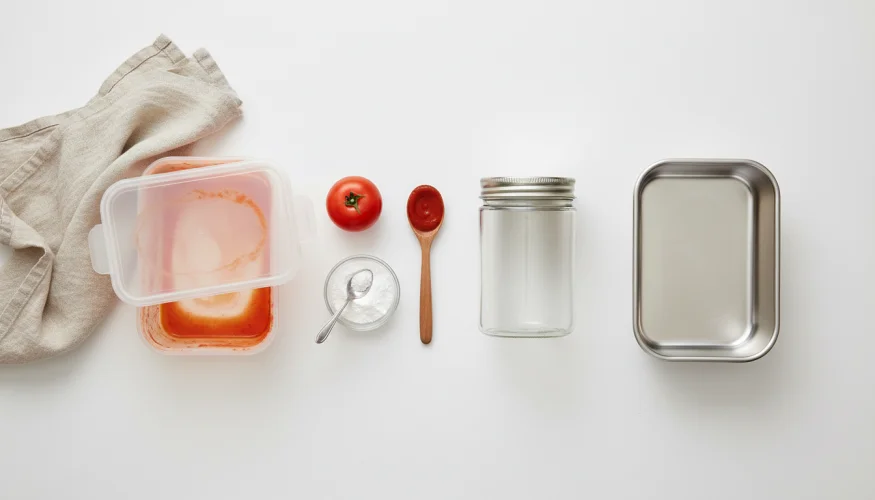
The basic rule is not to pour hot food directly into a plastic container. Simply let the sauce or soup cool to room temperature before transferring it to the container. This significantly reduces how deeply the pigment penetrates the plastic. Another trick is to lightly coat the inside of the container with a little oil before storing tomato sauce—the thin layer of oil creates a barrier between the plastic and the pigment, making stains much less intense or preventing them altogether.
Whenever possible, use glass or stainless steel containers for tomato dishes and save plastic ones for foods that do not cause stains—for example, cereal, nuts, dry pasta, or leftovers without strong pigments. This simple sorting approach will extend the life of plastic containers and reduce the frustration of cleaning them.
It is also important to check the condition of plastic containers regularly. Scratched, cloudy, or warped containers should be retired, because scratches dramatically increase the surface area to which pigments and potentially harmful substances can bind. A plastic container does not last forever, and its lifespan is limited—that is simply the reality of the material.
Orange tomato stains are therefore a small, everyday reminder of how important it is to think about the materials we use in the kitchen. It is not just a matter of aesthetics—although a discolored container really is unpleasant to look at—but of our overall approach to what comes into contact with our food. A high-quality glass or stainless steel container is an investment that pays off not only in the form of cleaner containers, but also in the peace of mind that comes from knowing food is stored safely and hygienically.