

# How to Recognize Shortened Hip Flexors Before They Start to Hurt Shortened hip flexors are one of
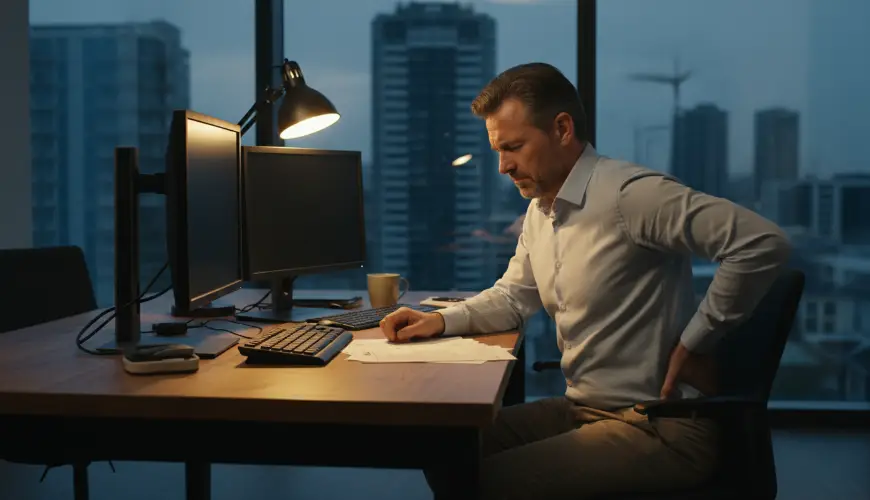
Most people think that if nothing hurts, everything is fine. But the human body is a far more sophisticated machine than it appears – it can compensate, adapt and conceal problems for so long that one day it speaks up in a way that cannot be ignored. Shortened hip flexors are exactly this kind of silent problem. Millions of people go to work with them every day, sit at computers, go for a run – and have no idea that their body is operating in a state that is gradually undermining their musculoskeletal system. So how do you recognise that you have shortened hip flexors, and why is it important to address this even when nothing hurts?
Hip flexors are a group of muscles whose primary function is to bring the thigh closer to the trunk – that is, to flex the hip joint. These include primarily the iliopsoas (composed of the musculus iliacus and musculus psoas major), as well as the rectus femoris as part of the quadriceps, and the tensor fasciae latae. These muscles are essential for walking, running, getting up from a chair, and for the stability of the entire pelvis. The problem arises when they become chronically shortened – meaning they lose their natural length and elasticity, most commonly as a result of prolonged sitting.
Try our natural products
Why the modern lifestyle shortens hip flexors
The average adult in the Czech Republic sits for approximately 8 to 10 hours per day. While sitting, the hip flexors remain in a shortened position the entire time – the thighs are drawn towards the trunk and the muscles simply have no reason to extend to their full length. If this position is maintained for hours every day, weeks, months and years, the muscles "remember" this shortened length as their new default state. Experts call this adaptive shortening.
But the problem doesn't end at the desk. Even people who exercise regularly can have shortened hip flexors – particularly those who cycle, row, or focus their strength training on the anterior side of the body without sufficient stretching. The body builds up shortening gradually and inconspicuously, so the person carrying it usually doesn't notice until it begins causing visible or painful problems.
Take as an example a thirty-year-old graphic designer who works eight hours a day at a computer, goes to the gym three times a week after work, and feels subjectively fit. He has no back pain, no knee problems, and exercises regularly. Yet when examined by a physiotherapist, he discovers that his iliopsoas is significantly shortened on both sides, his pelvis is tilted forward, and his lumbar spine is overloaded. This is a very typical story – and far from exceptional.
How to recognise shortened hip flexors
There are several ways to identify that the hip flexors are not in optimal condition. Some can be easily performed at home, while others require professional assessment.
The best-known test is the Thomas test, named after British orthopaedic surgeon Hugh Owen Thomas. It is performed lying on your back on a firm surface – ideally on the edge of a table or bench. One leg hangs freely over the edge, while the other is pulled by the knee towards the chest. If the hanging leg remains straight or drops slightly, the hip flexors are in good condition. If the thigh of the hanging leg rises from the surface (or from the vertical axis of the body), this signals shortening of the iliopsoas. If the knee simultaneously straightens, this indicates shortening of the rectus femoris. The test is surprisingly informative and physiotherapists use it as a standard diagnostic tool.
Another indicator is the so-called anterior pelvic tilt – a forward tilt of the pelvis, which is one of the most common consequences of shortened hip flexors. It is easy to spot: simply stand sideways in front of a mirror. If the lumbar lordosis is significantly deepened, the buttocks are pushed backwards and the abdomen protrudes slightly forward – even at a normal weight – this may be precisely this problem. The pelvis is literally being "pulled" forward by the shortened flexors, and the lumbar muscles must work under increased tension to maintain an upright posture.
Many people also notice restricted movement in the hip – specifically the inability to fully extend the leg behind the body during walking or lunging. In a deep forward lunge, the back leg should drop downward and the hip should open up. If you feel a pull or tension in the front of the hip of the back leg that prevents full movement, this is another clear signal.
Symptoms need not be purely movement-related. Shortened hip flexors can also manifest as fatigue or tension in the lower back after prolonged standing, a feeling of stiffness during the first steps after getting up or after long periods of sitting, or as non-specific tension in the groin area. These sensations are so common that most people attribute them to other causes – tiredness, a bad mattress, or age.
Why this is a problem even without pain
And now to the most important question: why address shortened hip flexors if nothing hurts? The answer lies in the principle of compensation. The human body is extraordinarily capable of adapting to unfavourable conditions – but this ability comes at a cost. Every compensation places a burden on other structures that are not primarily intended for this purpose.
When the hip flexors are shortened and the pelvis tilts forward, the lumbar spine moves into increased extension. This increases pressure on the intervertebral discs and facet joints. The muscles along the spine must work permanently under increased tension to keep the body upright. The result is overloading that can manifest after months or years as chronic lower back pain – one of the most common health problems of all. According to data from the World Health Organization, up to 60–70% of the population in industrialised countries suffers from lower back pain at some point in their lives, with sedentary lifestyles and muscular imbalances among the main risk factors.
But shortened hip flexors don't only affect the back. They have a direct impact on the function of the gluteal muscles – specifically the gluteus maximus, the largest and one of the most powerful muscles in the body. The principle of reciprocal inhibition applies here: when a muscle on one side of a joint is shortened and overactive, its antagonist – the muscle on the opposite side – is reflexively inhibited and weakened. Shortened hip flexors therefore literally "switch off" the gluteal muscles. And this has far-reaching consequences.
Weak gluteal muscles are unable to properly stabilise the pelvis and hip joint. The knees begin to rotate inward during walking or running, increasing the risk of anterior cruciate ligament injury or the development of iliotibial band syndrome. The feet may pronate. The entire kinetic chain from the feet to the spine reorganises itself around one original imbalance – the shortening of the hip flexors.
As physiotherapist and author of Becoming a Supple Leopard, Kelly Starrett, says: "Mobility is not just about how far you can bend. It's about whether your body can function the way it was designed to." And this is precisely what shortened hip flexors prevent – the body functions, but not as it was designed to. It functions in compromise.
Furthermore, the problem does not only concern athletes or people with physically demanding jobs. Older adults with shortened hip flexors statistically have worse balance, a shorter stride and a higher risk of falling. Research published in the Journal of Physical Therapy Science repeatedly confirms the relationship between hip joint flexibility and walking stability in older adults. Prevention therefore begins long before mobility problems become visible.
Another lesser-known consequence is the effect on breathing and the abdominal muscles. The musculus psoas major, part of the iliopsoas, attaches to the lumbar vertebrae and passes through the pelvis to the inner side of the femur. It therefore passes close to the diaphragm, and its chronic tension can influence breathing patterns, abdominal tension, and even the function of the digestive system. This is a connection that rarely appears in general awareness, but is well documented in the specialist literature.
So how should the situation be addressed? The key is a combination of regular stretching of the hip flexors – particularly the deep lunge with posterior pelvic tilt, the so-called hip flexor stretch – and strengthening of the antagonists, meaning the gluteal muscles and deep trunk stabilisers. Stretching alone is not enough; muscular balance must also be restored simultaneously. Physiotherapists in this context often also recommend techniques such as myofascial release using a foam roller or therapeutic massage in the groin and lower back area.
A change in habits is also important. Every 30 to 45 minutes of sitting should be interrupted by briefly standing up, stretching or walking. A standing desk or a dynamic seat cushion can significantly reduce the time during which the hip flexors remain in a permanently shortened position. This is not about a radical lifestyle change, but about conscious attention to what the body needs.
Shortened hip flexors are one of those problems that are best addressed before they manifest. The body remains silent for a long time – and this is precisely why it is so easy to overlook. But those who learn to listen to its quiet signals have a great advantage: they can act preventively, maintaining mobility, performance and quality of life for many years to come.