
Start Doing Barre at Home Without Equipment or a Studio
There is a form of exercise that combines the elegance of ballet, the precision of Pilates, and the strength-building benefits of resistance training – and practically anyone with a sturdy chair at home can do it. Barre workout has become one of the fastest-growing fitness trends in the world in recent years, and for good reason. It is not a passing fad, but a thoughtfully designed system of movement that transforms the body from the inside out.
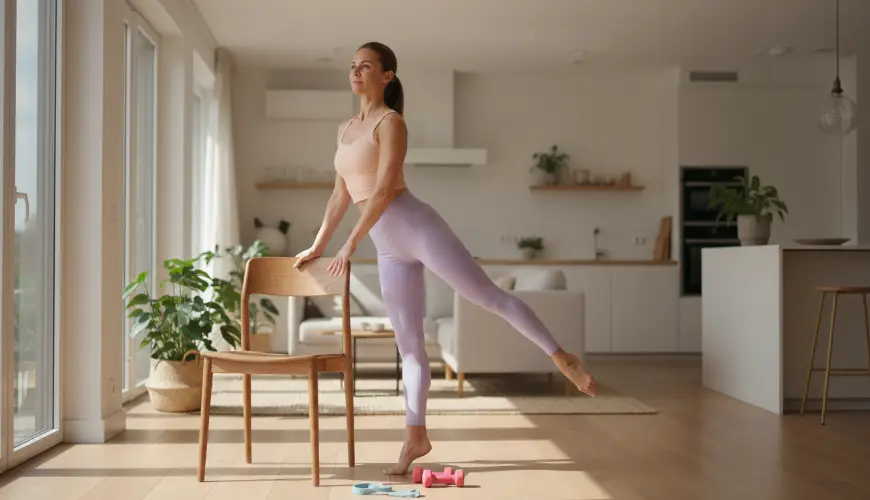
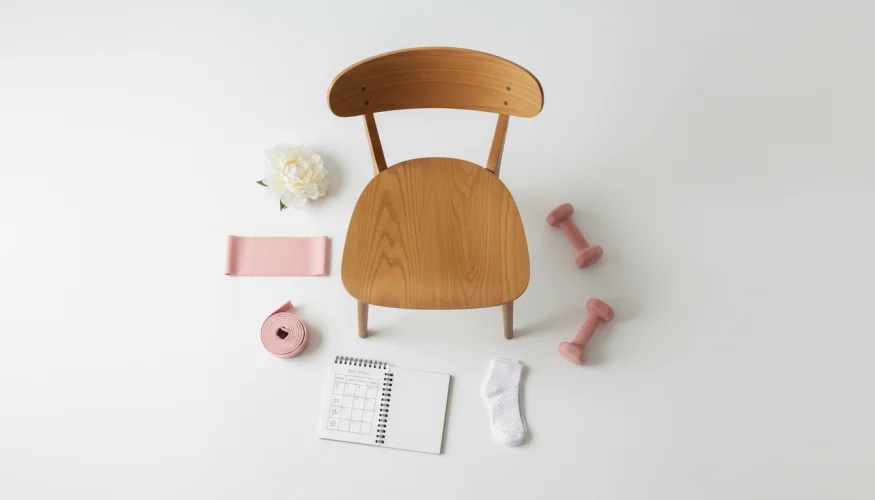
The name comes from the French word for bar – the wooden support ballet dancers hold onto during their daily training in front of a mirror. In professional studios, this bar is usually firmly attached to the wall. At home, however, the back of a kitchen or dining chair works just as well. And this accessibility is one of the biggest attractions of a barre workout – you do not need expensive equipment, a gym membership, or a lot of space.
Try our natural products


What exactly does a barre workout involve, and why does it work?
At first glance, barre training can look gentle, almost unassuming. No heavy weights, no dramatic jumps, no pushing yourself to the point of breathlessness. But anyone who has tried it knows that after the first twenty minutes, the muscles in the legs and buttocks begin to burn in a way they might not have experienced even after an hour at the gym. The secret lies in so-called isometric contractions and small pulsing movements that activate muscles deeply and keep them under constant tension for an extended period.
Barre workout draws inspiration from several disciplines. From ballet, it takes foot positioning, engagement of the deep muscles, and an emphasis on stretching. From Pilates, it borrows mindful breathing and activation of the body’s center – the core. And from traditional strength training, it adds elements such as squats, lunges, and arm exercises with light dumbbells or resistance bands. The result is a comprehensive workout that strengthens, stretches, and improves balance at the same time.
There is a substantial scientific basis for barre training. Research published, for example, in the Journal of Dance Medicine & Science has repeatedly confirmed that ballet-inspired movement significantly improves muscular endurance, flexibility, and postural stability – the body’s ability to maintain good posture in everyday life. Poor posture affects a growing proportion of the population, who spend hours sitting at a computer.
Barre workout is not intended only for women or people with an affinity for dance. In recent years, more and more men, athletes, and older adults have discovered it. The reason is simple: it is low-impact, easy on the joints, and can be readily adapted to a person’s current fitness level. A beginner can work with their own body weight and a minimal range of motion, while an advanced exerciser can add resistance bands or light dumbbells, or increase the number of repetitions.
Ballet training at home with a chair: how to get started
Imagine Markéta, a thirty-four-year-old accountant from Brno who, after having her second child, was looking for a way to get back into exercise without having to arrange childcare or travel to a gym. She came across a barre workout video online, pulled a sturdy wooden chair out of the kitchen, and gave it a try. “I thought it would be easy because it looked almost like standing at the kitchen counter,” she says. “After three days, I could feel muscles I never knew I had.” Today, she works out four times a week, always in the morning before her children wake up.
Markéta’s story is not unusual. Ballet training at home with a chair is an accessible way to start the barre method without any upfront costs. All it takes is following a few basic principles that turn a casual workout into a truly effective one.
The first and most important rule is correct body alignment. Keep your back straight, your shoulders down and back, and your head in line with your spine. Gently draw in your abdomen – not by holding your breath, but by consciously engaging your deep muscles. This basic alignment applies throughout the workout and is what separates barre from merely waving your legs in the air.
The basic exercises that form the backbone of every chair-based barre workout include:
- Plié – a ballet squat with the feet turned out in a V shape; strengthens the thighs and buttocks
- Relevé – rising onto the balls of the feet; strengthens the calves and improves balance
- Small-range arabesque – extending a straight leg behind you; activates the glutes
- Pulses – small, quick movements at the end of a range of motion that keep the muscles under tension
- Side kick series – lifting the leg out to the side with controlled movement; strengthens the outer thigh
Each of these exercises is performed in a series of repetitions, with an emphasis on slow, controlled movement and conscious engagement of the right muscles. Speed is not the goal – the goal is quality of movement.
A workout can be as short as twenty minutes at first. That is enough time to challenge the body without overloading a beginner. Gradually, sessions can be extended to thirty to forty-five minutes, the standard length of a class at a barre studio.
As the famous ballet teacher Lotte Berk, who created the modern barre workout, put it: “The body is a machine designed to move – and the movement that transforms it most is the one that demands your full attention.” This philosophy is evident at every step of barre training.
Why a barre workout is more than just exercise
One of the less frequently discussed but very real benefits of barre training is its effect on mental well-being. Movement inspired by dance naturally improves mood – and not just because of the endorphins the body releases during exercise. The ballet-inspired aesthetic, the emphasis on elegance, and mindful presence in every movement have a meditative effect that many people describe as one of their main reasons for returning to barre training regularly.
Research by the American Psychological Association confirms that physical activities requiring coordination and concentration – exactly what barre training offers – have a greater positive effect on reducing stress and anxiety than monotonous cardio activities such as running on a treadmill. During a barre workout, the brain is active: it must monitor body alignment, coordinate movements, and respond to music, creating a sense of full engagement.
Barre workout also significantly improves proprioception – the body’s ability to sense its position in space. This ability naturally declines with age, and its loss is one of the main causes of falls among older people. The regular balance and coordination training included in every barre class can maintain and even improve this ability at any age.
For postpartum women or people recovering from an injury, barre training is often recommended by physiotherapists as a gentle form of exercise that strengthens the deep stabilizing muscles without placing unnecessary stress on the joints. Because it uses a small range of motion and is low-impact, it is also suitable for those who cannot afford to risk injury.
It is also interesting to consider how barre training changes people’s perception of their own bodies. Many people – regardless of age or starting fitness level – report that after a few weeks of regular exercise, they begin to walk more upright, more mindfully, and with greater ease. This is no illusion: the muscles strengthened by barre training are precisely those responsible for good posture and efficient movement.
As for visible results, most regular exercisers report the first changes after four to six weeks. The buttocks become firmer and more lifted, the inner thighs develop tone that is otherwise difficult to achieve, and the core becomes stronger and more stable. These changes are not dramatic overnight – they are gradual but lasting, because they result from genuine strengthening of muscle tissue, not temporary swelling after strength training.
What makes barre workout particularly appealing in modern life is its adaptability. It can be practiced in the morning as a daily ritual, at midday as a break from work, or in the evening as a way to release the day’s tension. It requires no special clothing or footwear – barre is traditionally practiced barefoot or in socks with non-slip soles. It does not require much space – just enough room in front of an unobstructed wall or window. And it does not require much time – even twenty minutes a day brings results if you exercise regularly.
The world of barre training is more accessible today than ever before. Platforms such as YouTube offer hundreds of free classes of varying lengths and difficulty levels, many Czech fitness instructors offer online courses in Czech, and apps such as Barre3 and Pure Barre provide structured programs for exercising at home. You can literally start this afternoon: just move the kitchen table aside and pull up a chair.
Ballet training at home with a chair is not a second-best option for those who cannot afford a studio. It is a complete form of exercise with its own philosophy, its own history, and proven results. And perhaps it is in its apparent simplicity – barre, body, movement – that the secret to its lasting appeal and effectiveness lies.