
How to Make Roasted Pepper Ajvar for Winter: A Step-by-Step Guide
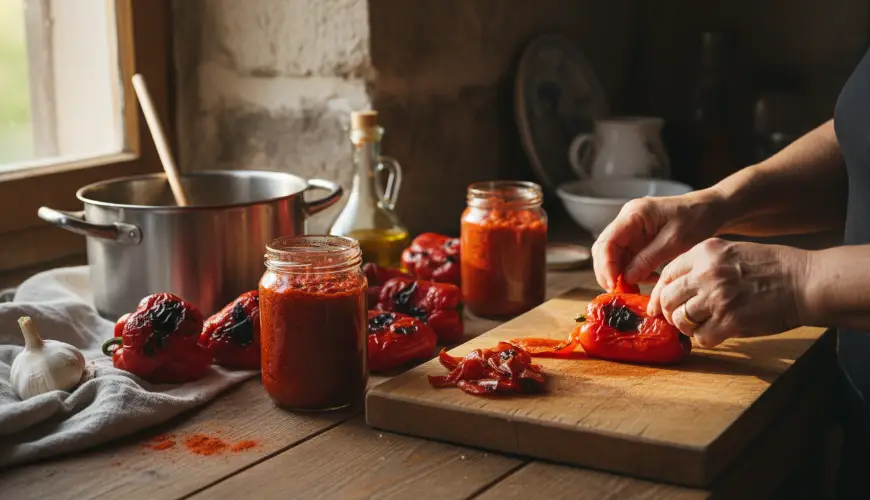
Autumn brings a flood of red peppers to markets and gardens, and this is when households across the Balkans begin an annual ritual that locals consider almost sacred. Making ajvar – a thick, fragrant spread of roasted peppers – is a tradition that has survived for generations and is now enjoying a revival far beyond the borders of Serbia, Macedonia and Bosnia. Homemade roasted pepper ajvar for the winter is more than just a preserve in the pantry; it represents a way of thinking about food that has flavour, provenance and a story.
Anyone who has tasted properly prepared homemade ajvar will understand why people make it in enormous pots and diligently preserve it in jars to last until spring. Shop-bought ajvar may be convenient, but it simply cannot compare with the homemade version – either in flavour or in ingredients. Industrially produced varieties often contain added sugars, preservatives or starch, while homemade ajvar contains only what you put into it yourself.
Try our natural products


Why make ajvar at home
The basic ingredients are simple: red peppers, optionally aubergine, garlic, oil, salt and a little vinegar or lemon juice for preservation. Yet these few ingredients produce something with a depth and complexity of flavour that is hard to achieve any other way. The secret lies in roasting – the peppers must be roasted until dark, ideally over an open fire or in the oven at its highest temperature, until the skins blacken and the flesh softens to a silky consistency. Only then are the sugars released that give ajvar its characteristic sweetness, while subtle smoky notes develop, taking the whole dish to another level.
Take, for example, a family from a small Moravian town who were given a recipe years ago by a neighbour originally from Bosnia. At first, they cautiously tried making ajvar with just a few kilograms of peppers. The result was so convincing that the following year they processed twenty kilograms, and today making ajvar is an established autumn ritual for them – the children help peel the peppers, the grandmother stirs the pot, and the grandfather is given the honourable task of tasting. Such scenes are not unusual. Ajvar has the power to bring people together around shared work and shared food, something no jar from a shop can replace.
From the perspective of sustainability and a healthy lifestyle, making ajvar at home is also a considerably more environmentally friendly choice. Peppers are exceptionally rich in vitamin C – according to data from the US National Institutes of Health, one medium red pepper contains more than 150% of the recommended daily intake of this vitamin. Although some vitamin C is lost during cooking, carotenoids, especially beta-carotene and lycopene, paradoxically increase after heating because heat breaks down cell walls and releases these substances in an absorbable form. Homemade ajvar is therefore not only delicious but nutritious too.
The food waste aspect is also important. An autumn surplus of peppers from your own garden, or an inexpensive purchase directly from a grower at a farmers’ market, can be put to good use in this way and turned into supplies that will serve the family all winter. This is precisely the kind of thinking behind the modern movement towards a sustainable household – less waste and more mindful use of what nature provides.
Recipe and step-by-step method
Before you start, it is worth knowing one basic rule for ajvar: the better the ingredients, the better the result. Fleshy varieties of red pepper, such as kapia or ramiro, work best, either on their own or combined with tlamanka peppers. Aubergine is optional, but adding it gives ajvar a smoother, creamier texture and a milder flavour. The classic ratio is approximately three parts peppers to one part aubergine, but every family has its own tried-and-tested recipe.
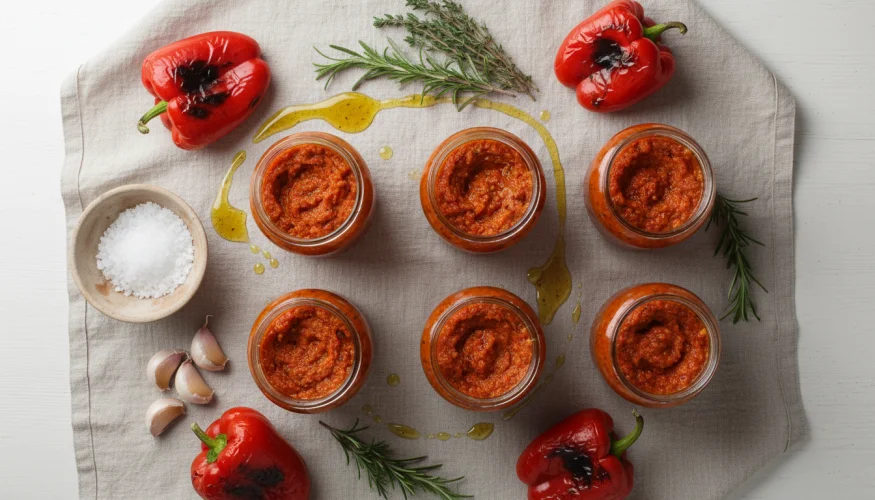
For approximately five to six 350-millilitre jars, you will need about three kilograms of red peppers, one large aubergine, four to five cloves of garlic, 80 to 100 millilitres of good-quality olive or sunflower oil, a tablespoon of salt and two tablespoons of white wine vinegar. If you like a spicy version, add one or two hot chillies – Balkan tradition knows this version as “ljuti ajvar”, and it is very popular.
The process begins with roasting. Arrange the peppers and aubergine on a baking tray lined with baking paper and place in an oven preheated to 220–240 °C. Roast for approximately 30–40 minutes, until the skins begin to blacken and blister. If you have a barbecue or a gas stove, you can roast the peppers directly over the flame – this will give them a more pronounced smoky aroma. Once roasted, transfer the vegetables to a bowl or pot, cover with cling film or a lid and leave to rest for about 15 minutes. The steam that forms will make them easier to peel.
Once the peppers and aubergine are cool enough to handle, peel them and remove the seeds. This part of the work is the most time-consuming, but also the most fragrant – the aroma of roasted peppers filling the kitchen is a reward in itself. Roughly chop the peeled peppers and aubergine, or place them straight into a food processor and blend to a coarse purée – ajvar should not be completely smooth, but have a little texture.
Transfer the mixture to a wide, heavy-bottomed pot, add the oil and cook over medium heat for approximately 45–60 minutes, stirring constantly. The ajvar will gradually thicken and lose its excess water. Towards the end of cooking, add the crushed garlic, salt and vinegar, stir and taste. Transfer the finished ajvar into previously sterilised jars, seal with lids and turn the jars upside down – this creates a vacuum that extends their shelf life. Once cooled, store in a cool, dark place. Properly preserved ajvar will keep for 12 months without a problem, but it is almost certain not to last that long – not because it will spoil, but because it will be too delicious.
As the famous French chef Auguste Escoffier once said: “Good food is the foundation of genuine happiness.” And ajvar, though Balkan in origin, fully embodies this idea.
Ajvar as part of a healthy and sustainable lifestyle
Making homemade ajvar fits naturally into a broader approach to food that emphasises seasonality, simple ingredients and respect for traditional methods. It is not a passing fad, but a practice that has existed for centuries and stood the test of time. At a time when more and more people are interested in what they eat and where their food comes from, preserving vegetables at home is becoming increasingly appealing.
Ajvar is also exceptionally versatile. It works as a spread on wholegrain bread, a sauce for pasta, a base for soups or an accompaniment to grilled meat and vegetables. In vegetarian and vegan cooking, it serves as a tasty and nutritious alternative to traditional cream- or meat-based sauces. Thanks to the healthy fats from olive oil and antioxidants from peppers, it is a food that contributes to a balanced diet.
If you are interested in the broader context of Balkan cuisine and the tradition of fermenting and preserving vegetables, an excellent resource is the Oxford Companion to Food, which maps food traditions across cultures and continents. Similar methods of preserving vegetables exist throughout Europe – from Italian peperoncino and Spanish romesco to Hungarian lecsó – and all follow the same logic: make use of autumn’s abundance and carry it through into winter.
It is also interesting to see how ajvar has made its way into the culinary world far beyond its original home in recent years. Modern chefs use it in sophisticated tasting menus, bistros serve it as part of tapas platters, and food bloggers around the world share their versions of the recipe. Yet at its best, ajvar remains a homemade product – a little uneven, a little smoky, a little different every time, but authentic for precisely those reasons.
Autumn is therefore the ideal time to pick up a few kilograms of red peppers, turn on the oven and set out on this fragrant journey. The result will be more than a well-stocked pantry: there will also be the satisfaction of having made something with your own hands, from good ingredients and with care that always leaves its mark on the finished product. And when you open a jar in January or February and the aroma of roasted peppers fills the kitchen, you will remember a sunny autumn day and be glad you made the effort.