
Washing Towels, Bedding and Pajamas: How Often to Change Them

Most people wash their laundry when it starts to look visibly dirty or smell unpleasant. But for items that come into direct contact with the skin every day, that is not enough. Towels, bedding and pajamas are exposed to sweat, skin oils, dead cells and bacteria every day – yet most households wash them far less often than hygiene would call for. The question of how often to wash these textiles has surprisingly specific answers, supported by microbiologists’ research and dermatologists’ recommendations.
Take a typical medium-sized Czech household as an example. The family changes the bed linen once every two weeks, towels hang in the bathroom for a whole week, and pajamas are washed “every once in a while.” It seems normal because everyone around them does the same. In reality, however, this practice creates ideal conditions for microorganisms to multiply, potentially causing skin problems, inflammation or allergies. This is not about scaremongering – it is about understanding what happens at a microscopic level every night.
Try our natural products

What actually builds up on textiles?
The human body sheds thousands of dead skin cells every hour. We lose so many overnight that after just a few days, bed linen is literally covered in this biological material. Add sweat to the mix – even someone who does not visibly perspire releases approximately half a liter of fluid during the night. This moist, nutrient-rich surface is a haven for house dust mites, yeasts and bacteria such as Staphylococcus or E. coli, which occur naturally on textiles but can become a problem in larger quantities.
Research published in the journal Microbiology showed that used towels contain a significantly higher concentration of bacteria after just two days of use than freshly washed ones. The bathroom environment makes matters worse – moisture and warmth are ideal for bacteria. A towel left hanging wet on a hook does not have time to dry properly between uses, creating conditions in which microorganisms multiply rapidly.
Pajamas and nightgowns are much like bed linen. They are in direct contact with the skin throughout the night, absorbing sweat and skin secretions. What is more, many people wear them repeatedly without thinking about what accumulates on the fabric. As American microbiologist Philip Tierno of New York University once remarked: “Your bed is like a Petri dish – it provides warmth, moisture and nutrients for microbes.” The same logic applies to everything with which we spend our nights in that bed.
How often to wash towels, bedding and pajamas – specific recommendations
Hygiene and dermatology experts broadly agree on the basic recommendations, although the specific numbers may vary depending on individual circumstances. As a general rule, bath towels should be washed after three to four uses, which means approximately once every four days for someone who showers daily. Face towels and washcloths should be washed even more often – ideally after every use or after two uses at most, because they come into contact with the more sensitive skin of the face and can contribute to acne.
Bedding – that is, sheets, pillowcases and duvet covers – should be washed approximately once a week. This recommendation applies to healthy adults who shower before bed. If someone suffers from allergies, asthma or skin problems, it is advisable to shorten the interval to every five to six days. Of all the components of bed linen, the pillowcase is the most important – it is in direct contact with the face, hair and mouth throughout sleep.
According to dermatologists, pajamas and sleepwear should be washed after approximately three to four wears, or roughly twice a week. Of course, this depends on whether a person showers before bed, whether they sweat at night and what time of year it is. In summer or during illness, it is advisable to wash pajamas after every second wear.
For clarity, these recommendations can be summarized as follows:
- Bath towels: every 3–4 uses (approximately every 4 days)
- Face towels and washcloths: after every use or after two uses at most
- Pillowcases: every 5–7 days
- Sheets and duvet covers: every 7–10 days
- Pajamas and nightgowns: every 3–4 wears
These intervals are, of course, guidelines. People with pets that sleep in their beds, those with skin conditions, and young children require shorter washing intervals in almost every category.
How to wash and dry textiles properly so they are truly clean
It is not enough to know how often to wash towels and bedding – it is also important to know how to do it properly. Washing temperature plays a key role. Bacteria and dust mites survive washing at low temperatures, so bed linen and towels should be washed at a temperature of at least 60 °C. If a fabric is delicate and cannot be washed at a high temperature, adding a laundry sanitizer to the wash cycle or using a special detergent with antibacterial properties can help.
The drying method has just as much influence on the final level of cleanliness as the washing itself. Textiles air-dried in a well-ventilated space or outside in the sun are a more hygienic choice than those left damp and bunched up in the washing machine drum. Ultraviolet radiation from the sun has natural disinfecting properties and helps eliminate remaining bacteria. That is why drying in direct sunlight, when conditions allow, is an excellent choice – and a more environmentally friendly alternative to an electric dryer.
Another important factor is the choice of laundry products. Synthetic fragrances and harsh chemical ingredients in conventional liquid detergents can irritate the skin, especially in people with sensitive skin or atopic eczema. An alternative is eco-friendly, naturally derived laundry products, which are gentler on both the skin and the environment. For example, liquid detergents certified by Ecocert or Nordic Swan are effective even at lower temperatures and do not contain unnecessary chemicals that remain in textiles after washing.
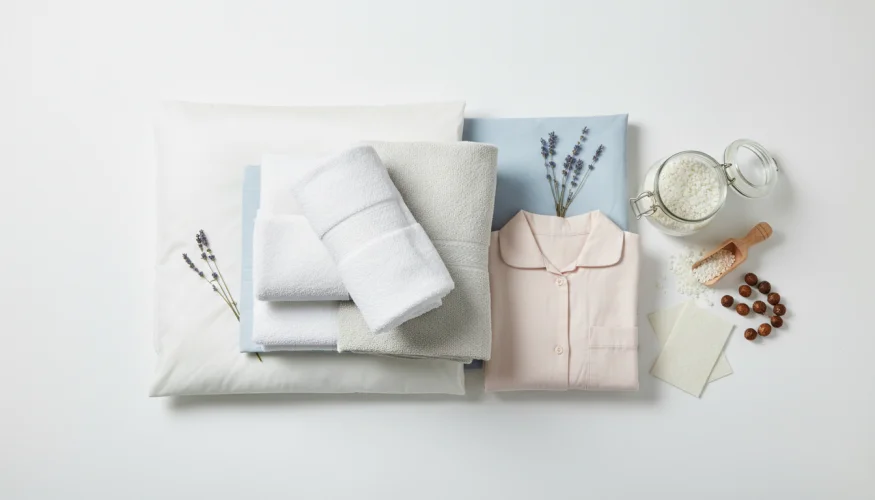
An interesting option for those who want to reduce plastic packaging and chemicals in the home is laundry sheets or soap nuts – compact, lightweight alternatives to conventional detergents that are becoming increasingly popular among people seeking a more sustainable way to care for their homes. Information on the ingredients and certifications of eco-friendly laundry products can be found, for example, in the EWG (Environmental Working Group) database, which evaluates the chemical composition of cleaning and laundry products in terms of health safety.
Proper textile care also includes storage. Clean towels and bedding should be stored in a dry, ventilated place – not in sealed plastic packaging, where moisture can accumulate and encourage mold growth. A closet with some air circulation or open shelves are better suited to storing bed linen than one might think.
It is also worth noting that the choice of textiles themselves has a significant effect on how quickly dirt accumulates on them and how easily they can be washed. Towels and bedding made from natural materials such as cotton, bamboo or linen are generally a more hygienic choice than synthetic alternatives. Natural fibers absorb moisture better, dry faster and are less prone to retaining odors. Bamboo textiles also have natural antibacterial properties that slow bacterial growth – this does not mean they can be washed less often, but their overall hygienic properties are better.
Many people also underestimate the importance of caring for the washing machine itself. If the machine is not cleaned regularly, mold and bacteria can accumulate in the drum and seals and then transfer to the laundry being washed. Once a month, it is advisable to run an empty wash cycle at a high temperature with a cleaning product or vinegar to keep the machine hygienic.
Changing your habits when it comes to washing household textiles is neither drastic nor expensive. It is more a matter of awareness – understanding what happens on textiles and why regular washing is not just a matter of appearance, but of genuine hygiene and health. A clean towel, fresh bedding and washed pajamas are not a luxury – they are the foundation of well-being and healthy sleep. And sleep quality, as research from the National Sleep Foundation shows, has a fundamental effect on a person’s physical and mental health.
The next time you hang a towel back on the hook, thinking it “can last a little longer,” it may be worth pausing for a moment. Not out of excessive perfectionism, but because small changes in daily habits have a surprisingly big impact on how we feel – and how well we sleep.