

You can achieve clean air in your home even without an air purifier
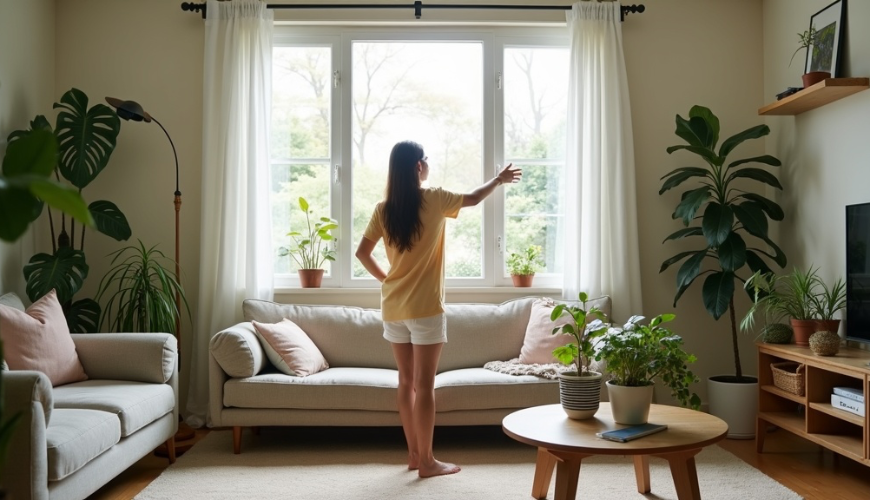
The air at home is often taken for granted – until it starts to scratch the throat, burn the eyes, or one wakes up with a feeling of "heavy head" in the morning. However, clean air in the household is neither a luxury nor a privilege for people with expensive technology. In many apartments and houses, it is the sum of small decisions: what is used at home, how it is ventilated, what is used for heating, how it is cleaned, and how much humidity is allowed to "live its own life." And the good news? Healthy air at home even without a purifier is achievable – you just need to know where to start and which habits have the greatest effect.
You might be thinking: how to improve air quality without a purifier, when it’s dusty in cities, there’s smog outside, and in winter, ventilation is not favored? The answer is not one magical solution, but several simple steps that can be adapted to any household. And surprisingly often, it’s not about "adding" another thing to the apartment, but rather about removing sources of pollution and better managing what’s already at home.
Try our natural products
-1-m.jpg)
-1-m.jpg)
-1-m.jpg)
-1-m.jpg)
-1-m.jpg)
What most commonly worsens the air at home (and why it's not just dust)
When bad air is mentioned, most people think of dust. It is visible on shelves, clings to black clothing, and sometimes rises when changing bed linens. However, air quality is often affected by things that are not visible: volatile substances from some cleaning agents and fragrances, smoke from cooking, excessive humidity, or conversely, overheated dry air. In the apartment, "chemistry" from new furniture, floors, paints, or adhesives is also added – especially in the first weeks after renovation.
An important term is CO₂, or carbon dioxide, which we exhale. It’s not a poison, but in a poorly ventilated room, its level increases, and a person can become tired, find it harder to concentrate, and may have a headache. In offices, this is addressed with air conditioning, at home, often a smart ventilation regime is sufficient.
When one looks at indoor air quality comprehensively, it makes sense to take inspiration from authoritative institutions' recommendations. For example, the World Health Organization (WHO) has an overview of the risks of polluted air and warns that the indoor environment can be as much of a problem as the outdoor one. Similarly, the EPA (U.S. Environmental Protection Agency) summarizes what most commonly worsens indoor air and why prevention is often more effective than "putting out" the consequences.
And now practically: if the goal is clean air in the home, the best results come from a combination of three things – regular ventilation, limiting sources of pollution, and sensible management of humidity.
Tips on how to improve air at home without a purifier: small changes with a big effect
Ventilation sounds trivial, but in reality, it’s the quickest way to improve air quality without a purifier. It’s not about keeping a window "cracked" all day in winter. Often, short, intense ventilation is better – a draft for a few minutes, ideally several times a day. The air is exchanged, but the walls and furniture don’t cool down so much that the apartment takes a long time to heat back up.
At the same time, it makes sense to think about when to ventilate. On a busy street, the air is often cleanest early in the morning or after rain, while during rush hour, more emissions can enter the apartment. In cities, it pays to monitor dispersion conditions and smog situations; when it’s really bad outside, it’s better to ventilate for shorter periods and wisely.
A big difference is also made by what is used at home for cleaning and scenting. Many common sprays and intense fragrances just "cover up" smells but also add more substances to the air. If the goal is healthy air at home even without a purifier, it pays to opt for gentler variants – without unnecessary perfumes, with simple compositions, ideally in concentrates or powder form, to also limit packaging and water transportation. The scent of home can be created in other ways: ventilate, wash textiles, clean drains, and regularly dispose of organic waste. Sometimes it’s less "romantic" than a scented candle, but much more honest for the air.
The kitchen is a big topic. Cooking is wonderful, but frying and searing produce smoke and fine particles that linger in the air and settle on surfaces. If there is a hood, it helps to always use it – and especially to maintain it. A clogged filter loses efficiency and starts to be more of a decoration than a helper. When there is no hood or it’s weak, a simple trick works: briefly cover the pan while frying, lower the temperature, and ventilate intensively right after cooking. In winter, this means a few minutes of discomfort, but the reward is air that doesn’t "stick" to clothing in the evening.
Humidity is another chapter, often underestimated. Too dry air worsens irritation of mucous membranes, too humid air encourages mold. Mold is not just an aesthetic problem in a corner behind the wardrobe; it can irritate the respiratory tract and worsen allergies. Ideally, humidity should be kept roughly in the middle range (often stated as approximately 40–60%), but practice is more important than numbers: after a shower, close the bathroom door, turn on the fan or ventilate, don’t leave wet clothes to dry in an unventilated room, and monitor corners where air doesn’t circulate.
Speaking of dust, it’s worth considering how cleaning is done. Sweeping and dry "polishing" tend to stir up dust rather than remove it. A wet clean is more effective – a microfiber cloth or damp rag, regularly washed. For vacuuming, a quality filter (HEPA is often mentioned) helps, as does a simple habit: vacuuming slowly and systematically so that dust is truly sucked in, not just passed over.
Textiles are a huge reservoir of everything – from dust to kitchen odors. Clean air at home often means clean curtains, pillows, blankets, and carpets. It’s not necessary to wash everything every week, but a regular rhythm works wonders. And those dealing with allergies know that the bedroom is key: clean air in the household is also recognizable by sneezing less in the morning than before.
One thing is surprisingly effective and yet free: not overheating. An overheated apartment leads to dry air, higher dustiness, and greater fatigue. When rooms maintain a reasonable temperature and are regularly ventilated, the air tends to be "lighter." It’s not a dogma – some people like warmth – but from the perspective of the indoor environment, it’s often a step in the right direction.
And what about houseplants? They are often talked about as "natural purifiers". Reality is more sober: plants can improve the feeling of space, add a bit of humidity, and psychologically, they have a very positive effect, but on their own, they usually do not replace ventilation or solve pollution sources. However, they can be a useful part of the household – if only because they motivate one to ventilate more and care for the environment. Just be sure to monitor that mold doesn’t form in overwatered pots.
When it all comes together, a simple logic emerges: tips on how to improve air are not about one miraculous product but about everyday spatial hygiene. As one often-cited public health principle puts it: “The best pollution is that which doesn’t happen at all.” And in the household, this is doubly true.
A real-life example: an apartment above a busy street and "evening heavy air"
Imagine a common situation: a smaller apartment in the city, windows facing the street, in winter not much ventilation because "it would be cold". In the evening, dinner is cooked, sometimes something is fried, along with a candle or aroma diffuser for "atmosphere", and laundry dries on a rack in the living room. The result? In the morning, the air in the bedroom is heavy, condensation forms on the windows, and dark spots start appearing in the corners.
The solution doesn’t have to be a major investment. Just change a few things: always ventilate briefly and intensively after cooking, dry clothes only with an open window or in a room with better ventilation, limit scents and replace them with regular washing of textiles, and mainly establish a "quick ventilation" routine in the morning and evening. After a few weeks, it often happens that condensation on windows significantly decreases, kitchen odors linger less in the apartment, and mornings feel fresher. It’s not magic – just healthy air at home even without a purifier as a result of better habits.
When odors, humidity, or mold linger at home: what to check first
Sometimes people try to improve air by adding another scent, another candle, another "absorber". But odor is often a signal. It can be a clogged siphon, a trash can, damp textiles, a bio-waste bin without regular emptying, or perhaps an old carpet that can no longer be cleaned properly. In such cases, "cleaning the cause" works better than "masking the consequence".
With mold, it's important to act quickly and practically. If it repeatedly appears in the same place, it’s not enough just to wipe it off. It’s necessary to find out why moisture condenses there: Is there a wardrobe standing closely against a cold wall? Isn’t the bathroom being ventilated? Is laundry drying in the bedroom? Could there be a problem with a leaky window or water seepage? Mold in this sense is unpleasant but useful – it points to a place where air doesn’t circulate well or where moisture lingers.
At the same time, it’s worth paying attention to burning. If heating with stoves or a fireplace, a proper draft, dry wood, and regular chimney checks are essential. For gas appliances, service and safety checks are not a waste. All these sources can affect how it feels to breathe at home – and here it’s not just about comfort but also about safety.
For those who want to go a step further, a simple CO₂ meter or hygrometer can be purchased. It’s not a purifier and it’s not a necessity, but it’s a "compass" that helps detect when it’s necessary to ventilate or when it’s already too humid at home. Often it turns out that the subjective feeling is misleading: one gets used to stale air, but the numbers indicate that just three minutes of draft would completely change the room.
Finally, it’s good to remind one more thing: air quality is also related to what is stored at home. Old paints, thinners, aggressive chemicals, or large stocks of perfumed products can "smell" even through a closed cabinet. When such items are moved to a well-ventilated space (or safely disposed of), the difference is often noticeable.
So, clean air is often not born from one big change, but from several inconspicuous ones. Tips on how to improve air can be summarized into a simple idea: ventilate smartly, cook and clean in a way that doesn’t unnecessarily increase the load, and monitor humidity before it becomes a problem. And when the window is opened for a few minutes in the evening and the apartment breathes with you, it’s the kind of home comfort that can’t be bought – but can be quite easily created.