

Prepare Rafaelo coconut balls in a healthy way and without baking
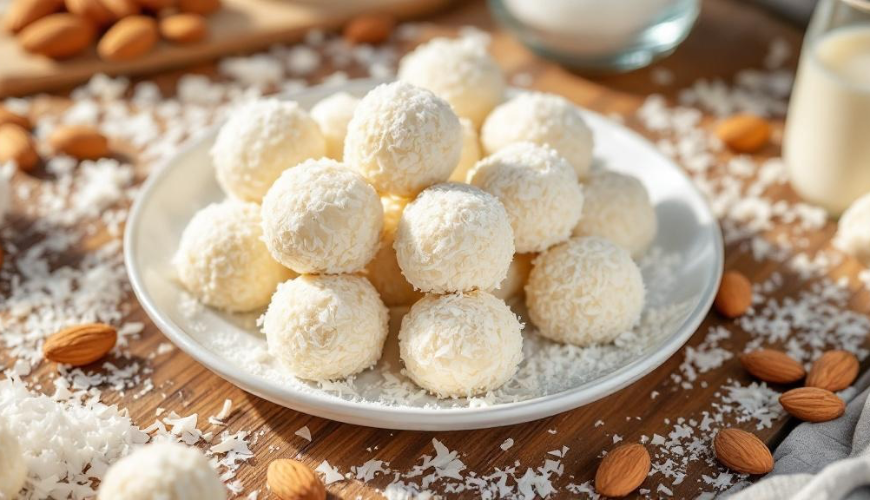
Coconut balls "Raffaello" belong to the sweets and small desserts that have become so naturally ingrained in our culture that we sometimes forget that their homemade version can be not only delicious but also surprisingly simple. At the same time, there is a common question surrounding them: can we make Raffaello balls healthier so that they are not just a "little white bomb" of sugar and fat? The good news is that yes, we can — and often it is enough to swap a few ingredients, choose a better method, and think about what we really expect from sweets. Are they meant to be balls for the festive table, a quick snack for work, or something to calm the craving for sweetness after lunch, without reaching for another in an hour?
Homemade coconut balls in Raffaello style work well precisely because they are "friendly at first sight": creamy mass, coconut, and an almond inside. You don't need an oven or molds, just a bowl, a spoon, and a bit of patience when shaping them. And what's more — once you find a favorite recipe for homemade coconut Raffaello balls, it can easily be adjusted depending on whether you want the result to be a festive dessert or everyday healthier snacking.
Try our natural products

Why homemade "Raffaello" makes sense even in a healthier version
Store-bought sweets often have one common feature: they are designed to be as "consistent" as possible — the same taste, the same texture, the same shelf life. This often means more sugar, hydrogenated fats, or ingredients that we don't typically use at home. The homemade version has the advantage that it can be based on ingredients that make both the body and mind feel better: less sweetening, adding proteins, choosing quality fats, avoiding unnecessary additives.
At the same time, it is fair to say that "healthy" does not automatically mean "diet". Even nuts, coconut, and quality fats are energy-rich. The difference is more that such a sweet tends to be more filling and less "triggers" the desire to eat half a box. As a frequently quoted saying aptly puts it: "It's not about eating less, but eating better." This is doubly true for sweets.
For those who want to lean on authoritative context, you can look at how it is generally recommended to work with added sugars — for example, the World Health Organization (WHO) provides recommendations for limiting free sugars, which is a good compass for home baking and "non-baking". It doesn't mean that sweets have to disappear, rather that it makes sense to monitor where the sweetness comes from and how much there is in the end.
And now the most important thing: healthier coconut balls are not a punishment. When made well, they are soft, fragrant, creamy and yet do not taste overly sweet. Moreover, they are naturally gluten-free and can easily be adapted for lactose-free or vegan versions.
Recipe for homemade coconut Raffaello balls (healthier, but still "wow")
There is not just one right way. However, a recipe that combines coconut, a gentle creamy component, and something to bind the mixture and lightly sweeten it, proves effective. Below is a version that tastes "desserty" but can still be considered a more reasonable choice. It's designed to be simple even for someone who doesn't usually bake.
Ingredients (about 18–22 balls depending on size)
- 200 g finely grated coconut + a little extra for coating
- 120–150 g quality quark or thick Greek yogurt (see below for a vegan version)
- 2–3 tablespoons almond butter (or cashew butter)
- 2–4 tablespoons honey or maple syrup (to taste; chicory syrup can also be used)
- 1 teaspoon vanilla extract or ground vanilla
- a pinch of salt (yes, even in sweets — it rounds the flavor)
- whole almonds for the "core" (ideally blanched; hazelnuts can also be used)
The process is practically without risk. In a bowl, mix the quark (or yogurt), nut butter, sweetener, vanilla, and a pinch of salt. Then gradually work in the coconut until a malleable mass is formed. If the mixture is too thin, add coconut; if it is too dry and crumbly, a spoonful of yogurt or a drop of syrup will help. It is then good to put the mass in the fridge for at least 20–30 minutes — it will firm up and shaping will be much more pleasant.
Take a piece of the chilled mixture, press an almond into the center, and form a ball. Finally, roll it in grated coconut. Allow the finished balls to rest in the cold for a while so that the flavors meld and the surface "sets" nicely. In the fridge, they usually last 4–5 days (depending on the dairy base used), in the freezer for several weeks — just let them thaw for a few minutes before serving.
What makes this version "healthier"? The sweetness can be kept low, the creaminess is largely from quark or yogurt, and part of the fat and flavor comes from nut butter, which also adds satiety. The result is not just sweet, but full of flavor.
Vegan and lactose-free variant that works
If the recipe is to be purely plant-based, a thicker coconut yogurt or the solid part of quality coconut milk (chilled in the fridge) often works well. A smooth cashew "quark" creamy solution can also be used: soak the cashews, blend them smoothly with a little lemon and sweetener, and then proceed the same way. Just be careful with the consistency, as the coconut base tends to be richer and sometimes requires a bit more coconut for firmness.
When done well, these Raffaello coconut balls have a pure taste and soft texture that don't feel like a compromise to anyone.
How to make Raffaello balls healthy: small changes, big difference
Healthier homemade sweets usually don't rely on a "miracle" ingredient but on several small decisions. Coconut balls are ideal for this: they are simple, so every change is immediately noticeable.
It starts with the sweetener. When honey or maple syrup is used, often a smaller amount is sufficient because the vanilla and a pinch of salt enhance the mixture's flavor. Some people use blended dates, which is also an option, but it's good to note that dates add a caramel tone and change the color and texture. Those who want a really delicate "Raffaello" whiteness usually stick with lighter sweeteners and quark/yogurt.
Fat is also important. Coconut itself contains a significant amount of fat, so it's not necessary to add a large amount of butter or cream. Nut butter in reasonable amounts makes the flavor fuller and also binds the mixture. If too much is added, the balls can become heavy and "greasy," so it's better to add by the spoonful and monitor the consistency.
And then there's one practical thing that is often underestimated in recipes: portion size. When smaller balls are made, the sweetness is distributed into more pieces, and snacking has a natural brake. Moreover, they look more elegant on a plate — and one feels like they indulged, even if it was just one or two pieces.
To make it as usable in everyday life as possible, it's good to keep a simple rule in mind: if the mixture is good before coating in coconut, the balls will be good too. If the mass is bland, coating will not save it. Here, vanilla, a pinch of salt, or a little lemon zest (just gently, so it doesn't overpower the coconut) can help.
Real-life example: "something sweet" for work without guilt
In offices and home offices, the same scenario repeats: afternoon fatigue comes, a colleague brings cookies, or the drawer with chocolate "for worse times" is opened. Healthier homemade coconut balls can be a surprisingly practical solution — they can be made in half an hour in the evening, put in a box in the morning, and they last without problems in the fridge at work. Moreover, when they are made smaller, one coffee and one ball are enough to calm the craving for sweetness without the typical sugar "crash" afterward. It's a small thing, but over the days, it makes a big difference.
And anyone who has ever struggled with what to offer a guest who "doesn't eat much sweet" knows that these balls often disappear first. They are soft, unobtrusive, yet festive.
What to watch out for to make them really successful
Coconut balls have one pitfall: the consistency changes depending on the type of coconut, the thickness of the yogurt, and the temperature. Therefore, it is better to add coconut gradually. If the mixture is overdone and too dry, the balls then crack and feel "sandy". On the other hand, too soft a mass sticks to the hands and the balls lose their shape. Cooling and slightly moistened hands help.
It's also worth not skimping on almonds. When the almond inside is fresh and crunchy, it creates exactly the effect that people associate with Raffaello. If the almonds are older and bitter, not even the best coconut will help.
If the balls are being prepared for a festive table, they can be given a slightly more "luxurious" impression: briefly roast the almond dry in a pan beforehand and let it cool. The aroma rises immediately, yet it remains simple.
The only list worth having on hand: quick variations without complicated inventing
- More protein: add a tablespoon of quality protein powder with a neutral or vanilla flavor (and adjust the coconut so the mixture holds).
- Dairy-free: use thick coconut yogurt or cashew cream.
- Less sweet: reduce the sweetener and add more vanilla + a pinch of salt.
- "Fit" chocolate touch: lightly drizzle some of the balls with dark chocolate with a high cocoa content (it won't be completely white Raffaello anymore, but deliciously flavored).
- Extra coconut aroma: a few drops of quality coconut extract (careful, it's potent).
All of these are small tweaks that don't require new equipment or complex techniques, just the desire to tailor the recipe.
Coconut itself is an ingredient that evokes emotions: some love it, others avoid it. Yet in homemade balls, coconut can be "softened" by using really finely grated coconut, or part of it can be blended smoothly with the base mixture. The texture is then creamier and less "grated," which even those who don't usually like coconut will appreciate.
And while we're on the topic of ingredients, it's worth mentioning the practical aspect: homemade sweets often mean less packaging and more control over what's being eaten. For a household trying to operate more sustainably, this is a pleasant bonus — and it naturally fits into the philosophy of a healthier lifestyle.
You might ask: is it worth making "healthy Raffaello" when it's still sweet? This is where the homemade recipe shows its strength. Sweetness can be adjusted to taste, the quality of ingredients is in the hands of the cook, and the portion can be made to delight but not overpower the daily routine. And sometimes, little is needed: better coconut, fresh almonds, less sweetener, and a bit of patience during chilling.
Coconut balls in Raffaello style can thus be exactly the kind of treat that doesn't forbid joy, but makes it more conscious and calm. And isn't that ultimately what is expected from a good homemade recipe — to fit into life, not to complicate it?