

Common Mistakes in Cleaning That Cost You Time, Energy, and Results
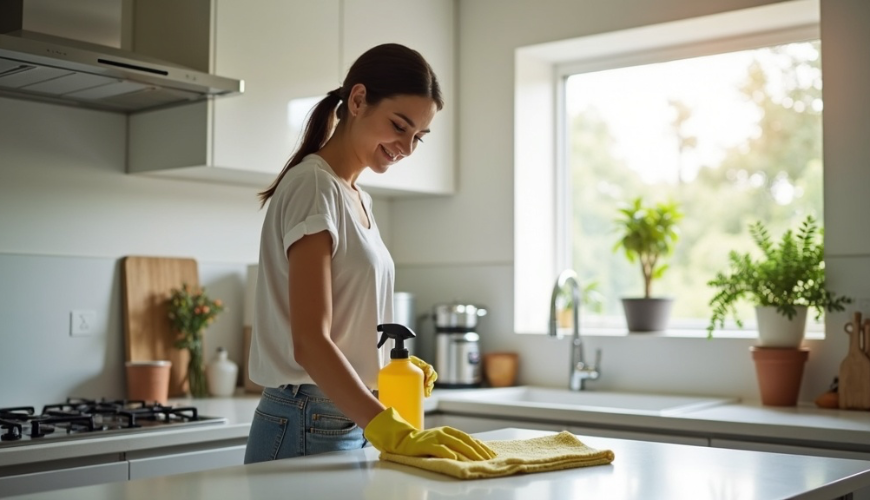
Cleaning can be a surprisingly thankless task. You spend half a day on the household, and yet it feels like everything returns to its original state within a few hours. It's often not about laziness or "lack of time," but about small, repetitive mistakes. The most common cleaning mistakes are not always immediately visible, but they can drain energy, prolong the work, and sometimes unnecessarily damage surfaces or worsen air quality at home. And since cleaning is also a great area where you can easily save on chemicals and packaging, it's worth knowing what not to do when cleaning and how to proceed smartly and gently.
Perhaps you know the scenario: music is playing, a window is opened, all sorts of sprays are pulled out, and you start "in the middle." You move from one room to another, wipe something down, then notice a dirty faucet in the bathroom, grab a mug on the way, carry it to the kitchen, and immediately start scrubbing the sink. After an hour, you're tired, but the apartment looks... almost the same. This chaos contains a large part of the answer to the question of what cleaning mistakes are and how to avoid them without turning cleaning into a military regime.
Try our natural products
Most Common Cleaning Mistakes that Waste Time and Effort
One of the most widespread mistakes is cleaning "based on what catches the eye." In practice, this means jumping between tasks and rooms, constantly searching for a cloth, changing water, returning for a trash bag, and feeling like the work is never-ending. A simple rule can help: stick to one room and one direction. When cleaning systematically, the brain gets less tired from deciding what to do next, and the hands work more smoothly.
Another common mistake is starting with the floor. It seems logical—"to make it clean"—but dust and crumbs fall from top to bottom. If you polish the floor first and then dust the shelves, you'll end up doing the floor twice. It's more efficient to work from higher surfaces to lower ones, from dry tasks to wet ones: first dusting, then the bathroom and kitchen, and only at the end vacuuming and mopping.
A special chapter is overusing cleaning products. More foam means a cleaner home, right? Not quite. Too much product often leaves a sticky film that dirt clings to more quickly. On floors, this can mean a "trodden" surface, in the bathroom, streaks, in the kitchen, smudges. And sometimes even irritated skin or breathing problems—especially in small, poorly ventilated bathrooms. There's also an old mistake: mixing different products "to make it stronger." This is one of the most important points of what not to do when cleaning. Some combinations (typically chlorine products and acids) can release irritating or even dangerous fumes. If you need to check safe handling of chemicals, the European Chemicals Agency (ECHA) summarizes it very clearly in the section on safe use.
Another frequent mistake is "waiting until there's time for a big clean." But the household doesn't follow a calendar. When small things are dealt with continuously (five minutes here, ten minutes there), the big clean isn't as demanding, and there's no feeling of having to sacrifice the whole weekend. It's not about perfectionism, more about rhythm.
And then there's the topic of tools. It sounds trivial, but a dull broom, a vacuum cleaner with a clogged filter, or a cloth that just smears dirt can ruin results and mood. A poorly chosen tool often means more friction, more time, and worse effect. Sometimes it's enough to change a filter, wash a mop, or use two cloths: one for coarse dirt, another for polishing.
How to Clean Correctly and Efficiently to Make Sense
Efficient cleaning isn't about doing more. It's about doing things in the right order and with reasonable moderation. A simple scenario works well: first ventilate and prepare everything in one place (cloths, product, trash bag, gloves), then quickly collect things that shouldn't be visible, and only then clean. This "pre-clean" often makes the biggest difference between feeling chaotic and feeling like the household is truly changing.
A helpful rule is "one surface = one task." When dusting, it's tempting to lift decorations, rearrange books, tidy cables, and throw away old receipts. But that's several tasks in one, and energy disperses. It's more efficient to first quickly tidy things from the surface, then wipe the surface, and finally return only what has its place. If something doesn't have a place, it's a signal for a small reorganization—not necessarily immediately, but soon.
It's interesting how much cleaning affects air quality. Dust isn't just about aesthetics but a mix of small particles that swirl with every movement. When wiped "dry" and without thought, dust just spreads. A slightly damp cloth or dusting cloth that captures particles helps. And if vacuuming, it's worth considering filtration—especially in households with allergy sufferers. The topic of indoor air can be well understood through resources like the World Health Organization (WHO) on the impacts of polluted air (though often mentioned mainly about outdoor air, the principle of particles and irritants is similarly important at home).
Timing also makes a big difference. Some things aren't cleaned by rubbing but by waiting. Typically, the bathroom: a limescale remover or gentler alternative needs a few minutes to work. Applying the product and scrubbing immediately often just tires the hands and results in a weaker outcome. It's more efficient to apply, let it work, do the mirror or sink in the meantime, and only then rinse or wipe. Similarly in the kitchen: dried grease on the hood or backsplash loosens better when given some time (ideally a warm, damp "wrap" with a cloth).
To avoid just theory, it's worth recalling a common real-life example. In a high-rise apartment where cooking happens every day, grease often starts accumulating on the upper cabinets and hood. Owners notice it only when dust clings to the surface, creating a gray film. Then comes the "big action": strong degreaser, long scrubbing, a heap of paper towels, and irritated hands. Yet it would suffice to wipe the hood and surroundings once a week with a gentle product (or soapy water), and once a month give surfaces five extra minutes of care. The result is a cleaner kitchen, less chemistry, and no marathon.
The psychology is often overlooked too. Cleaning is easier when it has a clear start and finish. It helps to set a "block"—like 30–45 minutes—and stick to it. Instead of the idea that the whole apartment needs cleaning, do one room really well. And then you can stop without guilt. As one simple yet apt saying goes, circulating in various forms: "Perfection is the enemy of done." Sometimes the greatest success is that the household moves significantly forward without exhausting the entire day.
Tips for Smart and Eco-Friendly Cleaning Without Unnecessary Chemicals
Eco-friendly cleaning doesn't mean cleaning "weaker." It means cleaning smarter: using products and methods that work but don't unnecessarily burden the home or nature. Often, it turns out that a gentler version is also more pleasant to use—less fragrance, fewer aggressive fumes, fewer disposable packages.
One of the most practical steps is to simplify your arsenal. Instead of ten sprays, you can manage the household with a few reliable helpers: a gentle all-purpose cleaner, a dishwashing product, something for limescale (a gentler acidic component), and quality cloths and a brush. When you add reasonable dosing, the household is clean without waste. Eco-friendly cleaning smartly often hinges on not adding more product than needed and working with exposure time.
Much is said about vinegar and baking soda. Both can be useful, but it's good to know when and how. Vinegar helps with limescale and odors but isn't suitable for some surfaces (for example, natural stone like marble can be damaged). Baking soda is gently abrasive and can help with burnt-on residues or odors, but it's not a miracle for everything. And mainly: when soda and vinegar are mixed together "because it bubbles," the result is mainly a showy reaction and then an almost neutral solution, which may not be particularly effective for cleaning. It's more sensible to use them separately according to the situation.
A big topic is also single-use items. Paper towels are convenient, but with frequent cleaning, they create a massive amount of waste. Switching to washable cloths, quality towels, and reusable sponges is a small change that shows in practice quickly. Plus, it's often cheaper. Similarly, you can consider refilling products into reusable bottles or using concentrates—fewer packages, less water transport.
And what about the "scent of cleanliness"? Many people associate it with strong fragrances and a "chemical" impression. Yet cleanliness is better recognized by surfaces not being sticky, the bathroom not having a musty corner, and textiles being regularly aired. If you need to add freshness to the home, often simple ventilation and washing textiles that hold odors (towels, rugs, bath mats) help. In this regard, the biggest "eco trick" is actually the simplest: don't cover up smells with fragrance, but remove the cause.
To combine an eco-friendly approach with efficiency, it's worth having a small routine that repeats. For example, after cooking, wipe the counter and stovetop, in the bathroom after a shower, squeegee water from tiles, and once a week quickly tackle the busiest spots. It looks like a small thing, but these are steps that prevent cleaning from becoming an exhausting project. Isn't it actually nicer to clean regularly than to battle layers once in a while?
A single list is enough to keep it all in mind—not as a dictate, more as a compass on how to clean correctly and efficiently and avoid what not to do when cleaning:
- Top to bottom and dry to wet, floors last
- One room in one go, without task jumping
- Less product, better result—always with exposure time
- Don't mix cleaners, especially aggressive combinations
- Regularly wash and change tools (cloth, mop, sponge) to prevent spreading dirt
- Reduce single-use items and choose gentler alternatives where it makes sense
When these principles are integrated, cleaning starts to feel less like an endless punishment and more like regular care for the space you live in. And perhaps that’s the main shift: instead of chasing a "perfect" home, finding one that's pleasant, healthy, and sustainable—and that can be kept clean even in a busy week.