

Marinades transform average ingredients beyond recognition

There is one kitchen trick that can transform an average dinner into something you'll look forward to all day. It's not expensive equipment, exotic ingredients, or complex techniques. It's a marinade – a simple mixture that changes the texture, flavour, and aroma of ingredients so fundamentally that the result barely resembles the original base. And yet many people underestimate it or skip it entirely, thinking that marinating is time-consuming or complicated.
The truth is that a marinade can rescue even the most boring ingredients – flavourless chicken breasts, tofu that sticks to the pan, or vegetables that would otherwise end up in the oven simply sprinkled with salt. You just need to know how it all works, and then dare to experiment. This article will walk you through everything essential – from the chemistry of marinating to specific tips you'll start using this very week.
Try our natural products




Why does a marinade actually work?
To understand why marinating is so effective, it's worth pausing for a moment to consider what happens during the process. A marinade typically contains three basic components: acid, fat, and aromatics. The acid – whether it's lemon juice, vinegar, yoghurt, or wine – disrupts the surface proteins of the ingredient and allows the other components to penetrate deeper into the structure of the meat or vegetables. Fat, most commonly oil, then acts as a carrier for the aromatic compounds from herbs and spices, because many flavours are fat-soluble rather than water-soluble. The result is a layered, complex flavour that cannot be achieved by simply seasoning just before cooking.
It's important to mention that acid in a marinade isn't always your friend – if you leave meat or fish marinating too long in a strongly acidic environment, the surface will begin to break down and the result will be mushy and unpleasant. Fish needs only 15 to 30 minutes, chicken breasts ideally 2 to 4 hours, and beef steaks can comfortably marinate overnight. Vegetables are more forgiving in this regard – an hour or two is generally sufficient, but leaving them overnight won't do much harm either.
The scientific basis of marinating is described, for example, at Serious Eats, where culinary scientist J. Kenji López-Alt examines how deeply a marinade actually penetrates and why surface flavour is more important than most people realise. Spoiler: a marinade doesn't penetrate meat to a depth of centimetres – it concentrates on the surface. And that's enough, because the surface is what we taste first and what shapes the overall impression.
This knowledge is liberating. It means that you don't need to plan a day ahead to achieve a striking result. Even a short marinade of thirty minutes can work wonders if it's well composed and suited to the ingredients.
How to rescue ingredients that would otherwise interest no one
Let's take a specific example from everyday life. Jana, a thirty-four-year-old mother of two from Olomouc, admits that just a year ago she bought chicken breasts only because they're "healthy," but she could never prepare them in a way her family would eat with enthusiasm. They always ended up the same – dry, without much flavour, drowned in ketchup just to make them somewhat edible. Then she discovered a simple marinade made from yoghurt, garlic, lemon juice, and turmeric. Left overnight, then cooked the next day on a grill pan. "For the first time in my life, my kids asked for seconds of chicken," she says with a smile.
Yoghurt marinade is, in fact, one of the oldest and most reliable. Yoghurt contains both mild acid and fat simultaneously, which makes it gentle on the texture of meat while also being excellent at carrying spices. It's no coincidence that Indian cuisines have used it for centuries – tandoori chicken, one of the most famous Indian dishes, is essentially chicken marinated in yoghurt with spices and then baked at high temperature.
The same logic applies to tofu, which for many people is synonymous with blandness. Tofu is like a sponge – it absorbs whatever you give it. The problem is that most people don't give it anything interesting, or simply put it in the pan without any preparation. A marinade of soy sauce, sesame oil, ginger, garlic, and a little maple syrup completely transforms tofu. The key is to press the tofu before marinating – to remove excess water so it truly absorbs the marinade. Simply wrap it in a paper towel, place a heavy pot on top, and leave it for half an hour. Then slice it, pour over the marinade, and leave it in the fridge for at least an hour. The result is surprisingly meaty, caramelised, and full of umami.
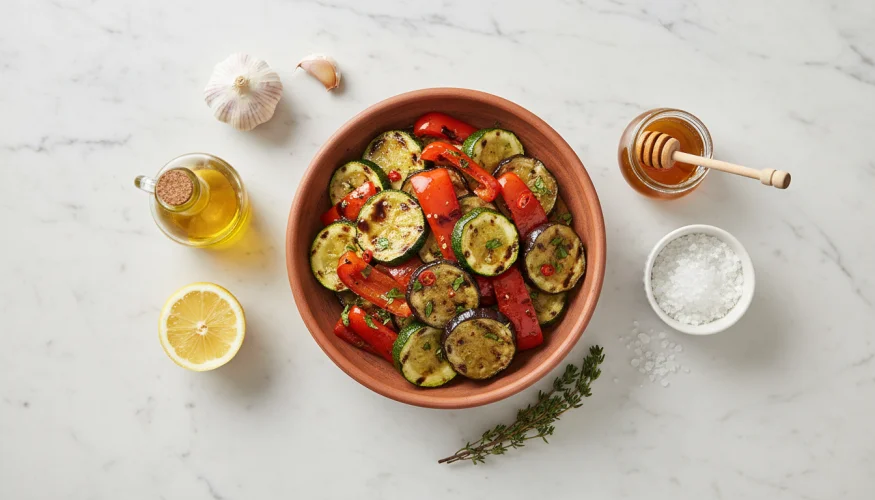
Vegetables are another candidate for rescue. Courgette, aubergine, or peppers are fairly neutral ingredients on their own, which without bold seasoning can easily become a dull side dish. A marinade of olive oil, balsamic vinegar, garlic, fresh thyme, and a touch of honey gives them depth, and when roasted in the oven or on the grill they caramelise beautifully. The honey or other sweetener in the marinade promotes the Maillard reaction – the chemical process that creates brown, flavour-complex surfaces, which is the basis of what chefs call a "good crust."
Recipes and combinations worth trying
There are several combinations that have proven themselves across cultures and cuisines and can easily be adapted to whatever you happen to have at home. There's no need to follow precise measurements – marinades are forgiving by nature and tolerate imprecision.
Citrus marinade works wonderfully on fish, chicken, and prawns. The base consists of the juice of one lemon or lime, two tablespoons of olive oil, a clove of garlic, a pinch of chilli, and fresh coriander or parsley. This marinade is quick – fish needs only 20 minutes, chicken pieces an hour.
Asian marinade is a versatile choice for tofu, strips of beef, or salmon. It combines soy sauce, sesame oil, fresh ginger, garlic, and a little rice vinegar. For a sweeter version, add a teaspoon of honey or maple syrup. This marinade also works as a sauce base – simply heat it in a pan and reduce it slightly.
Mediterranean marinade is ideal for lamb, chicken thighs, or aubergine. Olive oil, lemon juice, oregano, thyme, rosemary, and garlic form the base, to which you can add grated Parmesan for extra depth. This marinade smells so appealing on its own that people sometimes use it as a salad dressing too.
As French chef and writer Auguste Escoffier once noted: "Good cooking is the foundation of true happiness." And although Escoffier wrote at a time when marinating was the domain of professional chefs, his thought holds true for the home kitchen as well – good preparation of ingredients is the key to making food bring joy, not just satiation.
One of the most underestimated aspects of marinating is the choice of container. Glass or ceramic bowls and resealable bags are ideal, as they allow the marinade to coat the ingredient on all sides. Metal containers – especially aluminium – can react with acidic marinades and impart a metallic flavour. Plastic containers are functional, but it's worth making sure they are food-safe.
Another topic that doesn't get enough attention is the temperature at which you marinate. Almost without exception, ingredients should marinate in the fridge, not at room temperature. The only exception is when you're marinating for a very short time – for example, 15 minutes before cooking. At room temperature, bacteria can multiply, particularly in meat and fish. Food safety is a fundamental principle that should never be sacrificed in the name of culinary enthusiasm.
An interesting perspective on the health aspects of marinating is also offered by the Harvard T.H. Chan School of Public Health, where researchers have examined, among other things, how marinating meat before grilling reduces the formation of heterocyclic amines – substances that form during high-temperature cooking and are associated with an increased risk of certain diseases. A marinade is therefore not just about flavour; it can also offer a practical health benefit.
For those who care about sustainability and the composition of their food, marinating is also an opportunity to cut back on industrially processed sauces full of preservatives and added sugar. A homemade marinade made from basic ingredients – oil, vinegar, herbs, and spices – is not only tastier but also cleaner in terms of its composition. Quality oils, organic spices, and fresh herbs don't have to cost a fortune; it's simply a matter of always having them on hand and combining them according to mood and season.
Finally, it's worth remembering that marinating is essentially a form of creative cooking – a space where it pays to experiment, try new combinations, and not be afraid of mistakes. If a marinade turns out too acidic, use less vinegar next time. If it lacks depth, try adding a little dark soy sauce or miso paste. Every unsuccessful attempt is information for next time. And every successful one – like those yoghurt chicken breasts from Olomouc – is proof that even the most humble ingredients have the potential to surprise.