
# Why Rainwater is a Better Choice for the Garden
Every summer brings the same situation. Garden beds cry out for watering, the grass turns yellow, and gardeners face an unpleasant surprise in the form of a high water bill. Yet the solution literally falls from the sky – and many people still aren't making full use of it. Capturing and using rainwater for the garden is one of those simple steps that makes sense ecologically, economically, and practically. And most importantly: it is completely legal, accessible, and increasingly widespread in the Czech Republic.
Just a few years ago, gardeners held all sorts of myths about whether collecting rainwater was permitted, whether it was safe, and whether it was even worth it. Today, these doubts have largely been dispelled, and interest in rainwater management is growing – not only among environmentally minded enthusiasts, but also among ordinary households simply looking for a practical and affordable solution for garden care.
Try our natural products


Why collecting rainwater makes sense
Within Central Europe, the Czech Republic is among the countries facing a growing problem of drought. According to data from the Czech Hydrometeorological Institute, recent decades have seen a more pronounced occurrence of dry periods, particularly during summer months when the need for watering is at its highest. Tap water is a scarce resource that requires energy-intensive treatment – using it to water vegetables or a lawn is, from a sustainability perspective, inefficient at best.
Rainwater is more natural for plants than tap water. It contains no chlorine or limestone, has a lower pH, and plants generally absorb it more readily. Any experienced gardener will confirm this: after a good rain, the garden looks different than after even the most conscientious watering with a hose. This is no coincidence, but a matter of the water's chemical composition, which is simply more natural for plants.
Take, for example, a family from South Moravia who decided in 2022 to install a simple rainwater harvesting system from the roof of their family home. They purchased two connected barrels with a total capacity of 1,500 litres and a simple filter for coarse debris. The result? Over the summer, they covered approximately 60–70% of their watering needs for a garden of around 200 square metres without using a single additional litre of drinking water. Their investment paid for itself within the first season.
Such examples are multiplying. And that is precisely why it is worth taking a closer look at how the whole system works, what the law says, and how to get started – even without major investment or technical knowledge.
What the law says: Is collecting rainwater legal?
This question troubles many interested parties perhaps more than anything else. The answer is unequivocal: in the Czech Republic, collecting rainwater for garden irrigation is completely legal and requires no special permit. Rainwater that falls on your property or roof is considered precipitation water, and its use for non-commercial purposes – such as garden watering – is not subject to any restrictions.
The legislative framework for rainwater management in the Czech Republic is governed primarily by Act No. 254/2001 Coll., the so-called Water Act, and Act No. 274/2001 Coll. on water supply and sewerage systems. These regulations deal primarily with the discharge of rainwater into the sewerage system and the protection of water sources – not with prohibiting its use on private properties. On the contrary, the state and many municipalities actively support rainwater management through subsidies and incentives.
The Dešťovka grant programme administered by the State Environmental Fund of the Czech Republic offers households financial contributions towards the acquisition of systems for capturing and using rainwater and greywater. This in itself clearly shows that the state not only tolerates this approach but actively supports it. The programme's conditions change over time, so it is always advisable to check the current parameters directly on the fund's website.
As ecologist and science communicator David Attenborough once said: "Water is not a luxury. It is a right – and it is our duty to use it wisely." This thought resonates in the context of Czech legislation, which is slowly but surely shifting from a passive approach towards active management of water resources.
How to do it: Simple and accessible options for every garden
Once it is clear that collecting rainwater is not only legal but also supported, the question becomes how to approach it practically. The good news is that you can genuinely start simply and cheaply – without needing to dig up the garden, build underground tanks, or hire specialist companies.
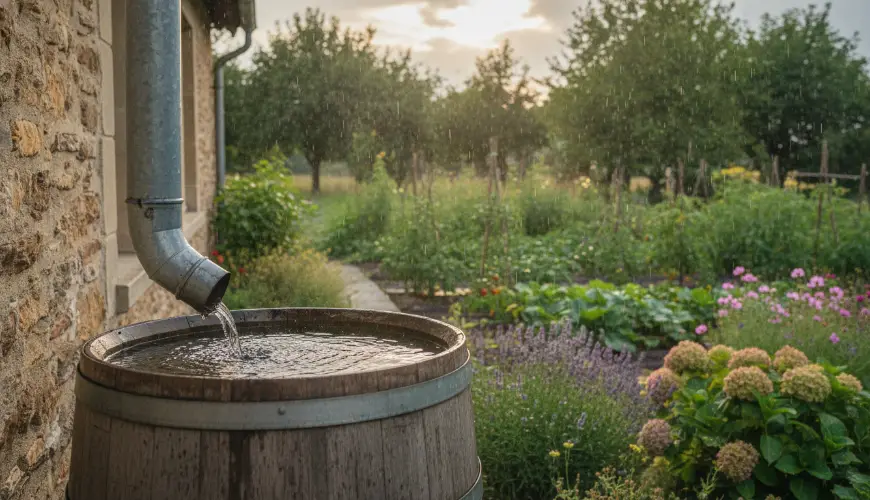
The most accessible solution is garden rainwater barrels. These containers, most commonly with a capacity of 200 to 500 litres, are connected directly to the roof downpipe using a special filter or diverter fitting. Any DIY enthusiast can install them in an afternoon, and costs range from a few hundred to a few thousand crowns. Barrels can be connected together, gradually increasing the system's capacity as interest and need grow.
For larger gardens or more demanding users, there are above-ground and underground tanks with capacities ranging from 1,000 to several tens of thousands of litres. Underground tanks have the advantage of keeping water at a stable temperature, reducing algae growth, and the system can be connected to an automatic irrigation system. This option is more costly, but for a larger garden or a planned property renovation, it can be a very worthwhile long-term investment.
Regardless of the size of the system, a few basic rules apply:
- Filtration: Every system should include at least a coarse filter to catch leaves, twigs, and other debris from the roof. Finer filters are suitable for tanks where water is stored for longer periods.
- Covering the tank: Open containers attract insects and promote algae growth. A covered tank keeps water in better condition and more safely.
- Overflow: When the tank is full, the system must have an overflow that safely diverts excess water away – ideally into a soakaway or the garden, rather than into the sewerage system.
- Regular maintenance: Once a season, it is worth cleaning the tank and checking the filters and overflow.
It is important to note that rainwater collected from a roof is not suitable for drinking or direct contact with food without further treatment. However, it is perfectly fine for watering ornamental plants, lawns, or vegetable beds (when watering at the roots rather than on the leaves). The World Health Organization and Czech hygiene regulations clearly distinguish between the category of drinking water and utility water – and rainwater from domestic systems falls into the latter category.
The larger the roof area, the more water can be collected. The approximate calculation is surprisingly straightforward: from every millimetre of rainfall and every square metre of roof, approximately one litre of water can be collected. A family home with a roof area of 100 square metres can therefore theoretically collect up to 1,000 litres in a ten-millimetre rainfall – after deducting losses due to evaporation, overflow, and debris, of course.
Rainwater management is not merely a fashionable ecological trend. It is a practical response to a real challenge that climate change presents to everyone who owns a garden. Droughts are lasting longer, summer temperatures are rising, and water prices are gradually increasing. Investing in a simple rainwater collection system is therefore becoming ever more worthwhile – not only ecologically, but financially as well.
After all, why pay for what nature gives us for free? You just need to catch it.