
Get rid of dirt between the oven door glass easily
The oven is one of the most frequently used appliances in every household, yet we only give it proper care when the situation truly leaves us no choice. Greasy stains on the inner glass, burnt food residue on the baking tray, or a grimy rack – these are problems that most people deal with fairly regularly. But there is one place that people are most reluctant to clean and that many consider almost inaccessible: the space between the glass panes of the oven door. That mysterious layer of grime that settles in exactly the spot you can't normally reach can be surprisingly stubborn and frustrating.
And it's not just about aesthetics. Dirty and greasy glass reduces visibility into the oven, making it harder to monitor food while it's baking. Moreover, accumulated grease and burnt residue can smoulder at high temperatures, produce unpleasant odours, and in extreme cases even contribute to smoke forming inside the appliance. The cleanliness of your oven – including its less accessible door section – directly affects both cooking quality and kitchen safety.
Try our natural products






Why grime ends up there in the first place
To tackle the problem effectively, it's useful to first understand how it actually occurs. The doors of modern ovens are constructed as a sandwich of several glass layers, with an air gap between them that serves as thermal insulation. This gap is not completely sealed – manufacturers deliberately leave small openings or slots in it to allow air circulation and prevent condensation.
However, it is through these very openings that cooking vapours, droplets of grease, and small food particles make their way inside. Each time the oven door is opened and closed, a slight air current is created that draws these contaminants into the gap between the glass panes. There they settle, and since you can't normally access them, they gradually form a layer of yellowed or browned grime that is clearly visible from the outside but unreachable from within. The result is that the glass looks dirty even after a thorough cleaning of its outer surfaces, which tends to be a source of great frustration.
Interestingly, this problem does not only affect cheaper appliances. Owners of ovens from various manufacturers across different price ranges encounter it, because the principle behind door construction is essentially similar. The difference may lie in how easy the manufacturer makes it to access the gap when dismantling the door.
How to reach the grime: dismantling the oven door
The most reliable and thorough solution is dismantling the door and separating it into its individual components. It may sound complicated, but with most modern ovens it's a task that even someone without technical knowledge can manage – all it takes is a little patience, a screwdriver, and the user manual.
The procedure varies depending on the manufacturer and model, but the general principle is usually similar. The door is first removed from its hinges – typically you just need to open it to a certain angle, secure the hinge locks, and carefully slide the door out. It is then placed on a table or the floor (ideally on a soft surface to avoid scratching the glass), and the frame holding the glass panes together is unscrewed. The individual panes are removed, washed, and once dry, the door is reassembled.
Before you get started, it's important to look up the specific instructions for your oven model. Many manufacturers publish video tutorials or PDF manuals on their websites, and on platforms like YouTube you'll find dozens of practical demonstrations for specific brands. An incorrect approach can lead to cracked glass or damaged seals – repairs that will cost you considerably more than the cleaning itself.
Once you have the glass panes out, the actual cleaning is fairly straightforward. A paste made from baking soda and water works excellently on greasy and burnt residue – simply apply it to the glass, leave it to work for twenty to thirty minutes, then wipe it off with a damp cloth. For more stubborn stains, you can add a few drops of white vinegar, which reacts with the baking soda and helps loosen the grime. Both of these products are environmentally friendly, leave no chemical residue, and are safe for use on food appliances.
When dismantling isn't an option
Not everyone has the inclination or the time to take oven doors apart. And it isn't always necessary either – it depends on how thick a layer of grime has built up in the gap. For less severe cases, there are alternative methods that, while not as thorough, can significantly improve the situation.
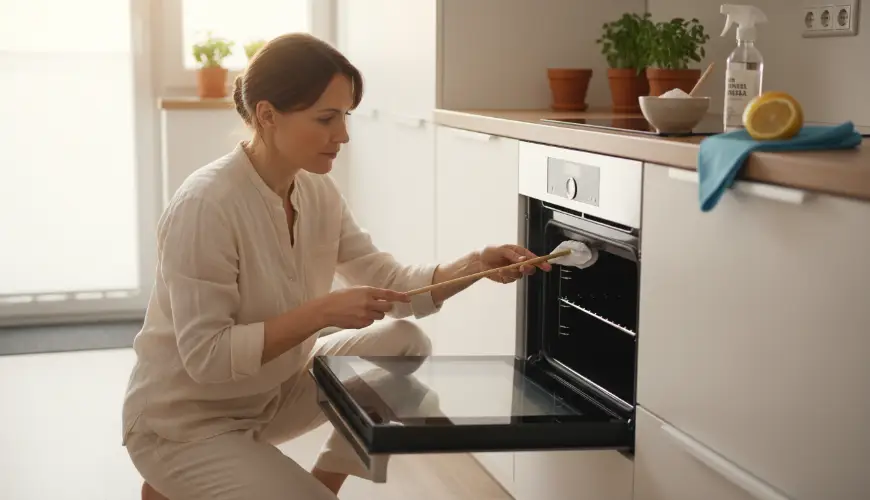
One popular household trick involves using a thin, flexible tool, such as a ruler, a thin spatula, or a specially adapted stick wrapped in a damp cloth or paper towel. This improvised cleaner is inserted into the ventilation slot at the bottom of the door and carefully moved across the full width of the glass. The method requires patience and a gentle touch, but it can pick up a surprising amount of grime.
There are also specialist tools available on the market designed specifically for this purpose – thin magnetic wands or sets with various attachments that allow you to clean the gap without dismantling the door. If this is a problem you face regularly, such a tool could be a worthwhile investment.
A real-life example comes from Kateřina from Brno, who shared her experience on a Czech cooking forum: she had never taken apart the door of her oven in four years of use, while the grime between the glass panes had been bothering her more and more. She eventually tried an improvised stick made from a bamboo sushi skewer, around which she wrapped a piece of damp flannel cloth soaked in a solution of vinegar and baking soda. The result apparently surprised her – she pulled such an amount of grime out of the gap that she decided next time she would go straight for dismantling the door.

Eco-friendly cleaning products as the natural choice
In the context of a sustainable lifestyle, it's worth noting that chemical oven cleaning sprays are among the most aggressive household products available. They contain sodium or potassium hydroxide, which effectively dissolves burnt grease but is also a health hazard on contact with skin or the respiratory tract, and poses an environmental burden when washed down the drain. When cleaning the door glass, which is in direct contact with the space where food is prepared, it is therefore advisable to opt for gentler alternatives.
As already mentioned, the combination of baking soda and vinegar forms the basis of most natural oven cleaning recipes. Baking soda acts as a mild abrasive and odour neutraliser, while white vinegar, thanks to its acidity, helps dissolve grease and mineral deposits. Lemon juice serves a similar function and also leaves a pleasant scent. These ingredients are available in every shop, are inexpensive, and their production and disposal do not burden the ecosystem in a way that is comparable to industrial cleaning products.
As the British organisation Which?, which is dedicated to testing consumer products, states: "Natural cleaning products may not always achieve the same performance as industrial chemicals, but for regular maintenance they are perfectly adequate in most cases, and their use is significantly safer for the household and the environment."
How to prevent the grime from building up
The best way to avoid the problem of grime between the glass panes is, of course, prevention – even though it cannot be eliminated entirely. It helps to regularly clean the outer and inner glass of the oven door after every major baking session, while the residue is still fresh and easier to remove. Fresh grease stains can be wiped away with a damp cloth in a fraction of the time it would take to remove hardened grime.
Another preventive measure is paying attention to the ventilation openings in the door. If they are dirty or blocked, the airflow that would carry contaminants away is disrupted and grime accumulates more quickly. The openings can be cleaned with a soft brush or compressed air.
When baking dishes that splatter or foam a great deal – such as marinated meat, filled cakes, or roasted vegetables – it's worth considering using a covered roasting dish or aluminium foil as a cover. This significantly reduces the amount of vapour and grease droplets that come into contact with the oven door.
The frequency of deep cleaning, including any door dismantling, depends on how intensively the oven is used. For a household that cooks every day, a thorough inspection and clean is recommended approximately once every six months. Families who use the oven less frequently can afford longer intervals. The key is not to leave grime for too long, as over time its removal becomes exponentially more demanding.
Caring for your oven – including its most tricky part, which the space between the door glass panes undoubtedly is – is not merely a matter of aesthetics or perfectionism. It is part of an overall approach to the home in which functionality, hygiene, and the long service life of appliances are valued. An oven that is regularly maintained works better, consumes less energy, and lasts longer – an argument that anyone trying to live a little more sustainably will appreciate.