
Well water deserves regular attention
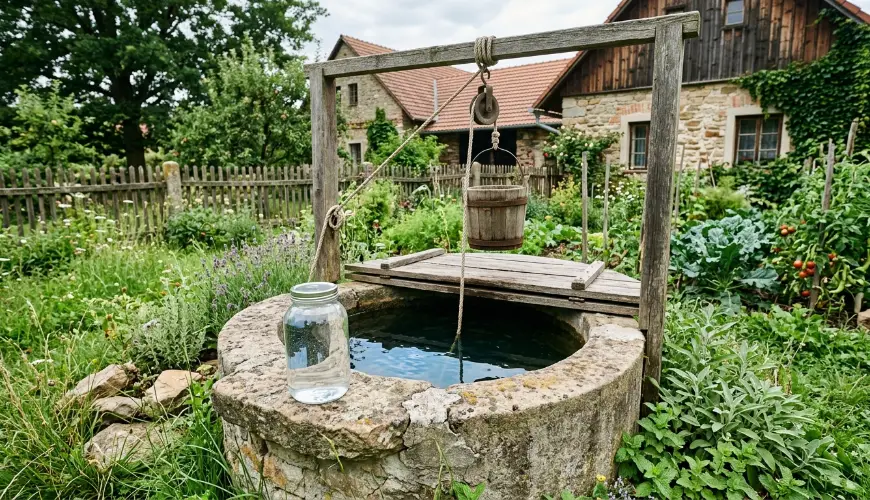
Well water has a long tradition in Czech households. Just a few decades ago, wells supplied drinking water to the vast majority of rural homesteads and cottages, and for many families it was an absolute matter of course. Today, most people draw water from the public water supply, yet hundreds of thousands of private wells still exist in the Czech Republic – whether as the sole source of drinking water or as a supply of utility water for garden irrigation, watering animals, or flushing toilets. But what was taken for granted by our grandparents now requires a little more attention. The quality of groundwater has changed significantly in recent decades, and what looks clean and tastes good is not always safe.
Groundwater undergoes natural filtration through layers of soil and rock, which removes many impurities. This process is fascinating and has worked reliably for thousands of years. The problem arises when human activity enters the picture – agriculture, industry, improper waste management, or ageing sewage systems in the neighbourhood. Nitrates from fertilisers, pesticides, heavy metals, bacteria from faecal contamination, or industrial solvents – all of these can quietly penetrate underground layers and contaminate well water without it being immediately apparent. That is precisely why regular testing of well water is an absolute necessity, not merely a formality.
Try our natural products





Why testing well water is so important
Imagine a situation that is by no means unusual: a family owns a cottage with its own well on the edge of an agriculturally used landscape. The water is crystal clear, odourless, and tastes excellent. Yet the children repeatedly experience digestive problems that no one can explain. Only a water analysis reveals elevated nitrate levels and the presence of coliform bacteria – the classic signs of contamination from agricultural land or a leaking cesspit nearby. Such situations do occur in reality and serve as a warning to anyone who relies on well water without regular monitoring.
Czech legislation stipulates that owners of private wells serving as a source of drinking water are obliged to ensure regular analyses. Decree No. 252/2004 Coll., which governs requirements for drinking water, also applies to individual water supply sources. According to expert recommendations, a basic bacteriological analysis should be carried out at least once a year, ideally in spring after snowmelt, when the risk of surface water penetrating the well is highest. An extended chemical analysis is sufficient once every three to five years, or whenever an extraordinary event occurs – a flood, drought, earthquake, or suspected contamination in the vicinity.
Where can water be tested? In the Czech Republic, accredited analyses are carried out by state health institutes, regional hygiene stations, or private accredited laboratories. Samples must be collected in special sterile containers, which the laboratory will generally provide, and a precise sampling procedure must be followed – otherwise there is a risk of distorted results. Water should be allowed to run for several minutes before sampling, the container should not be rinsed, and neither hands nor the container's neck should touch the inside. These may seem like minor details, but they determine the reliability of the analysis.
The results of an analysis can reveal a wide range of problems. Among the most common is elevated nitrate content, which is particularly dangerous for infants and young children because it impairs oxygen transport in the blood. Other common issues include water hardness caused by high calcium and magnesium content, and the presence of manganese or iron, which do not directly threaten health but leave brown deposits and damage appliances. The most serious finding, however, is microbiological contamination – the presence of coliform bacteria or enterococci indicates faecal contamination, and in such cases the water is entirely unsuitable for drinking without prior treatment.
How to improve water quality and use it safely
If an analysis reveals problems, it does not automatically mean the well is useless. There are numerous ways to improve water quality or treat it so that it is safe for use. The choice of method depends on the type of contamination identified.
In the case of microbiological contamination, the first step is to identify and eliminate its source – checking the integrity of the well casing, the condition of the surrounding terrain, and the distance from a cesspit or manure heap. The well should be at least 10 metres away from a source of contamination, ideally more. The well can then be disinfected with a chlorine-based product, followed by thorough pumping and a new control analysis. For a long-term solution, UV lamps installed directly in the distribution system have proven effective – ultraviolet radiation reliably destroys bacteria and viruses without the use of chemicals, so the water acquires no taste or odour.
For chemical contamination such as nitrates or heavy metals, UV radiation is not sufficient. This is where reverse osmosis or ion exchange come into play. Reverse osmosis is now an accessible technology that removes up to 95% of dissolved substances, including nitrates, pesticides, and heavy metals. A reverse osmosis filter is typically installed under the kitchen sink and supplies drinking water to a single outlet – a practical and economical solution for families where the remaining water is used only for hygiene or irrigation. For problems with iron or manganese, oxidation filters or filtration through zeolite work well.
As the National Institute of Public Health notes, "the quality of water in individual sources can change depending on the season, precipitation, and changes in the surrounding environment", which is why regular monitoring is absolutely essential regardless of how good the previous analysis was.
Alongside technological solutions, proper maintenance of the well itself plays an important role. The well casing should be regularly inspected for cracks or leaks. It should always be covered with a lid to prevent leaves, insects, and surface rainwater from entering. The surrounding terrain should be shaped so that water drains away from the well, not towards it. These seemingly trivial measures can significantly reduce the risk of contamination and extend the lifespan of the entire source.
A special topic is the use of well water for garden irrigation. Even water that does not meet the strict standards for drinking water may be perfectly suitable for irrigation – it depends on the type of contamination. Water with higher nitrate content can paradoxically even benefit vegetables as a natural fertiliser, whereas water containing heavy metals or pesticides is unsuitable for irrigating edible plants. Any decision should therefore always be based on the specific results of an analysis, not on general assumptions.
Particular attention is also warranted when a well is being brought back into service after a prolonged period of non-use – typically at a cottage after winter. Standing water in the pipes and the well itself is a breeding ground for bacteria. It is recommended to let the water run for several minutes, disinfect the well if necessary, and always carry out an analysis before using the water for drinking for the first time. It is a small step that can prevent serious health problems.
The age of the well and its construction also play a non-negligible role. Older wells, particularly so-called dug wells with concrete rings, are generally more susceptible to surface contamination than deeper drilled wells, which draw water from deeper and better-protected layers. However, this does not mean that a drilled well is automatically safe – contaminants can penetrate even deep layers, it simply takes longer. Detailed information on types of wells, their advantages, and risks is offered, for example, by the T. G. Masaryk Water Research Institute, which systematically addresses the issue of groundwater in the Czech Republic.
A practical overview of the most common indicators monitored during an analysis, along with their limit values, can help in better understanding laboratory results:
- Nitrates – limit 50 mg/l; if exceeded, unsuitable especially for infants
- Coliform bacteria – zero tolerance in drinking water
- Iron – limit 0.2 mg/l; higher values cause turbidity and deposits
- Manganese – limit 0.05 mg/l; higher values discolour water and are undesirable for health
- pH – optimal range 6.5–9.5; excessively acidic water corrodes pipes
- Hardness – not strictly limited, but very hard water damages appliances
The entire approach to well water should be built on the precautionary principle. Water can appear perfectly clean while concealing substances that are harmful to health with long-term intake. Regular analysis, proper well maintenance, and the installation of an appropriate filtration system where needed are investments that pay off – not only in terms of health, but also in terms of protecting the well itself as a valuable resource.
Interest in private water sources has, if anything, been growing rather than declining in recent years. Growing interest in self-sufficiency, an ecological lifestyle, and the desire to reduce dependence on public infrastructure are leading more and more people not only to maintain their wells but to actively improve their performance and water quality. The well is thus ceasing to be a mere relic of the past and is becoming a modern tool for sustainable water management – provided it is approached with awareness, responsibility, and regular care.