

Buckwheat porridge across the world in five forms
Buckwheat is one of those ingredients quietly making its way into modern kitchens around the world – yet humanity has known and used it for thousands of years. While in the Czech Republic many people know it primarily as a traditional side dish or soup filling, elsewhere in the world it forms the basis of dishes that would pleasantly surprise a domestic diner. Buckwheat porridge is not just one thing – it exists in as many forms as there are cultures that have adopted it as their own.
Buckwheat is not a grain in the true sense of the word. It is a pseudo-cereal related to rhubarb and sorrel, which is precisely why it is naturally gluten-free. This property makes it a popular ingredient not only for people with coeliac disease, but also for anyone seeking a more nutritious and easily digestible alternative to conventional grains. According to the World Health Organization, diversity in plant-based sources of protein and complex carbohydrates is one of the fundamental pillars of a balanced diet – and buckwheat excels in both categories.
But back to the porridge. What does it actually look like when prepared by a Japanese person, a Russian, an Ethiopian, or an Italian?
Try our natural products




From Siberia to Japan: How Buckwheat Conquered the World
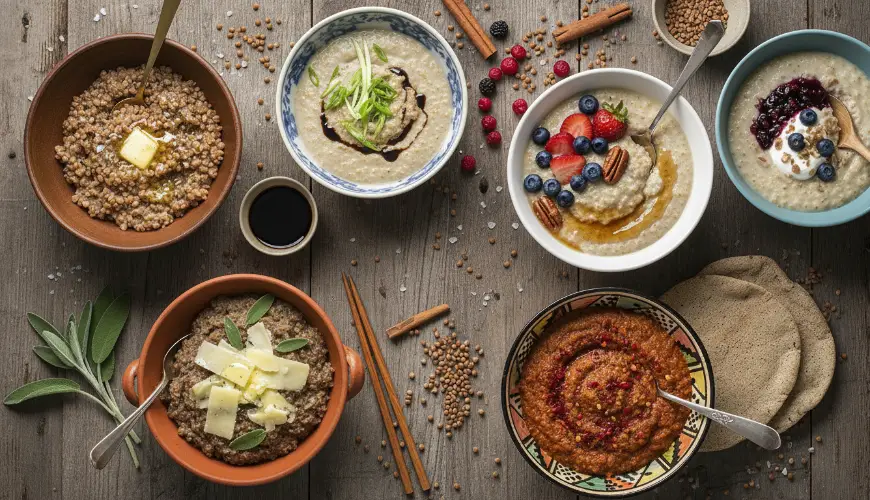
The story of buckwheat porridge begins somewhere in Southeast Asia, from where this crop spread along the Silk Road to Central Asia, Russia, and eventually Europe. The Russian and Eastern European tradition of buckwheat porridge – known as "kasha" – is probably the oldest and most widespread. It is made from roasted buckwheat groats, known as grechka, cooked in water or milk and seasoned with butter and salt. In Russia, it is served as a side dish with meat, but also as a standalone breakfast dish, poured over with milk and sweetened with honey. It is comfort food in the purest sense of the word – warm, filling, fragrant porridge that warms you from the inside.
The Japanese version, by contrast, is considerably more delicate and subtle. The Japanese call buckwheat "soba" – and although most people associate this word with noodles, traditional Japanese cuisine also features a porridge made from buckwheat flour, served with dashi broth, miso paste, and finely sliced spring onions. This version is less filling, but extraordinarily aromatic. Japanese cuisine works with buckwheat flour with admirable lightness – the result is a dish that resembles a silky soup more than a thick porridge in the European sense.
Equally surprising is the Italian tradition from northern Italy, particularly from Valtellina and Trentino. There, buckwheat flour is used to prepare a dish called polenta di grano saraceno – a dark, earthy porridge served with local Bitto or Casera cheese and butter toasted with sage. This combination of buckwheat earthiness, the richness of the cheese, and the herbal aroma is absolutely fascinating. It is little wonder that this tradition has endured for centuries in the Alpine valleys – buckwheat polenta is hearty, inexpensive, and yet full of flavour.
African, American and Scandinavian Variations: Buckwheat Without Borders
Less well known, but all the more interesting, is the Ethiopian tradition of using buckwheat flour. In Ethiopia and surrounding countries, buckwheat is mixed with other crops and made into a thick porridge consumed as part of a communal meal, similar to injera – the traditional fermented flatbread. The Ethiopian version of buckwheat porridge is typically seasoned with berbere spice blend, a mixture of chilli, fenugreek, coriander, and other spices. The resulting flavour is bold, spicy, and earthy at the same time – a combination that has no equivalent in European cuisine.
Crossing the Atlantic, we encounter the North American tradition, where buckwheat has been experiencing a genuine renaissance in recent years. The American version of buckwheat porridge – often referred to as "buckwheat porridge" – is prepared similarly to oatmeal, cooked in milk or a plant-based drink, and served with fruit, nuts, and maple syrup. This version is particularly popular among health-conscious individuals, as it combines high fibre, protein, and mineral content with a naturally sweet, creamy flavour. It is not unusual for an athlete to prepare it before a morning workout, just as a mother might make it for the whole family on a Sunday morning.
The Nordic countries of Scandinavia offer yet another perspective. Norwegians and Swedes have their own tradition of buckwheat porridges, prepared with the addition of sour cream or buttermilk, served with dried blueberries or lingonberries, and sometimes with a little smoked fish. This combination of sweet and salty, sour and rich is typically Scandinavian – and buckwheat plays the role of a perfect binding agent for all these contrasting flavours.
Such an overview of different traditions clearly shows that buckwheat is not tied to any single culture or method of preparation. It is an extraordinarily flexible ingredient that absorbs the surrounding flavours and aromas while retaining its characteristic earthy undertone.
Why Fall in Love with Buckwheat Porridge at Home Too
As British chef and healthy eating advocate Yotam Ottolenghi says: "The best foods are those that have a story – and buckwheat has more than enough." These words fit buckwheat porridge perfectly. Each of the versions described above carries within it a piece of cultural identity, local history, and the practical wisdom of generations who knew how to get the most out of a simple ingredient.
From a nutritional standpoint, buckwheat is truly exceptional. It contains all essential amino acids and is rich in magnesium, iron, zinc, and B vitamins. According to research published in the scientific journal Nutrients, buckwheat also has a beneficial effect on blood sugar levels due to its low glycaemic index – making it a suitable food not only for diabetics, but for anyone who wants stable energy throughout the day.
Consider Markéta, a thirty-year-old graphic designer from Brno, who decided two years ago to reduce her gluten intake and was looking for alternatives to oatmeal. She stumbled upon a recipe for Japanese buckwheat porridge with miso paste and has been making it every morning since. "It seemed strange to me at first, putting a salty paste into porridge," she says, "but then I understood that porridge doesn't always have to be sweet. Now I can't imagine a morning without it." Markéta's story is not an exception – people around the world are rediscovering buckwheat porridge as a versatile base for both breakfast and dinner.
Preparing buckwheat porridge is surprisingly simple. The basic ratio is approximately one part buckwheat groats to two parts liquid, whether water, milk, or a plant-based drink. The buckwheat is cooked for approximately 15 to 20 minutes over low heat, stirring occasionally. From there, it all depends on which world version you want to recreate – whether you add butter and salt in the Russian style, miso paste and spring onions in the Japanese manner, or maple syrup and blueberries the American way.
For those who want to take their buckwheat porridge to the next level, it is worth noting that roasted buckwheat – sold in shops as "kasha" or buckwheat groats – has a more pronounced, nuttier flavour than unroasted buckwheat. Unroasted buckwheat, on the other hand, is milder and absorbs the flavour of added ingredients more readily. Both varieties have their place in the kitchen, and the choice depends entirely on personal taste and the intended dish.
The world of buckwheat porridge is therefore far richer than it might appear at first glance. From the thick and hearty Russian porridge to the delicate Japanese variety with its umami undertone, the earthy Italian polenta with mountain cheeses, the spicy Ethiopian version with berbere spice blend, the creamy American buckwheat porridge with fresh fruit, through to the Scandinavian combination with blueberries and sour cream – each of these versions offers a completely different experience, yet all are derived from the same simple ingredient.
Buckwheat deserves more than the role of a forgotten side dish in the corner of a plate. It is an ingredient with a global story, exceptional nutritional properties, and remarkable culinary flexibility. Perhaps it is time to finally take it off the kitchen shelf and give it the chance it has long deserved – perhaps in the form of a porridge inspired by one of the world's great traditions.