

You will appreciate the use of baking soda in the household because it helps in the kitchen, bathroo
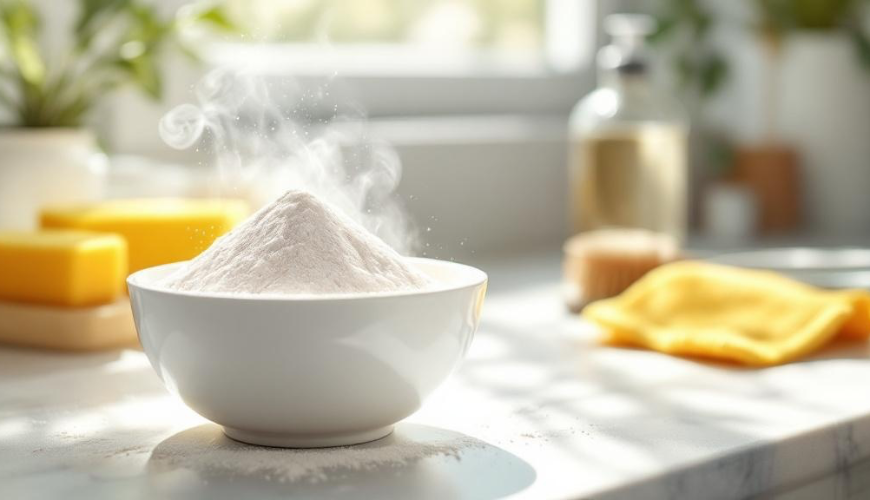
Baking soda is one of those inconspicuous items that often ends up at the back of a kitchen cupboard—until the moment something goes wrong at home. A pot overflows, the refrigerator starts to smell like "yesterday," a favorite shirt gets stained, or limescale begins to build up in the bathroom. It is precisely at such times that the uses of baking soda in the household prove to be not just old wives' tales, but practical assets for a modern, economical, and more environmentally friendly home. Baking soda (sodium bicarbonate) is cheap, readily available, and surprisingly versatile when used wisely. It's not a magical powder that solves everything, but a smart helper that can relieve the household of unnecessary chemicals—and often unnecessary expenses.
It's important to clarify right from the start: baking soda is not the same as "washing soda" (sodium carbonate). This article mainly discusses baking soda, which is also used in the food industry. Thanks to its mildness and broad compatibility, there are many possibilities for what to use soda for—from the kitchen to the bathroom and even textiles. And because there are often half-truths spread about it, it's useful to take a look at the effects of soda without exaggeration: what it really can do, when it makes sense, and when it's better to opt for another solution.
Effects of Baking Soda: Why It Works and Where It Has Its Limits
Baking soda is an alkaline substance that can react with acids. It sounds like school chemistry, but in the household, it means several practical things: soda can absorb odors, help release dirt with an acidic base, and thanks to its fine crystalline structure, it also works as a gentle abrasive—something like a very fine "sand" that helps mechanically remove dirt without immediately scratching every surface. It is this combination of properties that forms the most common benefits of using soda.
At the same time, it's fair to say that soda is not a universal disinfectant. If the goal is to eliminate bacteria and viruses, it's good to have realistic expectations and rely on authoritative recommendations. For regular cleaning and odor removal, it's great, but for targeted disinfection of risky areas (for example, during illness in the household), it is often more appropriate to follow verified healthcare sources. A user-friendly overview of safe cleaning and hygiene is offered by the CDC (Centers for Disease Control and Prevention): https://www.cdc.gov/hygiene/cleaning/
The great strength of baking soda is that it supports the "less is more" approach. Instead of ten specialized sprays, you can get by with a few basic helpers—and soda is one of them. When used sensibly, it is gentle on both the household and nature. It's just necessary to watch where it is not suitable: on some sensitive surfaces (such as aluminum, certain types of stone, or lacquered surfaces) even its gentle abrasiveness can be too much. It's always worth trying it first on an inconspicuous spot.
Soda and Its Use in the Household: Kitchen, Bathroom, Laundry, and Odors
When people think of what to use baking soda for, most think of baking. But the household is a much broader playing field, and soda often wins especially where it comes to odors, grease, and deposits.
In the kitchen, it proves useful for cleaning the sink, stovetop, or grout around the countertop. Simply make a thicker paste with a bit of water, apply, let it sit briefly, and wipe it off. For a burnt pot or baking dish, a combination of patience and mechanics works: warm water, soda, a soaking period, and then gentle cleaning. Soda itself is not an aggressive "solvent," but it can loosen dirt and make the job easier.
Its use against odors in the fridge is very well known. An open bowl of soda can absorb odors continuously, which is pleasant especially in homes where cooking happens frequently or strong ingredients are used alternately. Similarly, soda can be used in trash cans—a small layer on the bottom or a sprinkle in the bag helps keep the "smell" at bay without the need to spray everything with perfumed neutralizers.
The bathroom is a chapter of its own. There, soda is useful for the sink, tub, and grout—especially in combination with not using unnecessarily aggressive agents. For ordinary soap buildup and lighter limescale, a paste made from soda helps, but for strong limescale, acid (like vinegar or citric acid) often works better. And this is where a typical mistake is worth mentioning: people like to mix soda with vinegar and expect a "miracle." The fizzing effect looks impressive, but chemically it's mainly neutralization—the result is salty water and carbon dioxide bubbles. In some situations, the fizzing can mechanically help release dirt, but in terms of effectiveness, it often just cancels out the power of both components. Practically, this means: either use soda (alkaline) or *[vinegar/citric acid](https://www.ferwer.cz/blog/co-na-vodni-kamen)* (acidic), ideally sequentially, not simultaneously.
Baking soda is also suitable for textiles and laundry, mainly as support against odor. It is sometimes added to the wash of sports clothing or towels that tend to "hold" mustiness. It also helps with laundry that is harder due to minerals in the water—soda can slightly "soften" the water, making the laundry feel more pleasant. However, it is always better to follow the manufacturer's instructions for functional membranes and special materials to avoid damaging the surface finish.
And then there are shoes, carpets, and upholstery—places where odor often lingers the longest. In this regard, soda is surprisingly useful: sprinkle, let sit, and vacuum. It is not a perfume that masks the odor but a simple way to bind some of it. For shoes, it's good to use a small amount and leave it overnight, then shake it out in the morning. For carpets and sofas, it's worth first testing colorfastness and not overdoing it, so the powder doesn't unnecessarily embed deep into the fibers.
One real-life situation shows why soda is so often successful at home: in an apartment after renovation, a new cabinet for sorted waste was left in the kitchen. Everything seemed clean, but after a few days, an unpleasant odor began to linger, which returned even after taking out the trash. The solution was not another perfumed spray but a simple routine: rinse the bin, let it dry, and sprinkle a thin layer of baking soda at the bottom. The odor significantly calmed down, and the household stopped "fighting" fragrances with fragrances. And this is precisely one of the biggest benefits of using soda: it gives the household the opportunity to function more cleanly, not just more fragrantly.
Benefits of Using Soda: Less Chemistry, Less Waste, More Simplicity
In recent years, baking soda has returned to households because people are seeking simpler and more sustainable solutions. In an era of dozens of disposable plastic bottles and aggressive cleaners, soda seems almost old-fashioned—and yet it's exactly the type of helper that fits into modern thinking about an ecological household. The benefits of using baking soda can be summarized into several practical aspects: it is affordable, compact, has a long shelf life, and can perform multiple tasks, resulting in fewer specialized products accumulating at home.
At the same time, it is a way to be gentler on surfaces and oneself. Many common cleaners are based on strong fragrances and aggressive substances that may seem "professional" but often are a burden in more sensitive households (children, allergy sufferers, pets). In this regard, soda is minimalist: it doesn't mask the problem with fragrance but helps address the cause of the odor. Sometimes, very little is needed—and that is appealing.
However, it's important to keep safety and reasonable usage in mind. Even though baking soda is a common food-grade ingredient, during cleaning, it's better not to inhale the powder, not to use it on porous or delicate materials without testing, and not to overdo it with "home recipes" from the internet. If truly effective disinfection or mold removal is needed, it's good to rely on verified methods and recommendations, for example, from WHO: https://www.who.int/publications
And the often-asked question—can baking soda replace half the cleaning products? In some households, yes; in others, no. It always depends on lifestyle, water hardness, surface types, and the degree of dirtiness. But even if soda doesn't replace everything, it often manages to do a surprisingly large amount of work: from ordinary degreasing to odor absorption to gentle grout cleaning. And in times when people strive to live more sustainably and with fewer unnecessary items, that is very welcome news.
"The best cleaning is the one that can be done regularly and without unnecessary stress."
Perhaps that's why baking soda has remained in households for generations. Not because it's perfect, but because it is simple, accessible, and surprisingly effective where it counts: in the everyday little things that together create a sense of a clean and pleasant home. And isn't it nice that one ordinary powder can manage so many things—without having to promise miracles?