
Ecological heating saves money and nature
Winter is knocking at the door, and with it comes a question that is troubling an increasing number of households: how to heat more cheaply, more sustainably, and still maintain thermal comfort? Ecological heating has ceased to be the preserve of sustainability enthusiasts – today it is discussed by architects, developers, and families who simply do not want to pay unnecessarily high energy bills. Yet there are many options available, and navigating them is not always easy. Heat pumps, modern biomass boilers, wood-burning stoves, or pellet stoves – each of these technologies promises something slightly different. And to make the decision even more complex, the outcome always depends on the specific house, its location, size, and the family's habits.
Take a typical situation as an example: a family with a 120-square-metre house on the outskirts of a Central Bohemian town. The old gas boiler is on its last legs, energy prices are rising, and the couple is wondering what to do next. One neighbour recommended a heat pump, another swears by a pellet boiler, and the mother-in-law calls to say that wood has always been the best option. Exactly this kind of scenario is being experienced by thousands of households across the country today – and that is precisely why it is worth taking a closer look at the individual options.
Try our natural products



Heat pumps: a quiet revolution in family homes
Heat pumps have in recent years become a symbol of a modern and ecological approach to heating. Their principle is surprisingly simple – the pump draws thermal energy from the surrounding environment (from the air, ground, or groundwater) and converts it into heat for the home. For every kilowatt-hour of electrical energy it consumes, it can produce three to five kilowatt-hours of heat. This ratio is called the heating factor or COP (Coefficient of Performance), and it is precisely this that makes heat pumps one of the most efficient technologies available.
Air-to-water heat pumps are today the most widespread option in domestic households. Installation is relatively straightforward, requires no earthworks, and the purchase price is lower than for ground-source systems. Their disadvantage is that at very low outdoor temperatures – typically below minus ten to fifteen degrees Celsius – their efficiency drops, and they are therefore often combined with electric direct heating or another backup source. Ground-source pumps, which draw heat from deep boreholes or horizontal collectors, are considerably more stable throughout the year, but their installation is more demanding and expensive.
It is important to mention the context of the electricity that heat pumps consume. If it comes from renewable sources – for example from solar panels on the roof of the house – the entire system is genuinely almost carbon-neutral. However, if the household draws standard grid electricity with a higher proportion of fossil fuel sources, the environmental advantage is partly reduced, although it still remains more favourable than directly burning gas or coal. The European Environment Agency repeatedly lists heat pumps among the key technologies for decarbonising building heating in Europe.
From a financial perspective, the purchase price of a heat pump remains relatively high – air-source systems range from approximately 150,000 to 300,000 Czech crowns including installation, with ground-source systems costing even more. On the other hand, state subsidies are available under the Nová zelená úsporám programme, which can cover a substantial portion of the costs. The return on investment then ranges from eight to fifteen years, while the lifespan of a properly maintained heat pump exceeds twenty years.
Biomass boilers and pellet stoves: wood heat in the 21st century
While heat pumps are a technological innovation of recent decades, heating with biomass is essentially as old as humanity itself – it has simply been significantly refined over time. Modern pellet or wood chip boilers bear almost no resemblance to the smoking hearths of their ancestors. Automatic pellet boilers today achieve efficiencies of over 90 percent, are equipped with electronic controls, can be operated via a mobile app, and their emissions are a fraction of what an old solid-fuel boiler produced.
Pellets as a fuel have one key advantage: they are considered a carbon-neutral energy source, because the CO₂ released during their combustion corresponds to the amount the tree absorbed during its lifetime. This of course holds true provided that the pellets come from sustainably managed forests and that their production and transport are not excessively energy-intensive. Certifications such as ENplus guarantee the quality and origin of pellets, so consumers can be confident they are not purchasing a product of dubious provenance.
Pellet boilers are a suitable choice particularly where natural gas is not available and where conditions are not ideal for a heat pump – for example in mountainous areas with very low winter temperatures, or in houses with poor thermal insulation where a pump would be operating at the limits of its capacity. However, storing pellets requires a dry and sufficiently large space, which can be a complication in smaller homes.
Wood-burning and pellet stoves form a separate chapter – they do not serve as the primary heating source but as a supplement. Wood-burning stoves are popular for both aesthetic and practical reasons – they create a pleasant atmosphere and can make a significant contribution to heating the living room or the entire ground floor. Modern accumulation stoves with a stone or fireclay core can slowly release heat for several hours after the fire has burned out, increasing their efficiency. As the Scandinavian designer and advocate of slow living Lars Mytting once observed: "Wood warms you twice – once when you chop it, once when it burns." And there is truly something to that – the direct contact with the fuel and the ritual of lighting a fire brings a sense of self-sufficiency that no thermostat can fully replace.
How to compare the individual technologies?
When one attempts to compare heat pumps, boilers, and stoves with one another, it becomes clear that there is no single universally best solution. It depends on many factors simultaneously – the age and insulation of the house, the availability of fuels in the given area, the available investment budget, and the personal preferences of the owners. Nevertheless, several generally applicable observations can be made.
In terms of operating costs at current energy prices, heat pumps come out on top – especially when combined with photovoltaics. Pellet boilers are generally cheaper to run than electricity or gas, but more expensive than a heat pump with photovoltaics. Wood-burning stoves are the cheapest to operate if the household has access to cheap or self-sourced wood, but they are insufficient as the sole source of heat.
Regarding ecological footprint, all three technologies are significantly more environmentally friendly than traditional natural gas or coal boilers – this is confirmed by the State Environmental Fund of the Czech Republic, which supports all three options under its subsidy programmes. Heat pumps have the lowest direct emissions, biomass boilers are carbon-neutral, and wood-burning stoves, when properly operated and using certified dry wood, meet strict EU emission standards.
From the perspective of installation complexity and space requirements, the situation is exactly the opposite. Stoves are the simplest – all that is needed is a chimney and a floor capable of bearing their weight. A pellet boiler requires a pellet storage container and regular resupply. An air-to-water heat pump needs an outdoor unit and a suitable location, while a ground-source pump requires extensive groundworks.
Specialised online tools and calculators also help with navigating this landscape – for example on the TZB-info portal, where various heating systems can be compared in terms of costs, emissions, and investment requirements for a specific type of building.
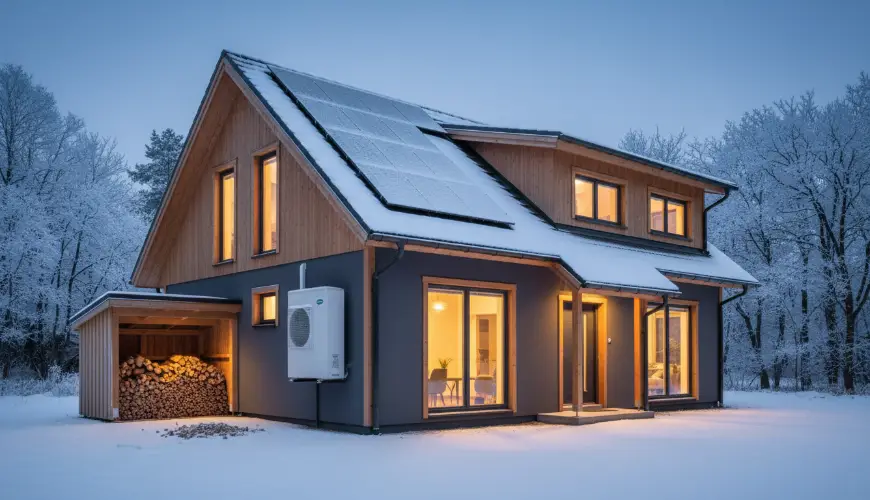
Returning to our Central Bohemian family – after careful consideration, they opted for an air-source heat pump supplemented by a wood-burning stove in the living room. The pump provides basic heating and hot water throughout the year, while the stove adds warmth and atmosphere on cold winter evenings. The subsidy from the Nová zelená úsporám programme covered a third of the heat pump costs, and the overall system is now significantly cheaper to run than the old gas boiler. Their experience is not exceptional – combined approaches to heating are increasingly popular today precisely because they can harness the advantages of multiple technologies simultaneously.
Ecological heating is not about blindly following trends, but about taking a smart approach to one's own home. A well-chosen combination of technologies can significantly reduce both the household's carbon footprint and its energy costs – and these are two goals that go hand in hand in this case. The market for ecological heat sources is also developing rapidly, technology prices are falling, and subsidy support from both the state and the European Union is becoming increasingly accessible. Anyone who chooses modern and sustainable heating today is investing not only in their own comfort, but also in the value of their property and the air quality for the entire surrounding area.