

Hanging on a bar or pole benefits the spine and shoulders
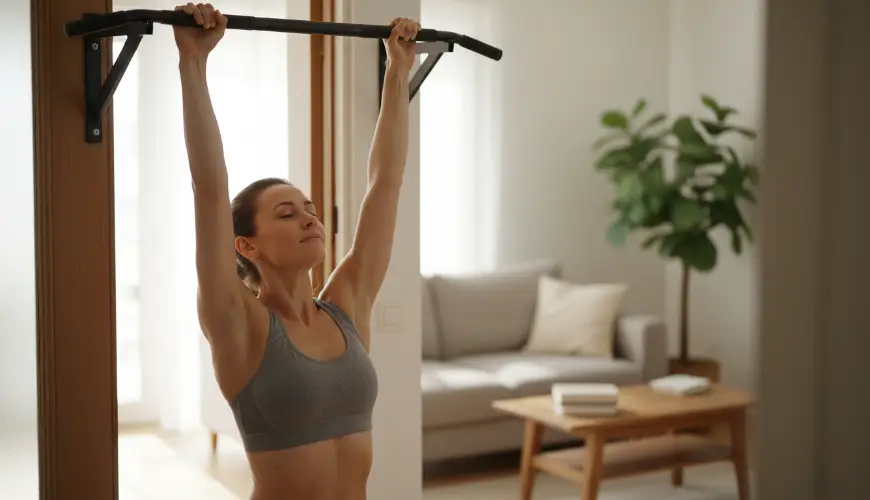
Maybe it seems simple – grab a bar, lift your feet off the ground, and just hang. No complex exercises, no equipment costing thousands, no special training required. And yet hanging from a pull-up bar or a bar is one of the most underrated movement habits a person can incorporate into their day. Orthopaedic surgeons, physiotherapists, and scientists are increasingly agreeing that regular hanging has a profound effect on the health of the spine, joints, and the entire musculoskeletal system – and yet virtually anyone can do it.
Just look at children on the playground. They naturally hang from climbing frames, swing, and climb. In doing so, their spines decompress, their shoulders open up, and their muscles stretch in ways that modern adults practically never experience. The sedentary lifestyle that has become the norm for a large part of the population constantly loads the spine in one direction – downward, with gravity, head bent over a screen. Hanging from a bar acts as a natural counterforce to this pressure.
Try our natural products


Why Regular Hanging Is So Beneficial for the Body
When a person grabs a bar and lets their body hang freely, more happens than might be apparent. Intervertebral discs are relieved, because gravity stops compressing the spine and begins to gently stretch it. This decompression effect is similar to what happens during specialised traction therapy, for which patients pay considerable sums in physiotherapy clinics. Regular hanging can significantly help people suffering from back pain, particularly in the lumbar region, where disc compression is the most common problem.
Research published in the specialist journal Journal of Orthopaedic & Sports Physical Therapy repeatedly shows that traction – the stretching of the spine – brings pain relief and improves mobility in people with degenerative spinal changes. Hanging from a bar is a natural, gentle form of precisely this kind of traction. It is no coincidence that many physiotherapists recommend their patients install a simple pull-up bar in their doorframe at home and hang from it every day for at least a minute or two.
Another significant benefit is the health of the shoulder joints. In modern life, shoulders are chronically overloaded in the forward direction – computer work, carrying bags, driving, using a phone. The muscles at the front of the chest shorten, the muscles around the shoulder blades weaken, and the result is the typical forward-head posture that has become the hallmark of our times. When hanging from a bar, the entire shoulder girdle naturally opens up. The muscles around the shoulder blade are activated, the head of the humerus is released within the joint socket, and the whole area receives the blood flow and movement it is literally crying out for.
It is not just about the spine and shoulders. Regular hanging strengthens grip strength in the hands and forearms, which – as extensive studies have shown – is a surprisingly good indicator of overall health and even longevity. Research published in The Lancet followed over 140,000 people in 17 countries and found that grip strength predicts the risk of cardiovascular disease better than blood pressure. Hanging from a bar is one of the most effective ways to naturally develop this strength.
Add to this the effect on overall body stretching. When hanging, the muscles along the entire spine are stretched, the hip flexors are released, the intercostal muscles are stretched, and breathing improves. People who practise hanging regularly often describe a feeling of the body being "lengthened" and significant relief from the tension that accumulates throughout the working day. This is exactly what Jana, a thirty-four-year-old graphic designer from Brno, experienced after her physiotherapist recommended she hang for two minutes every morning from a pull-up bar in her bathroom doorway. After three weeks, she stopped taking ibuprofen for the neck pain that had troubled her for years.
As physiotherapist and movement advocate Katy Bowman said: "Movement is not just exercise. It is a nutrient your body needs all day long, not just for an hour in the gym." Hanging from a bar is precisely this kind of movement – simple, natural, and available at any time.
How to Hang from a Bar Correctly So That It Actually Helps
Proper hanging technique is more important than it might seem. It is not enough to simply grab the bar and stop moving – without correct execution, a person may unnecessarily overload themselves or miss out on most of the benefits.
Everyone should start with a passive hang, in which the body simply hangs with relaxed muscles. This is ideal for the decompressive effect on the spine. The hands are on the bar at shoulder width or slightly wider, the thumbs can either be over the bar (overgrip) or under it (undergrip) – both variants are fine, they simply differ in muscle engagement. The feet hang freely off the ground, knees slightly bent to avoid creating unnecessary pressure on the lumbar region.
It is important not to forget scapular activation. Many beginners hang passively with their shoulders raised up towards their ears, which can overload the rotator cuff. Correctly, the shoulders should be slightly drawn down and back – technically referred to as scapular depression and retraction. This movement activates the muscles around the shoulder blade, protects the shoulder joint, and simultaneously increases the overall benefit of the exercise. It helps to imagine trying to pull the shoulder blades down into the back pockets of your trousers.
The duration of the hang should increase gradually. For complete beginners, 10 to 20 seconds is sufficient, repeated three to five times. Over time, the duration can be extended to 30 seconds, a minute, and more. The ideal daily amount, referenced for example by natural movement therapy pioneer Ido Portal, is a total of 7 minutes of hanging per day – spread across shorter intervals throughout the day, not all at once. This is a goal for advanced practitioners, but even 2 minutes a day will produce noticeable results.
There are several factors that significantly influence how hanging from a bar goes and what results it brings:
- Bar height – the bar should be high enough that a person can fully extend themselves, but without their feet touching the ground; a bar that is too low does not allow full decompression
- Grip strength – weak hands are the most common limiting factor; hooks or special straps for beginners can help by making the grip easier
- Frequency – a short daily hang is significantly more effective than a long hang once a week
- Condition of the shoulder joints – people with an acute shoulder injury should consult a physiotherapist before starting
If a person wants to progress further with hanging, active forms come into play, such as scapular retractions during the hang (so-called scapular pull-ups), shifting weight from side to side, or gradually increasing the number of pull-ups. All of this builds on the basic hang and naturally develops strength throughout the upper body. Pull-ups – pulling the body upward to the bar – are incidentally considered one of the most comprehensive strengthening exercises there is, as they engage the back, biceps, shoulders, and core simultaneously.
For those who do not have access to a pull-up bar in a park or gym, there is a practical and affordable solution: a doorframe pull-up bar. These products require no drilling, install in a minute, and hold the weight of an adult without any problem. They are an ideal addition for anyone who wants to start hanging at home. On e-shops focused on healthy living and movement, such as Ferwer, various versions of these aids suitable for home use can be found.
Age plays less of a role than many might think. Seniors who cannot hang with their full body weight can start with a partial hang, where the feet remain on the ground and the body simply leans slightly forward with hands on the bar. Even this provides part of the decompressive effect and helps gradually build grip strength and shoulder muscle strength. The important thing is to start where the body currently is – not where it should be.
Regular hanging from a pull-up bar or bar is not a trend or a fitness fad. It is a return to the natural movement that the human body practised for thousands of years – climbing, hanging, bearing weight on the hands. The modern way of life has deprived us of this movement, and its absence manifests in the health of the spine, shoulders, and overall fitness. All it takes to start is one bar, two minutes a day, and the willingness to try something that looks almost suspiciously simple – and yet works.