

# How to Teach a Child to Swim Safely and with Joy Teaching a child to swim is one of the most valu
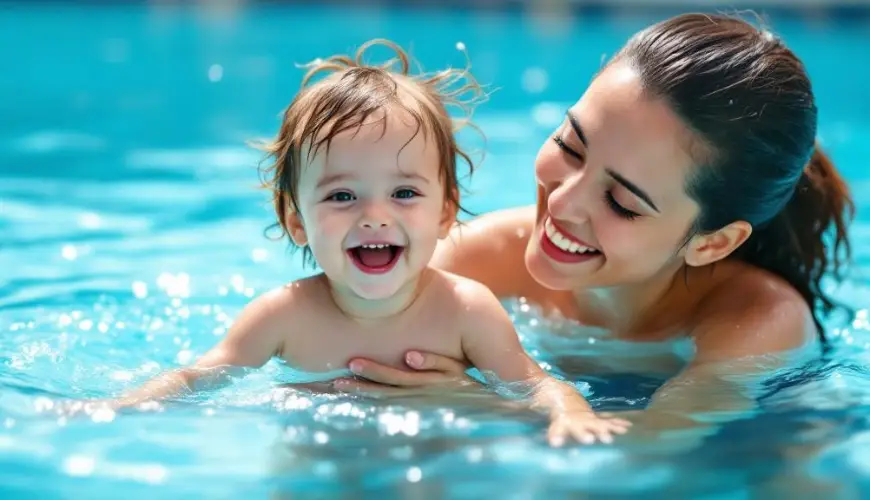
Water attracts children like a magnet. Barely has a toddler learned to walk before they're already pulling their parents toward the nearest puddle, fountain, or swimming pool. This natural fascination with water is a gift worth nurturing – and as early as possible. Teaching a child to swim is not just about athletic performance or summer fun. It is one of the most important life skills parents can pass on to their children.
According to data from the World Health Organization, drowning is among the leading causes of injury-related death in children under fourteen. Yet research repeatedly shows that children who have received systematic swimming instruction face a significantly lower risk of a tragic accident near water. The American Academy of Pediatrics recommends beginning formal swimming instruction for children from the age of one year, while emphasizing that earlier contact with water in a safe environment is welcome. The question, therefore, is not whether to let a child into the water, but how to do it properly – with care and joy.
Try our natural products



When to start and what the first steps look like
Many parents ask at what age it makes sense to begin. The answer is surprisingly simple: the earlier, the better – though with regard to the child's developmental capabilities. Infants and toddlers under two are not yet able to learn technically correct swimming strokes, but they can become accustomed to the aquatic environment, learn not to fear submersion, and develop basic movement reflexes. This period is professionally referred to as aquatic adaptation, and its primary goal is confidence, not performance.
In practice, this might look something like this: the Novák family from Brno began taking their daughter Eliška to the swimming pool at just three months of age, when her mother would simply hold her in the warm water and sing to her. By the age of two, Eliška was already jumping fearlessly from the edge of the pool into her father's arms. At four, she completed her first group swimming course, and the instructor was struck by how naturally she moved in the water. This fluency did not develop overnight – it was the result of hundreds of hours of carefree contact with water in early childhood.
For toddlers, the golden rule applies: never leave a child unsupervised, even in a centimetre of water. A child can drown in even shallow water in a bucket. Safety is the absolute priority; only then does instruction come into play. Parents should be physically present with the child in the water, not merely sitting poolside with a phone in hand.
Shallow children's pools with a water temperature of around 32–34 °C are ideal, where the toddler feels comfortable and does not get cold. Cold is, in fact, one of the greatest enemies of early swimming instruction – a tired and shivering child will not associate water with joy, but with an unpleasant experience that can persist for years.
Toddler age: play as the foundation of everything
Between the ages of one and three, play is the only meaningful tool for learning. No commands, no pushing toward submersion, no rushing. A child at this age learns through imitation and repetition, which is why the presence of a parent or older sibling who moves naturally and joyfully in the water is essential.
Practical activities for toddlers include pouring water from a small container onto their own hands and gradually onto their face, blowing bubbles into the water, kicking their legs in the water while sitting on the edge of the pool, or walking in the shallow end. Each of these seemingly trivial steps builds confidence and reduces the natural wariness of water. As leading Czech swimming educator Alena Puková puts it: "A child who laughs in the water learns a thousand times faster than a child who is afraid."
Aids such as buoyancy vests or armbands can be useful for a sense of security, but should not become a crutch. Experts caution that excessive use of flotation devices can paradoxically slow the development of natural technique, as the child learns to move through the water in a vertical position rather than a horizontal one. If aids are used, it should be done consciously and temporarily.
The way parents communicate is also crucial. Phrases like "don't be afraid, nothing will happen" are well-intentioned, but inadvertently confirm to the child that there is indeed something to fear. A neutral and loving approach works better: "Look how nice the water is, come and play with us." A child's emotions mirror those of their parents – if a parent displays anxiety, the child will reliably pick up on it.
Regularity also plays an indispensable role. A one-off trip to the water once a summer is not enough. Ideally, visit the pool at least once a week so that the child retains familiarity with the environment and does not have to overcome the same fears anew each time.
From three to six years: time for real instruction
The preschool years bring a significant turning point. A child between the ages of three and six is capable of consciously following simple instructions, imitating movements, and working deliberately on specific skills. It is precisely during this period that it makes sense to enrol them in an organised swimming course led by a qualified instructor.
A good swimming course for preschoolers should have a maximum of six to eight children per instructor, instruction should take place in a playful manner, and the instructor should have experience in child developmental psychology, not just swimming technique. When choosing a course, it is worth asking about the child-to-instructor ratio, how the course works with children who are afraid of water, and what the water temperature in the pool is.
Gradual swimming instruction for preschoolers typically progresses through several stages. Children first learn to glide on the surface – lying in the water with the support of the instructor or with a kickboard, feeling how the water carries them. Then comes the practice of leg movement, the so-called flutter kick, which is more intuitive for children than the breaststroke leg movement. Submerging the face and exhaling into the water are further milestones that many children master surprisingly quickly, provided they are not forced but naturally motivated.
Breaststroke, which is traditionally taught first in the Czech context, is not biomechanically the most natural style for young children. Many modern swimming schools therefore begin with front crawl or simple gliding, introducing breaststroke only as a second step. Parents should not fixate on a particular style, but observe what comes naturally to their child and what they enjoy.
Motivation is absolutely key at this age. A child who enjoys swimming will make progress in one year that would otherwise take three. Simple rewards work well – praise, a sticker, the opportunity to jump into the pool from a height as a reward for completing a task. What does not work is pressure, comparing children to one another, or expressing disappointment at slow progress. Every child develops at their own pace, and what one masters at four, another will master at five – and both outcomes are perfectly fine.
Parents can supplement home preparation with simple activities outside the pool. Blowing through a straw into a glass of water develops the correct breathing technique that is essential in swimming. Leg movements performed lying on the floor prepare the muscles and coordination. And above all – talking about swimming, reading books with water themes, or watching videos of children swimming in safe environments strengthens positive associations.
An important topic that parents sometimes overlook is water safety as part of instruction. Children should know from an early age that one does not jump into a pool without adult supervision, that running near water is not allowed, and that swimming lessons do not mean they are safe under all circumstances. These rules are not meant to frighten, but are a natural part of a healthy relationship with the aquatic environment.
The Czech Republic has a fairly dense network of swimming schools and courses for children, and many primary schools offer compulsory swimming instruction as part of physical education. Yet research shows that a significant proportion of Czech children start first grade without basic swimming skills. The preschool years are therefore an ideal window of opportunity that parents should not allow to close.
Teaching a child to swim is an investment whose return cannot be measured. It is a gift of freedom – the freedom to move through the sea, a lake, or a swimming pool without fear, with joy and confidence. And at the same time, it is a safeguard that may one day save a life. Perhaps that is precisely why swimming is among those skills that parents around the world recall with particular pride – not because their child swims the fastest, but because they swim at all, with a smile and without fear.