

Smoothie bowls will fill you up and give you energy
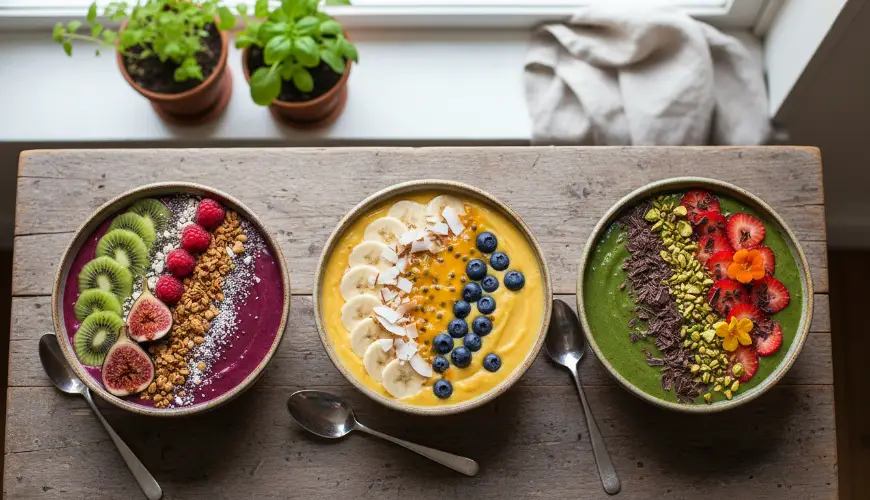
A breakfast that looks like a work of art while giving your body everything it needs – that is precisely what smoothie bowls have become a phenomenon of recent years. Photos of these colourful bowls spread like wildfire on social media, but behind the aesthetic surface lies something more substantial: a smart way to concentrate nutrients, flavour and the joy of eating into a single meal. However, putting together a truly balanced smoothie bowl that satisfies, provides energy and tastes great requires a little more than just blending a banana with a handful of strawberries.
Smoothie bowls, sometimes also called "smoothie bowls" or "açaí bowls", have their origins in the Brazilian culture of consuming açaí – thick porridges made from the fruits of the açaí palm, which are traditionally served in Brazil with granola and fruit. This trend gradually spread around the world, and today there are hundreds of variations, from tropical versions to bowls inspired by chocolate, matcha or blueberries. According to the World Health Organization, every person should eat at least 400 grams of fruit and vegetables daily, and smoothie bowls are one of the most enjoyable ways to achieve this goal.
Try our natural products




What makes the foundation of a good smoothie bowl
The secret of every successful smoothie bowl lies in its base. Unlike a liquid smoothie that is drunk through a straw, the base of a smoothie bowl must be thick enough to support the toppings – that is, everything placed on top of the bowl. The thickness of the base is achieved by using a minimal amount of liquid and choosing the right ingredients. Frozen fruit is an absolute necessity: frozen banana provides a creamy consistency, frozen mango brings tropical sweetness, and frozen blueberries or forest fruits provide intense colour and antioxidants.
Alongside fruit, added protein also plays a key role. Without it, the smoothie bowl might look beautiful, but hunger would set in after an hour. Greek yoghurt, plant-based protein powder, tofu or cashew butter are excellent choices that will thicken the base while also providing the body with amino acids needed for muscle recovery and a feeling of fullness. Research published in the academic journal The American Journal of Clinical Nutrition has repeatedly confirmed that a breakfast with a higher protein content reduces appetite throughout the entire morning.
The liquid we add to the base should be as small an amount as possible – ideally just enough for the blender to work. Almond milk, coconut water, oat milk or plain water are all legitimate choices. The less liquid, the thicker the result, and the better the bowl will hold its shape when served.
Another important element of the base is vegetables. Many beginners are afraid of vegetables in smoothie bowls, but the truth is that a handful of spinach or kale barely makes itself known in the base flavour-wise, while significantly increasing the content of fibre, B vitamins, vitamin C and iron. Beetroot, meanwhile, adds a striking purple-red colour and an earthy sweetness that pairs beautifully with the chocolate notes of cocoa powder.
As American nutritional therapist Mark Hyman once said: "Food is not just fuel. It is information. It tells your body how to function." And a smoothie bowl can be one of the richest sources of information we provide our bodies with in the morning.
Toppings: where flavour and nutrition are born
If the base is the soul of a smoothie bowl, then toppings are its personality. It is precisely the layered ingredients on the surface of the bowl that determine the final flavour experience, textural variety and visual appeal. And this is where there is room for creativity, but also for thoughtful nutritional thinking.
Granola is a classic and popular topping that adds crunch and complex carbohydrates. It is important to choose granola without added refined sugar, or to prepare it at home – all you need is rolled oats, a little maple syrup, coconut oil and favourite spices such as cinnamon or cardamom, all baked in the oven at a low temperature. The result is not only tastier but also significantly healthier than most commercial versions.
Fresh fruit sliced or left whole forms another layer. Strawberries, kiwi, mango, raspberries, figs or pomegranate – each variety brings a different micronutrient profile. A combination of differently coloured fruit ensures an intake of a wide spectrum of antioxidants, with each colour corresponding to different phytochemicals. The red colour of tomatoes and strawberries signals lycopene, the orange colour of mango and papaya means beta-carotene, and the purple of blueberries or açaí signals anthocyanins.
Nuts and seeds are a topping that should not be underestimated. Chia seeds, hemp seeds, flaxseeds or sunflower seeds provide healthy omega-3 fatty acids, zinc, magnesium and other minerals that occur only in small amounts in fruit and vegetables. Almonds, walnuts or pecans add healthy fats and a feeling of fullness that transforms the smoothie bowl from a light snack into a full meal.
Superfoods such as maca powder, spirulina, matcha or cacao nibs are an optional but interesting choice. They are added in small amounts – a teaspoon is enough – and can specifically support particular areas of health, from immunity and concentration to hormonal balance. It is not necessary to add them all at once; simply choose one or two according to current needs.
Let us consider a specific example: Jana, a thirty-year-old teacher from Brno, started preparing smoothie bowls every morning after discovering that classic breakfasts – toast with butter or cereal – left her tired and hungry even before the morning break. She started simply: frozen banana, a handful of spinach, a tablespoon of peanut butter and a little oat milk as the base, topped with granola, banana slices and a teaspoon of chia seeds. After two weeks, she noticed she had more energy, concentrated better and was less prone to sweet cravings after lunch. Her story is not unique – thousands of people who have incorporated smoothie bowls into their morning routine share a similar experience.
How to put together a balanced smoothie bowl step by step
Putting together a truly balanced smoothie bowl is not rocket science, but it pays to have a simple framework in mind. The base consists of a combination of frozen fruit (ideally two to three varieties), a source of protein (yoghurt, protein powder or nut butter) and a minimal amount of liquid. Vegetables are a bonus worth adding. Everything is blended to a thick, creamy consistency and poured into a bowl.
The toppings are then placed on top in a considered order: first granola or another crunchy element, then fresh fruit, followed by seeds and nuts, and finally any superfoods or decorative elements such as edible flowers or coconut flakes. The visual aspect is not just for Instagram – research shows that attractively presented food actually tastes better, because visual stimuli activate taste perception even before the first bite.
When it comes to nutritional balance, a useful guide is the so-called plate model recommended by the Harvard T.H. Chan School of Public Health: half of the meal should consist of fruit and vegetables, a quarter of wholegrains and a quarter of quality protein. A smoothie bowl naturally meets this model if assembled thoughtfully.
The seasonality of ingredients is an aspect worth mentioning. Smoothie bowls are wonderful in that they can be adapted to the time of year. In spring, strawberries and rhubarb dominate; in summer, raspberries, apricots and peaches; in autumn, plums, pears and pumpkin; and in winter, citrus fruits, pomegranate and frozen fruit from the summer season. Seasonal fruit is not only cheaper and tastier, but also more nutritious, as it contains more vitamins and minerals than fruit transported from the other side of the world.
The ecological dimension of smoothie bowls is also worth mentioning. Choosing local and organic ingredients, minimising plastic packaging and preferring plant-based protein sources over animal ones are steps that turn an everyday breakfast into a conscious decision with a positive impact not only on personal health but also on the planet. Shops focused on sustainable living, such as Ferwer, offer organic superfoods, ecological granolas and sustainably grown seeds and nuts, making it easier than ever to put together a smoothie bowl in line with values of environmental responsibility.
Smoothie bowls are not a passing trend that will disappear next season. They are proof that healthy eating does not have to be boring, complicated or expensive. All it takes is a few frozen fruits, a little imagination and a willingness to experiment – and the morning ritual can be transformed into one of the most enjoyable moments of the day.