

How balcony photovoltaics saves money and the planet
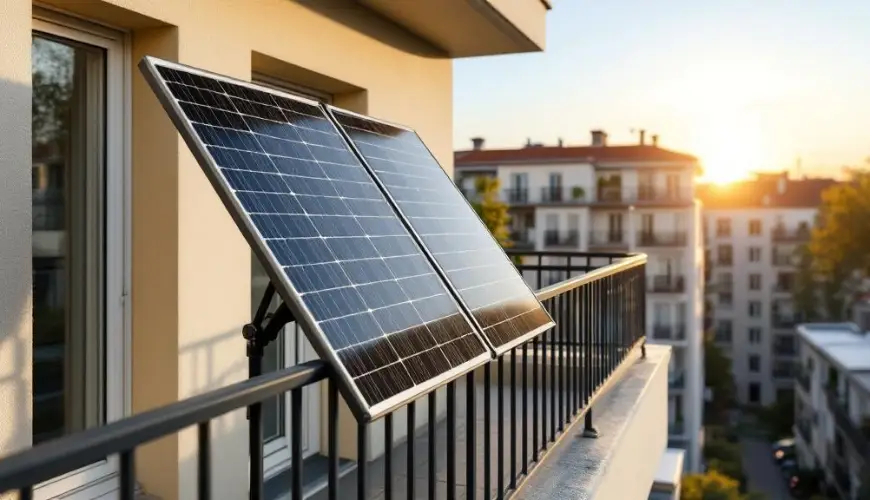
Imagine that every morning, when the sun rises, your household begins generating electricity on its own – without a rooftop, a plot of land, or complex building permits. This is precisely what balcony photovoltaics makes possible, a technology that has been experiencing a genuine boom in recent years across Europe and the Czech Republic. This is not some distant future, nor is it the exclusive privilege of homeowners. A balcony power plant is today accessible to virtually everyone – a tenant in a panel block, a flat owner on the fourth floor, or a resident of an urban attic.
Interest in this technology has grown sharply, particularly since 2022, when energy prices soared to unprecedented heights and people began looking for ways to reduce their dependence on electricity suppliers. According to data from the Czech Statistical Office, households are among the largest consumers of electrical energy in the country, with the average Czech household consuming approximately 2,500 to 3,500 kWh per year. Even a seemingly small balcony power plant can cover part of this consumption – and over time, this makes a very noticeable difference to the family budget.
Try our natural products






What balcony photovoltaics actually is
Balcony photovoltaics, also referred to as "plug-in" or "mini" photovoltaics, is a small solar system designed for installation on a balcony, terrace, loggia, or even a garden fence. Unlike conventional rooftop photovoltaic power plants, it requires no major construction work, no building permit, and no approval from an entire owners' association. The system consists of one or two solar panels, a microinverter that converts direct current into alternating current, and a special plug through which the entire assembly connects directly to a wall socket.
The principle is elegantly simple. Solar panels capture sunlight and convert it into electrical current. The microinverter adjusts this current to make it compatible with the home's electrical grid, and the energy then flows directly to the appliances in the flat. If the household is consuming less energy at a given moment than the power plant is generating, the surplus flows back into the grid – although in the current Czech legal environment, the system of selling surplus energy back for balcony power plants has not yet been fully standardised.
The output of such a system most commonly ranges between 300 and 800 watts, depending on the number and quality of the panels. Modern panels achieve efficiencies of over 20%, meaning that even a relatively small balcony can yield a decent amount of energy. It naturally depends on the orientation of the balcony – south, south-west, or south-east is ideal – and on how many hours per day direct sunlight reaches the panels without being blocked by surrounding buildings or trees.
As an example, consider the Novák family from Brno, who live in a flat on the third floor with a south-west-facing balcony. They purchased a two-panel system with an output of 600 W for approximately 15,000 crowns. According to their own measurements, the system produced around 550 kWh of electricity over the course of a year, which, at an electricity price of around 5 CZK per kWh, represents a saving of roughly 2,750 crowns annually. The return on investment thus works out to approximately five to six years – and the panels have a lifespan of 25 years or more.
How to get started: from choosing a system to connecting it
The decision to acquire a balcony power plant may seem complicated at first glance, but in reality it is one of the simplest ways to enter the world of renewable energy. The first step is to assess your own balcony. The key factors are its orientation relative to the cardinal directions, the degree of shading, and the available surface area. A standard solar panel for balcony use measures approximately 170 × 110 cm, so even a smaller balcony can usually accommodate at least one panel.
The next step is selecting the system itself. The market offers a range of ready-made kits containing everything needed – panels, a microinverter, mounting brackets, and a connection cable. When choosing, it is worth paying attention to panel certification, the manufacturer's warranty, and the quality of the microinverter. Reputable brands such as Hoymiles, AEG, and Deye offer reliable microinverters with monitoring apps through which electricity generation can be tracked in real time directly from a mobile phone. This feature is surprisingly motivating – watching your power plant at work and seeing how much energy it is currently producing carries its own sense of satisfaction.
As far as the legal side of things is concerned, the situation in the Czech Republic has simplified considerably in recent years. Since 2024, balcony power plants with an output of up to 2 kW (or, more specifically, with a single-phase connection of up to 600 W) can be operated without a building permit and with significantly simplified administrative requirements vis-à-vis the electricity distributor. The operator is nonetheless required to notify their distributor – depending on the region, this will be a company such as ČEZ Distribuce, E.ON, or PREdistribuce – by means of a simple notification form. This is not a bureaucratic obstacle; it is more of a formality that takes less time than obtaining a parking permit.
If you live in a block of flats as a tenant or member of an owners' association, it is advisable to inform the building manager or the owners' committee in advance. An installation on a balcony that does not affect common areas or the façade generally does not require the consent of the other owners. However, if the brackets are to be anchored to the façade or to the balcony railing, consent may be required. It is always better to discuss the situation in advance and avoid any unnecessary misunderstandings.
The installation itself is surprisingly quick. Experienced users can assemble and connect the entire system in a single afternoon. The panels are secured to brackets that are either hung over the railing or placed on the balcony floor at a suitable angle, the microinverter is connected to the panels, and the output cable is plugged into a standard 230 V socket. No special wiring is required, no electrician, and no intervention in the building's electrical installation. This simplicity is one of the main reasons why balcony photovoltaics is gaining popularity so rapidly.
As German energy expert Volker Quaschning once observed: "The best energy is the energy you produce yourself, right where you consume it." Balcony power plants bring this idea to perfection – generation and consumption take place in the same location, without losses from long-distance transmission.
After installation, it is worth monitoring output and comparing it with your own consumption. Most modern microinverters offer online monitoring, but you can also purchase a smart electricity meter or a smart plug with consumption measurement, which shows in real time how much energy appliances are drawing. The ideal situation arises when the largest consumers – the washing machine, dishwasher, electric cooker, or electric vehicle charger – are running precisely when the power plant is generating the most, namely around midday on a sunny day. This conscious adjustment of consumption to match generation is known as "load shifting" and can significantly increase the proportion of self-generated energy that is actually consumed on-site.
Some users go even further and supplement their balcony system with a small battery for storing surplus energy. Such a solution increases the initial investment, but also makes it possible to use energy generated during the day in the evening or at night. The market offers compact battery storage units designed specifically for use in combination with balcony power plants – they fit in a cupboard or under a bed and have a capacity of around 1 kWh, which is sufficient, for example, to run a refrigerator throughout the night.
The ecological dimension of balcony photovoltaics is just as important as the economic one. Generating electricity from solar panels produces no CO₂ emissions during operation, and the International Renewable Energy Agency IRENA states that solar energy is among the sources with the lowest carbon footprint across its entire lifecycle. A single average balcony system can save hundreds of kilograms of CO₂ over its lifetime – a contribution worth mentioning even if the economic return were not as compelling.
The Czech Republic is still catching up with its neighbours in the field of balcony photovoltaics. In Germany, balcony power plants are a mass phenomenon – the German government estimates that hundreds of thousands of households operate them, and interest grows every year. German experience shows that as the number of users increases, equipment prices fall and the legislative environment improves. The Czech Republic is following a similar path, albeit with a certain delay.
For anyone considering a first step towards energy self-sufficiency, balcony photovoltaics is the ideal entry point. It requires no large investment, brings no construction complications, and the results are visible almost immediately. All it takes is a sunny day, a balcony with a good southward aspect, and the desire to try something that makes sense – for the wallet and for the planet alike.