
Easy One-Pot Recipes for Quick Family Cooking
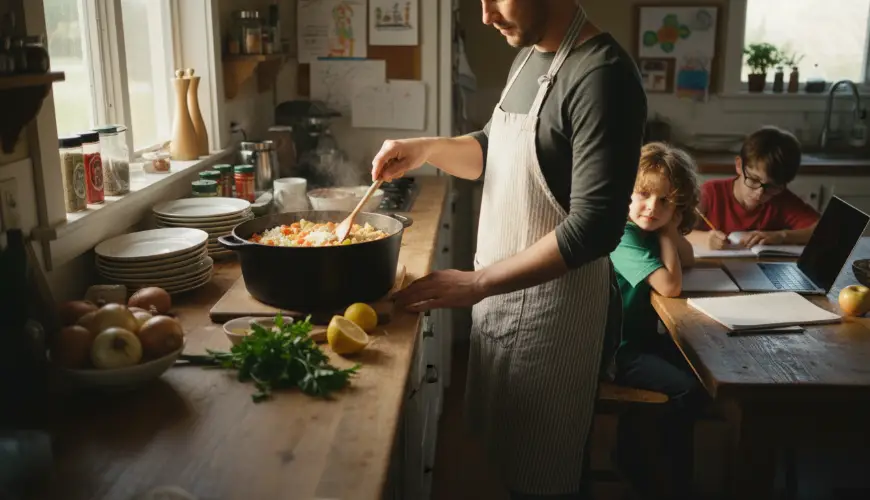
Modern family life revolves in a relentless rhythm. School, activities, work, shopping, household chores – and then suddenly it's six o'clock in the evening and nobody knows what's for dinner. These are precisely the moments when a cooking philosophy comes into its own – one that has actually existed forever, but has been experiencing a genuine renaissance in recent years: one-pot cooking. This is no fashionable trend or culinary gimmick. It is a practical approach to food that saves time, energy, money and stress – while still bringing nutritious, tasty and filling meals to the table for the whole family.
The principle is simple: all the ingredients are prepared in a single vessel – whether that is a pot, pan, casserole dish or slow cooker. Meat, vegetables, legumes, grains, stock – everything is added gradually to one place and cooked together into a finished dish. No washing up four different pots, no watching three burners at once, no chaos in the kitchen. The result is food that tastes like something grandmother made, because the ingredients have had time to meld together and develop a deep, full flavour profile.
Try our natural products




Why are one-pot meals so advantageous?
There is not just one answer to this question. The benefits extend far beyond simply saving time on washing up. Let us start with the most practical aspect: preparation takes a fraction of the time compared to conventional cooking. A parent who comes home after a long working day does not need a complicated recipe with ten steps. They need a method they can manage even when tired, with a child at their feet and a phone in their hand.
Another significant benefit is the nutritional value of meals prepared this way. When vegetables are cooked together with meat and stock, vitamins and minerals are not poured down the drain but remain part of the dish. Research shows that gentle cooking at lower temperatures over a longer period – which is precisely how slow cookers or braising in a covered pot works – preserves more nutrients than rapid cooking over a high flame. The United States Department of Agriculture (USDA), for example, has repeatedly noted that the method of heat treatment significantly affects the final nutritional value of a dish.
The economic aspect is also not to be overlooked. One-pot meals are made for cheaper and less "premium" ingredients – root vegetables, legumes, less expensive cuts of meat, leftovers from the fridge. Beans, lentils, potatoes, carrots, celeriac, onions – these are ingredients that cost almost nothing yet can feed an entire family. And because everything is cooked together, the flavours intertwine and even modest ingredients shine in a way they would not achieve in another recipe.
There is yet another dimension that is spoken of less often, but which may be the most important for many families: reducing the stress of cooking. Cooking should be a pleasure, but for busy parents it often becomes a source of daily anxiety. One pot significantly reduces this stress. There is no need to monitor the timing of several dishes simultaneously, no need to be a chef with perfect organisation. It is enough to proceed step by step and the result takes care of itself.
As British cook Nigella Lawson once said: "Cooking shouldn't be a test of endurance. It should be a joy." And it is precisely one-pot meals that are capable of returning that joy even to the most packed family schedule.
Recipes for popular one-pot meals that anyone can make
Theory is all very well, but what exactly should you cook? The following examples are popular not only for their simplicity, but also because they are loved by children and adults alike and can easily be adapted to whatever happens to be in the fridge.
Chicken risotto with vegetables is a classic that deserves rehabilitation. Many people are afraid of risotto because they feel it requires constant stirring and monitoring. In reality, there is a way to prepare it in one pot without continuous stirring – pieces of chicken are browned, then onion, garlic, rice, vegetables and stock are added, and everything is left to simmer gently under a lid. The result is creamy, filling and ready in under thirty minutes.
Another favourite is lentil soup with sausage, which serves as both a soup and a main course. The lentils do not need to be soaked beforehand; they cook directly with chopped vegetables, slices of sausage or other smoked meat, spices and stock. This dish is incredibly hearty, rich in protein and fibre, and yet it can be prepared by a complete beginner. It also tastes even better the next day, making it ideal as a packed lunch for work or school.
Spanish rice with minced meat is a recipe that functions in many families as a reliable standby for difficult days. Minced meat is fried with onion and pepper, tinned tomatoes are added along with spices, rice and a little water or stock – and in twenty minutes there is a substantial meal on the table that is reminiscent of Mediterranean cuisine. This combination is particularly popular with children, because the rice absorbs all the flavours and the dish is neither too spicy nor too exotic.
For those who prefer meat-free options, minestrone is an excellent choice – the Italian vegetable soup that combines beans, pasta, seasonal vegetables and herbs. The recipe has no fixed form and is essentially made for improvisation based on whatever happens to be at home. Everything that might otherwise be thrown away goes into the pot – a piece of celeriac, leftover carrots, a few potatoes. Minestrone is proof that sustainable cooking and delicious cooking are not opposites.
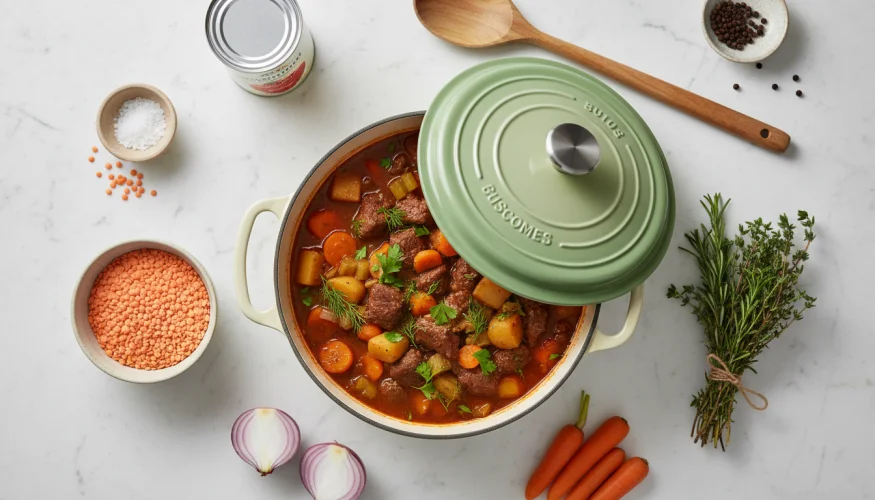
The slow cooker, or crockpot, must also be mentioned – it is practically made for one-pot meals. In the morning, a parent puts chunks of beef, root vegetables, stock and spices into the pot, sets it to a low temperature – and comes home in the evening to a ready-made goulash or braised meat that falls apart under a fork. The Culinary Institute of America, a culinary research and education organisation, confirms that slow cooking at low temperatures is one of the best ways to preserve the natural flavours and textures of both meat and vegetables.
Imagine, for example, a family with two school-age children. In the morning before leaving for work, preparing the slow cooker takes ten minutes – carrots, potatoes, onion, pieces of turkey, herbs and a little stock. In the evening, after collecting the children from their activities and finishing homework, a ready-made dinner is waiting on the table, filling the entire flat with its aroma. No stress, no ordering takeaway, no guilt about the family eating unhealthily again. This is precisely what the real-life benefit of this approach to cooking can look like.
How to get started and what to keep in mind
Switching to one-pot cooking requires no special equipment or extensive preparation. All you need is a good-quality, heavier pot with a lid at home – ideally cast iron or stainless steel – that distributes heat evenly. Such an investment pays for itself many times over, because a good pot lasts for decades and significantly influences the outcome of your cooking.
A basic store of ingredients is also important – one from which a meal can be assembled on any given day without needing to go shopping. It is enough to keep a few tins of tomatoes, legumes, rice or pasta, basic spices and frozen vegetables at home. With such a foundation, it is possible to put together a nutritious dinner from practically nothing.
One-pot meals are also an excellent opportunity to involve children in cooking. Adding ingredients to the pot, stirring, watching how the dish transforms – these are activities that children can manage and that build a healthy relationship with food and cooking. Studies published in the academic journal Public Health Nutrition have shown that children who participate in meal preparation tend to eat more healthily and are more willing to try new foods.
One-pot cooking is not a compromise between convenience and quality. It is a way to achieve both at once – and for the modern busy family, it may be one of the most valuable culinary skills there is to master.