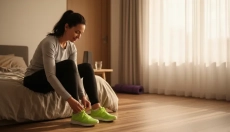

Learn how to exercise with knee pain without making it worse
Knee pain is one of the most common reasons people stop exercising. Yet this is precisely where a paradox lies that doctors and physiotherapists repeat over and over again: in most cases, movement is the best medicine, not resting on the couch. The question therefore is not whether to exercise at all, but how to exercise smartly, mindfully, and without unnecessary risk of further injury.
The knee is one of the most complex joints in the human body. It connects the femur to the tibia, contains menisci, ligaments, and cartilage, and withstands enormous mechanical load every day – during walking it bears approximately three times the body weight, during running up to six times. It is no wonder, then, that knees are often the first place where overloading, inappropriate footwear, poor movement technique, or natural age-related wear and tear manifests itself. According to data from the World Health Organization, more than 1.7 billion people worldwide suffer from musculoskeletal problems, with knee pain forming one of the most widespread categories.
Yet far too many people opt for complete rest. The result is typically weakened muscles around the joint, stiffness, and paradoxically even greater pain when returning to movement. Physiotherapists are therefore increasingly emphasizing an approach called "active rehabilitation" – targeted exercise that strengthens, stabilizes, and keeps the joint in condition even when it hurts.
Try our natural products



First identify the cause, then act
Before embarking on any exercise program, it is essential to know what is causing the pain. The approach differs for osteoarthritis, tendon inflammation, meniscus problems, and what is known as runner's knee or iliotibial band syndrome. Without a correct diagnosis, even well-intentioned exercise can worsen the situation. A visit to an orthopaedist or physiotherapist should therefore be the first step – not one that is postponed indefinitely.
Once the cause is clear, space opens up for movement that genuinely helps. And there are surprisingly many options. Take Markéta, a forty-year-old teacher from Brno, who after years of jogging began experiencing pain beneath her kneecap. An orthopaedist diagnosed her with chondromalacia – cartilage damage – and recommended reducing running. Markéta was afraid she would gain weight and lose her fitness. Instead, she took up swimming, strengthened her quadriceps, and incorporated yoga. After three months, she not only did not gain weight, but her knee improved significantly and she gradually returned to light running.
Markéta's story is not exceptional. It is an illustration of what science also confirms: correctly chosen movement with painful knees is not dangerous – it is healing.
Which sports and exercises are gentle on the knees
The choice of appropriate movement depends on the intensity of the pain and its origin, but there are several activities that are generally considered safe and beneficial for people with knee problems.
Swimming and aqua aerobics are almost always at the top of the list. Water buoys the body and significantly reduces pressure on the joints, while movement in it strengthens the entire body, including the muscles around the knee. Cycling or using a stationary bike works similarly – if the saddle is correctly set to a height where the leg remains almost fully extended at the bottom of the pedal stroke, the load on the knee is minimal while effectively strengthening the thigh muscles. An elliptical trainer is another excellent option, as it simulates the natural movement of walking without the impact that burdens the knee during running.
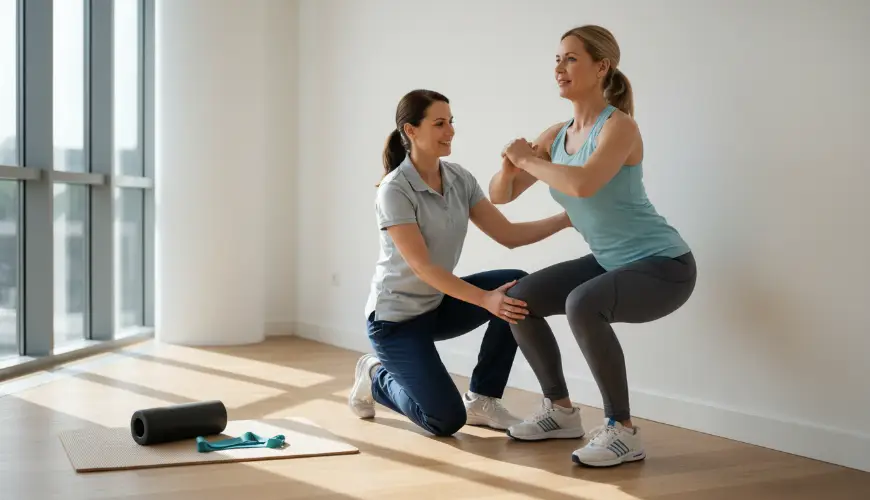
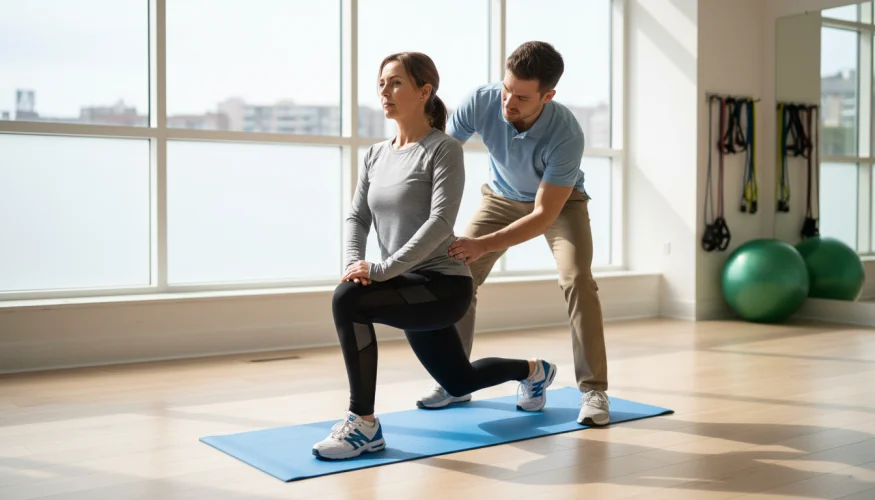
When it comes to strength training, the key is to focus on the muscles that surround and stabilize the knee. These are primarily the quadriceps on the front of the thigh and the hamstrings on the back. Strong muscles in these areas act as natural shock absorbers and significantly reduce pressure directly on the joint. A favourite exercise among physiotherapists is isometric quadriceps contraction – simply put, tensing the muscle while lying or sitting without moving the joint. Shallow-range lunges, straight-leg raises while lying down, and walking backwards – which activates muscles differently from normal walking – have also proven effective.
It is also important not to neglect the gluteal muscles. Weak glutes are one of the most common causes of knee overload, because when the gluteal muscles do not function properly, the knee takes on roles that do not belong to it. Targeted glute strengthening – such as bridges, clamshells, or lateral band walks with a resistance band – can provide significant relief for painful knees.
Conversely, movements that load the knee in deep flexion or with impact should reasonably be avoided during the acute phase. These include full-depth squats, jumps, sharp changes of direction, and running on hard surfaces. This does not mean a person can never return to them – but gradual progression and patience are absolutely essential here.
How to approach exercise so that pain does not increase
One of the most important principles when exercising with painful knees is the so-called pain rule. Mild discomfort or a pulling sensation are acceptable during rehabilitation exercise, but sharp, stabbing, or increasing pain is a signal to stop. Physiotherapists in this context often use a simple scale: if the pain is at most a four on a scale of zero to ten and does not decrease by the following day after exercise, the intensity needs to be reduced or the exercises modified.
As leading British sports physiotherapist Tim Gabbett once noted: "The problem is not movement itself, but the transition from no movement to too much movement too quickly." This idea is the foundation of the modern approach to knee rehabilitation – a slow, gradual return to activity that gives the body time to adapt.
Another practical recommendation is to pay attention to the surface on which we move. Walking or light jogging on grass or clay is significantly gentler on the knees than moving on asphalt or concrete. Footwear also plays a role – quality sports shoes with adequate cushioning and arch support are an investment that pays off. Those interested in more eco-friendly alternatives can opt for shoes made from sustainable materials, the range of which has expanded considerably in recent years.
Recovery is equally important. Knees need time to recuperate, and therefore alternating exercise days with rest days is not laziness but strategy. Applying ice after exercise can also help – ten to fifteen minutes can effectively reduce inflammation and decrease swelling. Heat, on the other hand, is more suitable before exercise to loosen muscles and joints.
Nutrition also plays a role. Cartilage is nourished by synovial fluid, the production of which is supported by movement itself – this is another argument for why complete rest does not improve the situation. At the same time, there are substances that can support joint health from within. Collagen, omega-3 fatty acids, vitamin C, and curcumin are among the most thoroughly researched. A systematic review published in the PubMed academic database suggests that hydrolysed collagen supplementation may contribute to reducing joint pain and supporting cartilage, although research in this area is ongoing. Quality joint nutrition supplements are now offered by many health and wellness online shops, and it is worth looking for products with transparent ingredient lists and no unnecessary additives.
Body weight is also a vastly underestimated factor. Every extra kilogram places approximately four kilograms of load on the knees during walking. Movement combined with a balanced diet can therefore have a dual effect – directly strengthening the muscles around the joint and indirectly providing relief through weight reduction.
People who have been dealing with painful knees over the long term should also consider working with a physiotherapist on movement patterns. Many joint problems do not originate in the knee itself, but stem from incorrect movement at the hip or ankle, or from muscle imbalances arising from sedentary work. Correcting poor movement habits is more difficult than adding new exercises, but in the long term it is the most effective prevention and treatment.
The role of the mind is also worth mentioning. Chronic pain changes the way the brain perceives movement – people unconsciously begin to protect the affected area, move asymmetrically, and compensate, which leads to further problems. A mindful approach to exercise, for example through yoga, tai chi, or Pilates, helps not only physically but also restores confidence in one's own body. These activities are also very gentle on the knees in terms of load, while effectively working on flexibility, balance, and overall body tension.
Knee pain does not have to be the end of an active life. It is rather an invitation to listen to your body, reconsider your approach to movement, and perhaps discover activities that bring more joy than the original routine. Smart exercise with consideration for the knees is not a limitation – it is a way to remain active in the long term and in good health.