

# How to Cook with Children Safely and Joyfully
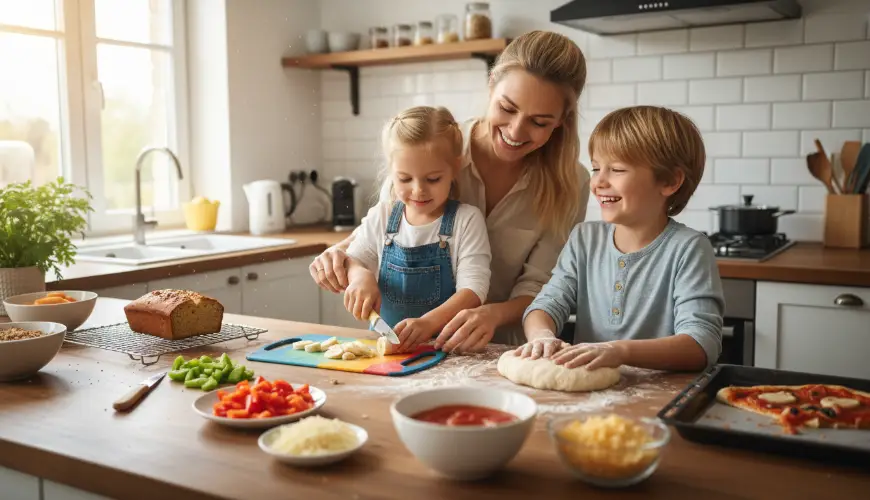
The kitchen is one of the liveliest places in any home. The smell of freshly baked bread, the sizzle of onions in a pan, or a colourful parade of vegetables on a chopping board – all of this can awaken a curiosity in children that is hard to suppress. And why should it be suppressed? Cooking with children is much more than just preparing food – it is an opportunity for learning, sharing, and shared moments that are never forgotten.
Many parents admit, however, that the idea of letting a child into the kitchen frightens them a little. The concerns are understandable – a hot hob, sharp knives, batter spilled on a freshly washed floor. Yet it is precisely these situations, handled with calm and preparation, that shape children the most. According to research published in the journal Appetite, children who regularly participate in meal preparation have healthier eating habits and are more willing to try new foods. The kitchen thus becomes a gentle school of nutrition, patience, and cooperation.
Try our natural products





Safety first – but without unnecessary fear
Before embarking on your first cooking session together, it is worth taking a moment to think about the environment in which you will be working with your child. Safety does not mean prohibitions – it means setting smart rules that protect the child while also giving them the feeling of being a fully valued helper.
The foundation is age-appropriate involvement. A two-year-old toddler can manage stirring batter with a spoon or adding ingredients to a bowl. A preschooler can wash vegetables, peel eggs, or cut shapes from dough. A school-age child is capable of grating cheese independently, cutting soft foods with a blunt knife, or watching the oven timer. And a teenager? They can handle an entire simple recipe from start to finish with minimal supervision.
The right equipment also matters. Ergonomically shaped children's stainless steel knives with a rounded tip are an excellent investment – they are sharp enough to cut vegetables, yet do not pose the same risk as standard kitchen knives. Similarly, a non-slip mat under the chopping board or a stable step stool that allows the child to stand and reach the worktop significantly reduces the risk of accidents. It is always the case that a hot hob and oven are exclusively the domain of adults or older children under direct supervision.
One thing that works well in practice is the so-called "kitchen briefing" before each cooking session. Just five minutes spent going through with your child what you will be doing, which tools you will use, and what is off-limits. Children accept these rules surprisingly well, especially when they are framed positively: "We don't touch pots of boiling water, but you can help me add the pasta when I tell you."
Recipes made for little chefs
Choosing the right recipe is half the battle. An ideal recipe for cooking with children should be simple enough for the child to manage most of the steps independently, yet interesting enough to hold their attention throughout the preparation. Recipes with vivid sensory experiences work wonderfully – colourful ingredients, interesting textures, or pleasant aromas.
Firm favourites include homemade pizza, where everyone can assemble their own portion to their taste. Preparing the dough is fascinating for children – kneading, shaping, feeling how the dough changes under their hands. Spreading tomato sauce and sprinkling cheese brings a sense of creative freedom. The result is always delicious, even if the pizza looks more like a work of modern art.
Another great idea is smoothie bowls or fruit salads – no heat, no risk, but plenty of fun slicing bananas, blending strawberries, and decorating the finished dish. For older children, homemade pasta or Japanese onigiri – rice balls that children can shape with their own hands and fill with various fillings – make for a satisfying challenge.
Simple baked recipes are also very popular. Homemade granola, oat biscuits, or banana bread are among the recipes where a child can measure out ingredients, mix them together, and watch the result in the oven. These recipes are also a wonderful opportunity for gentle maths practice – measuring cups and spoons lays the groundwork for understanding fractions and proportions.
If you are looking for inspiration for specific recipes suitable for different age groups, BBC Good Food offers an extensive collection of tried-and-tested recipes designed specifically for cooking with children, arranged by difficulty and age.
One mother from Prague described her experience as follows: she began baking simple oat biscuits with her five-year-old daughter every Sunday. After six months, her daughter not only knew the recipe by heart but had begun suggesting her own variations – cinnamon one time, dried cranberries another. Today, at eight years old, she can bake the biscuits almost entirely on her own and proudly brings them to school for her classmates. What began as a Sunday ritual has become the foundation of a self-confidence and relationship with food that will stay with her for life.
Cooking as a path to sustainability and a healthy relationship with food
It is interesting how naturally cooking with children leads into topics that are very relevant today – sustainability, food waste, and mindful consumption. When a child sees vegetable scraps being turned into stock, or overripe bananas becoming a delicious loaf of bread, they begin to understand the value of food in a completely different way from a child who simply receives a ready-made meal on a plate.
Cooking with children is a natural path to ecological thinking. Children learn that food does not come from a supermarket, but has its own origin, journey, and story. A joint visit to a farmers' market before cooking deepens this experience further – a child who has personally chosen a red pepper from a local grower will eat it with entirely different enthusiasm than one that ended up in the basket out of obligation.
As the British chef and healthy eating advocate Jamie Oliver said: "Cooking is the greatest gift you can give your children – it is the gift of independence." And indeed – a child who can cook is a child who is capable of looking after themselves and others.
In the context of a sustainable household, it is also worth mentioning the choice of cookware and kitchen equipment. If you want cooking with children to be truly healthy from start to finish, it is worth reaching for eco-friendly kitchen tools free from harmful substances – for example, cookware without PTFE coatings, wooden spoons instead of plastic ones, or glass containers for storage. Such choices are not only healthier for the family, but also show children that what we use and how we treat the world around us matters.
A natural part of mindful cooking with children is also the topic of seasonality. Spring brings wild garlic and the first radishes, summer brings tomatoes and strawberries, autumn brings pumpkins and apples, and winter brings root vegetables and citrus fruits. Cooking according to the seasons teaches children the rhythm of nature while also guiding them towards a varied and balanced diet that reflects what nature currently has to offer.
There is one further dimension of cooking together that is spoken about less, yet is perhaps the most important – time spent together. At a time when children and parents alike are constantly surrounded by screens and everyone is rushing in different directions, the kitchen offers a rare space for genuine conversation. While peeling potatoes or stirring batter, questions arise that would never otherwise be asked. Children confide, laugh, and ask about things that interest them. Cooking together thus becomes a ritual that strengthens family bonds in a way that no app or after-school club can replace.
If you are interested in exploring the topic of raising children to eat healthily in greater depth, the World Health Organization (WHO) offers clear recommendations for children's healthy nutrition, which can serve as inspiration when planning shared kitchen adventures.
You can start at any time and anywhere – with a simple recipe, a little patience, and a willingness to laugh at spilled batter. Because the best childhood memories often carry the smell of freshly baked biscuits and flour on the nose.