

# Recipes for Dishes That Taste Better the Next Day --- ## Why Do Some Dishes Taste Better the Nex
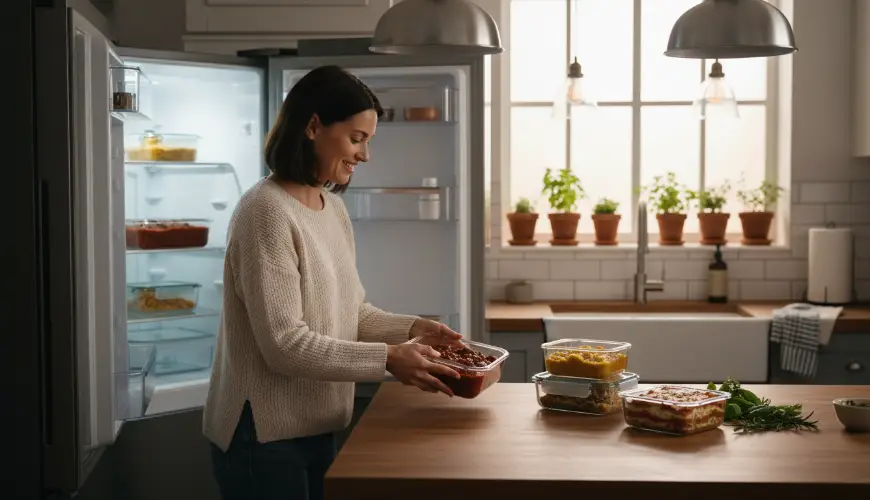
There is a special kitchen magic that happens overnight. A pot of goulash taken off the stove in the evening, a bowl of lentil soup slid into the fridge, a tray of lasagne wrapped in foil – all these dishes have one thing in common. The next day they taste more pronounced, fuller and deeper, as if cooked by someone else entirely. This is no coincidence, nor a romantic myth of experienced cooks. Real chemistry lies behind this phenomenon – fascinating processes that continue in food even after cooking has finished.
Anyone who has ever reheated leftover svíčková or had a plate of tomato sauce from the day before knows the feeling. That sense that the food has somehow "ripened". And they are right – literally. Understanding why this happens can fundamentally change one's approach to cooking and meal planning throughout the week.
Try our natural products





Why does food taste different – and better – the next day?
The key is time and the chemical processes that make use of it. When food cools down and spends several hours in the fridge, what is known as flavour maturation takes place – experts speak of retrograde starch gelation, diffusion of aromatic compounds and the deepening of reactions between individual ingredients. Put simply: spices, herbs, fats and other components get enough time to "get to know" each other and meld together.
Goulash is a classic example of this. Paprika, caraway, onion and meat may spend hours together during cooking, but it is only during slow cooling and subsequent resting that the individual flavours truly unify. The fat released from the meat during cooking becomes a carrier of aroma and evenly coats every piece. The sauce thickens and the flavours concentrate. The result? In the morning, the goulash is noticeably better than it was the evening before.
A similar principle applies to acidic dishes, such as various marinades, pickled vegetables or lentil dishes with vinegar. Acid helps break down the cell walls of ingredients and allows flavours to penetrate more deeply. This is why lentils with vinegar or bean salad with garlic and lemon reach their best form on the second day, when the acid has had time to complete its work.
According to research published in the journal Food Chemistry, the Maillard reaction – the browning of proteins and sugars at high temperatures – also plays a key role in flavour maturation, as its products continue to break down during the food's resting period and form new, more complex aromatic compounds. In other words, cooking is only the first chapter of the story. The rest is written in the fridge.
Recipes worth preparing a day in advance
Once you understand which dishes benefit most from maturation, you start thinking about cooking in an entirely different way. Preparing food ahead of time ceases to be a necessity born of time pressure and becomes a deliberate strategy for achieving better flavour. Here are the best candidates.
Beef or pork goulash is the king among dishes that taste better the next day. The secret lies in plenty of onion, quality paprika and slow cooking. The onion must first be thoroughly fried until golden – this is a foundation that cannot be skipped. Only then comes the meat, paprika and braising. After cooking, allow the goulash to cool completely and transfer it to the fridge. The next day, simply reheat slowly and serve – the difference in flavour will be immediately apparent.
A similar principle applies to Asian-style braised dishes – for example, beef or tofu in hoisin sauce with ginger and garlic. Soy sauce, which is naturally rich in glutamates, penetrates every fibre of the meat or every piece of tofu overnight and creates a complex umami flavour that is difficult to achieve when serving directly after cooking.
Bolognese sauce is another dish in which patience is rewarded. Classic bolognese is cooked for hours, but it is only after an overnight rest in the fridge that the tomatoes, wine, carrot and meat fully unite. Italian nonnas knew this long ago – which is why in traditional families, bolognese was always cooked a day in advance. The same principle applies to lasagne, where the layers of pasta, béchamel and sauce also connect perfectly during resting, so that when reheated the dish holds together beautifully rather than falling apart.
Among soups, lentil soup with spices, minestrone and bean soup with smoked meat stand out in particular. Legumes have the advantage of absorbing liquid and spices during resting, becoming creamier and more flavourful. If you add a little lemon juice and fresh coriander to lentil soup at the end of cooking, the flavour will be even more pronounced and fresh the next day.
A less obvious but equally convincing example is marinated salads – such as classic coleslaw made from red cabbage with carrot and apple. Although it tastes good when freshly prepared, after an overnight rest in the fridge the cabbage softens, the flavours meld and the dressing is absorbed. The result is fuller and more harmonious. The same applies to Greek salad with olives and feta, where the salt from the feta gradually permeates the vegetables and creates a natural marinade.
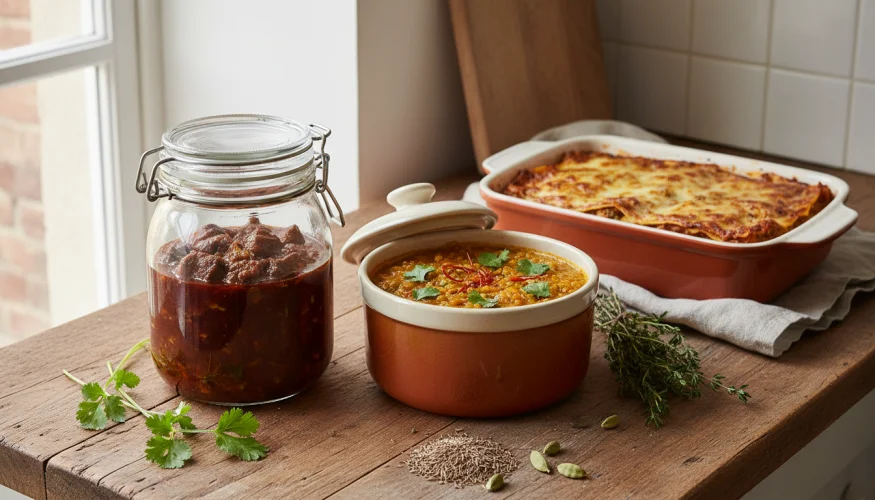
Curry dishes form a special category of their own – whether Indian lentil dahl, Thai green curry with coconut milk or Moroccan tagine. Complex spice blends such as turmeric, coriander, cumin, cardamom or cinnamon need time to connect with one another and lose any potential harshness. A freshly cooked curry can seem slightly unbalanced, but the next day all the notes unify into a harmonious whole. As the Indian proverb goes: "Good curry is cooked twice – once on the stove and once in time."
Practical tips for cooking ahead
Preparing food several days in advance is not just about flavour – it is also about efficiency and a sustainable approach to the household. Less waste, less energy consumed through repeated cooking, less stress on weekdays. This is precisely why this approach to cooking is closely aligned with the philosophy of mindful and sustainable consumption, which is becoming an increasingly important part of everyday life.
For food to genuinely taste better the next day and remain safe to eat, a few basic rules apply. Food should cool before being stored in the fridge, ideally to room temperature, and within no more than two hours of cooking – as recommended by the British Food Standards Agency, for example. Hot food placed directly in the fridge unnecessarily strains the appliance and can disrupt the temperature of surrounding foods. Store in sealed containers to prevent the transfer of odours and to retain the dish's moisture.
When reheating, it is essential to warm the food evenly and thoroughly – ideally in a pot over a low heat with occasional stirring, rather than in a microwave, which heats unevenly and can disrupt the texture of sauces or soups. If the food is too thick, simply add a little water, stock or coconut milk to adjust the consistency.
An interesting strategy is also deliberately cooking "excess quantities" – in English this approach is known as batch cooking. Instead of cooking every day, it is enough to prepare larger portions of maturing dishes once or twice a week and simply reheat them for the rest of the week. A family with children who tries this will quickly find that the evening chaos around cooking is significantly reduced and the food is paradoxically better than when prepared fresh each day.
One real-life example to illustrate: Markéta, a thirty-four-year-old mother of two from Brno, began cooking a large pot of lentil curry and a tray of lasagne every Sunday. Monday and Tuesday lunches were thus taken care of without a single minute of cooking, while the whole family ate noticeably better than when she cooked tired after arriving home from work. She also found that she had less food left to throw away – the lentil curry kept in the fridge for up to four days without any loss of quality.
It is worth noting that not all dishes benefit from an overnight rest. Fried foods, fresh leafy green salads, dishes with a crispy texture, or dishes with a high water content such as courgettes or cucumbers generally lose quality by the next day. The rule is simple: the more spices, sauce and fatty or starchy components a dish contains, the better it tolerates maturation.
Legumes, braised meat, tomato- or coconut milk-based sauces, soups, curries and baked dishes – these are the categories worth investing time in once, so that they reward you two or three times over. And if you want to go a step further, try using higher-quality ingredients in these dishes – organic spices, locally grown vegetables or ethically raised meat. The quality of the starting ingredients is further amplified during flavour maturation, because there is more to develop.
Cooking ahead and consciously making use of the flavour maturation phenomenon is, in effect, a small revolution in the kitchen – quiet, understated, but all the more convincing for it. All it takes is a little replanning, cooking a little more than usual, and then simply being surprised by what the fridge can achieve overnight.