
# How to Recognize Dyslexia in a Child Before School Does
Every parent wants what's best for their child – and this is doubly true the moment they begin to sense that something is wrong. The child is bright and curious, capable of spending hours assembling puzzles or telling elaborate stories, but whenever a book or pencil enters the picture, something gets stuck. Parents initially put this down to age, laziness, or simply the idea that "reading will come in time." But dyslexia is not a question of effort or intelligence – and the sooner it is identified, the better for the child and the whole family.
Schools do have systems for catching difficulties with reading and writing, but the truth is that formal diagnosis often comes only in second grade, sometimes even third. That is two or three years during which a child may needlessly struggle, lose confidence, and become convinced that they are simply "not cut out for school." Yet there are clear signals that parents can pick up on much earlier – before school even begins, or in the very first months of instruction.
Try our natural products



Signals parents can pick up on very early
Dyslexia does not appear overnight the moment a child is handed a primer. Its roots run deeper, and the first hints are visible in the preschool years – if we know what to look for. One of the earliest warning signs is delayed or unusual speech development. A child with dyslexia often muddles words, mixes up their order, or struggles with pronunciation that comes easily to other children of the same age. This does not mean that every child with a speech difficulty has dyslexia – but recurring problems with the rhythm, length, and sound structure of words are worth paying attention to.
A very telling indicator is also how a child engages with nursery rhymes and poems. Preschool children generally take to them readily and enjoy repeating their rhythm. A child with dyslexia may have surprisingly persistent trouble with this seemingly playful activity – struggling to catch a rhyme, muddling the order of syllables, or failing to remember even a short verse. Specialists refer to this as reduced phonological awareness, and it is one of the most reliable early indicators of dyslexia. Research published in journals such as Dyslexia has repeatedly confirmed that phonological language processing is a key predictor of later reading difficulties.
Another signal that parents can easily overlook is difficulty remembering the names of letters, digits, or colours. While peers pick up colours and numbers relatively quickly and without much effort, a child with dyslexia must repeat them again and again – and still gets them confused. This is not a lack of attention or interest. The brains of these children simply process linguistic symbols in a different way.
A telling real-life example is the story of a family from Brno, where the mother of six-year-old Eliška noticed that her daughter – despite loving fairy tales and being able to retell entire stories from memory – refused any activity involving letters. When being read to, she always preferred the pictures, and her descriptions of what she saw on the page were far richer than any attempt to recognise a word. The mother initially put this difference down to temperament, but after a conversation with an educational psychologist it emerged that Eliška displayed classic signs of dyslexia. Thanks to early intervention, she started school with clearly defined support in place, and first grade was not a trauma for her but a manageable challenge.
What to watch for in the first months of school
Starting school brings new stimuli – and with them new opportunities to recognise dyslexia. A child with dyslexia typically struggles to connect letters and sounds – the so-called phoneme blending that underpins reading. While classmates begin to sound out syllables and gradually build words, a child with dyslexia seems unable to grasp this mechanism. Reading does not come even after repeated practice, and every reading lesson is exhausting.
Parents may also notice that the child confuses visually similar letters – most commonly b and d, p and q, or m and n. This mirror-image writing is one of the best-known signs of dyslexia, though it is not sufficient on its own for a diagnosis. What matters is whether these reversals persist after a longer period of instruction, by which point a child without difficulties would have overcome them.
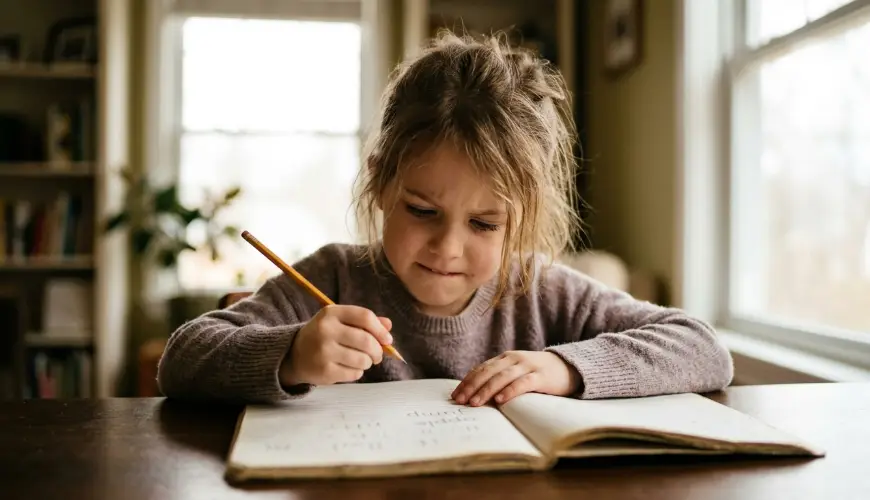
It is equally worth paying attention to how the child manages writing. A child with dyslexia often omits or adds letters, writes words backwards, or is unable to maintain the correct order of sounds within a word. The results of dictations or copying exercises look inconsistent and seemingly random, even though the child is concentrating and trying their hardest. This very gap between effort and outcome is confusing for parents and teachers alike, and unfortunately sometimes leads to the mistaken conclusion that the child is lazy or inattentive.
As Czech specialist in specific learning difficulties PhDr. Olga Zelinková puts it: "Dyslexia is not an inability – it is a different way of processing information that requires a different way of teaching." This perspective is essential for every parent encountering this topic.
Beyond reading and writing, dyslexia also manifests in less expected areas. A child may have difficulty with time orientation – confusing concepts such as "yesterday" and "tomorrow," being unable to remember the days of the week or the months of the year. Difficulties may also appear when learning poems or song lyrics, when following verbally given instructions, or when memorising phone numbers and addresses. All of these seemingly unrelated difficulties share a common denominator: the brain of a child with dyslexia processes linguistic and symbolic information by a different route.
Parents sometimes ask whether they might be confusing dyslexia with another problem – such as an attention disorder or developmental delay. It is true that these difficulties can overlap, and that dyslexia sometimes co-occurs with ADHD or dyscalculia. It is therefore important not to draw conclusions on the basis of a single symptom, but to observe the overall picture and, in case of doubt, to seek professional advice. Educational and psychological counselling centres in the Czech Republic offer assessment and guidance free of charge, and parents can approach them at any time – no referral from the school is required.
Why early identification matters more than we think
The brain of a child in the preschool and early school years is extraordinarily plastic. This means that interventions carried out during this period have a significantly greater effect than the same methods applied to an older child or an adult. The sooner a child receives the right support, the better equipped they will be to learn compensatory strategies – ways of working with their differences so that those differences do not stand in the way of achievement.
Without timely help, the situation unfortunately unfolds differently. A child who year after year struggles with reading and receives poor marks despite every effort very quickly develops the belief that they are stupid or inferior. This belief then shapes their entire academic and personal self-concept. Research shows that children with unrecognised dyslexia are significantly more at risk of school anxiety, school refusal, and, in later years, depressive states. This is not inevitable – but it is a real risk that can be prevented.
Early identification of dyslexia also changes the dynamic between parent and child. A parent who understands why their child is struggling with reading is able to offer patience and understanding instead of frustration. Homework ceases to be a daily source of conflict and becomes a space for collaboration. That alone is of enormous psychological benefit to the child.
There are well-established methods for working with children with dyslexia both at home and at school. Structured phonics programmes, multisensory learning, and working with audiobooks can all make a significant difference. What matters, however, is that this support is grounded in a diagnosis and in the individual needs of the specific child, rather than in generic advice downloaded from the internet. This is why collaboration with a specialist – whether an educational psychologist, a special education teacher, or a speech therapist – is irreplaceable.
Parents who suspect dyslexia should not wait for the school to name the problem itself. Schools are overstretched, and teachers do not always have the capacity to attend to the individual differences of every pupil with the necessary depth. A parent is the first and most important observer of their child – and it is the parent who will notice deviations first, because they know the child best.
So if several of the signals described above keep appearing in a child's behaviour or performance – difficulties with rhyming and nursery rhymes, letter reversals, trouble remembering symbols, slow and laboured reading, or a marked disparity between spoken and written performance – it is time to act. The aim is not to label the child or to limit them in advance. The aim is to give them the tools they need to show what they are truly capable of. And today, fortunately, there are more of those tools than ever before.