

# Effects of Rice Water on Digestion, Skin, and Healthy Hair
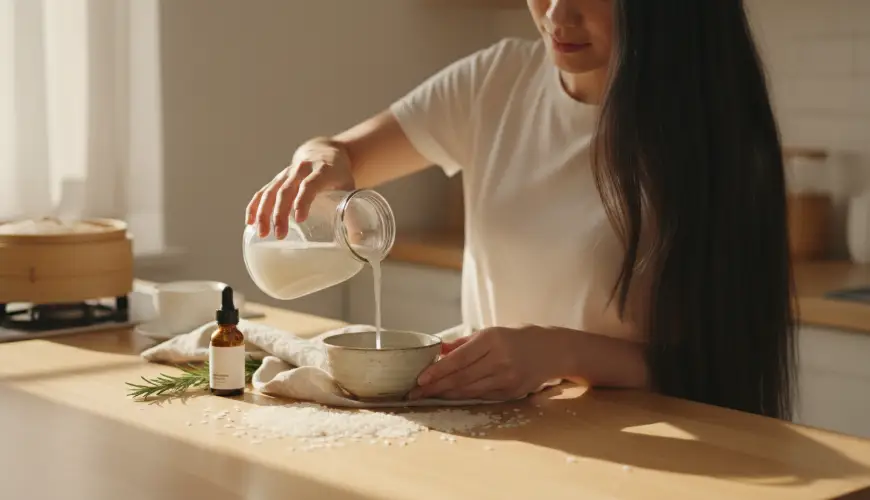
There are things that people have been doing for centuries as a matter of course, without realizing there is real science behind them. One of these is rice water – a liquid that arises as a by-product of preparing one of the world's most widespread foods, and yet contains a surprising amount of beneficial substances. In Asia, rice water has been used since time immemorial both for consumption and for hair and skin care. Today, this practice is returning to the forefront of interest in the West as well, and for good reason.
One need only look at the village women of Yuzuihara in Japan, or the women of the Yao tribe from China's Guangxi province, whose hair grows to lengths of over two meters and remains healthy and lustrous well into old age. Their secret? Regular rinsing of their hair with fermented rice water. This practice attracted the attention of scientists and the cosmetics industry, and gradually began to be discussed in the media and academic studies. It is no wonder, then, that rice water is coming to the forefront of interest among people seeking natural alternatives to chemically laden products.
Try our natural products
What rice water actually is and what it contains
Rice water is a simple matter – it is created by soaking or cooking rice in water. Although it may seem at first glance like nothing more than a cloudy liquid of little value, the opposite is true. During the soaking or cooking process, a whole range of valuable substances pass into the water. These include B vitamins such as thiamine (B1), riboflavin (B2) and niacin (B3), as well as vitamin E, amino acids and minerals including zinc and magnesium. A key component is inositol – a natural carbohydrate that demonstrably supports cell growth, slows damage to the hair shaft and helps restore its structure.
Inositol is remarkable in that it can penetrate into the damaged part of the hair and act there even after it has been rinsed out. This makes rice water one of the few natural remedies whose effect persists even after washing off. This property was confirmed, for example, by a study published in the International Journal of Cosmetic Science, which examined the effect of inositol on damaged hair and demonstrated its ability to reduce friction and strengthen the hair shaft.
In addition to inositol, rice water also contains ferulic acid – a powerful antioxidant that protects cells from oxidative stress and slows the aging process. Combined with vitamin E, rice water thus offers comprehensive protection for both the scalp and the hair shafts themselves. And it is precisely this combination of substances that makes rice water a tonic with genuine merit in hair care, rather than merely a passing trend.
Preparing rice water could not be simpler. The basic method involves soaking a cup of white or brown rice in two to three cups of water for 30 minutes to one hour. The rice is then strained and the resulting liquid is ready for use. For a more intensive effect, fermented rice water is recommended, which is made by leaving the soaked rice at room temperature for one to two days. Fermentation increases the nutrient content and changes the pH of the water so that it better matches the natural pH of the skin.
Rice water as a tonic for hair and skin
The women of the Yao tribe, also mentioned by National Geographic, have been rinsing their hair with fermented rice water since childhood. The result is hair that retains its natural color and density even past the age of seventy – without the use of any commercial products. This real-life example is perhaps the most compelling argument for trying this ancient ritual.
How does rice water work on hair in practice? After washing hair with shampoo, rice water is applied as a final rinse or as a tonic that is rinsed out after a few minutes. It can also be applied directly to the scalp using a spray bottle and gently massaged in. Regular use contributes to the smoothness of the hair shaft, makes combing easier and gives hair a natural shine. Hair feels softer and more supple after application, because the proteins in rice water temporarily fill in small cracks on the surface of the hair shaft.
Beyond hair, rice water has also proven itself as a facial tonic. In traditional Japanese cosmetics, where it is known as bijin-nuka, geishas used it to cleanse and soften the complexion. Modern research confirms that rice water can help with problems such as eczema or dermatitis – the National Institutes of Health (NIH) references studies that have demonstrated the soothing effects of rice water on irritated skin. It is applied simply with a cotton pad like a classic toner, or added to a bath.
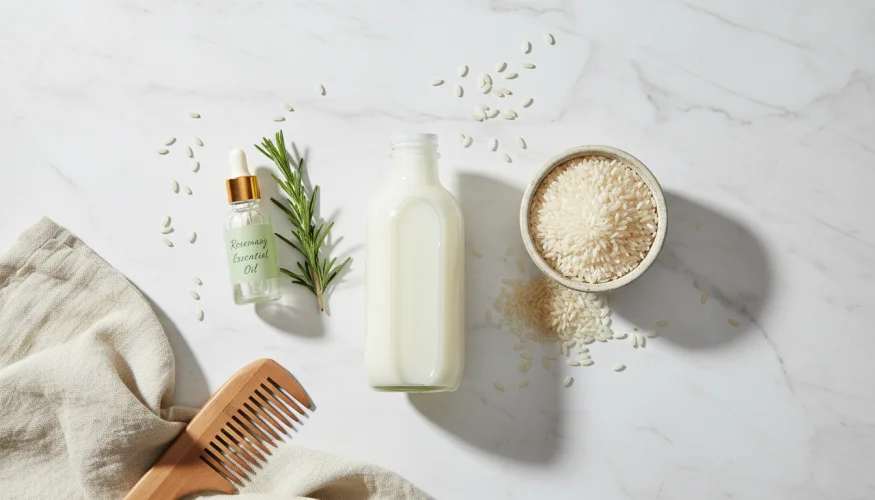
Fermented rice water has a significantly higher nutrient content and lower pH than fresh rice water, meaning it better seals the hair cuticles and contributes to the overall vitality of the hair shaft. Its scent may be more intense at first – slightly more sour – but this can be mitigated by adding a few drops of essential oil, such as lavender or rosemary. Rosemary oil is itself considered one of the most effective natural remedies for promoting hair growth, so this combination makes real sense.
As dermatologist Dr. Iris Rubin said in an interview for Healthline magazine: "Rice water is not a miracle cure, but it is one of the few natural remedies for which there is a scientific basis for the claim that it genuinely strengthens the hair shaft." These measured yet positive assessments from experts are precisely what sets rice water apart from many other social media trends that promise miracles without any scientific foundation.
Rice water as a healthy drink
Less well known, but equally interesting, is the use of rice water as a beverage. In many Asian countries, from India to Japan to Thailand, rice water is among the traditional home remedies for digestive problems, diarrhea or nausea. And modern medicine largely confirms this practice.
Rice water helps with diarrhea by supplying the body with electrolytes while also soothing the intestinal lining. The World Health Organization (WHO) has previously recommended it as part of oral rehydration therapy, precisely because the starch contained in rice water slows intestinal peristalsis and reduces fluid loss. It is therefore a natural, inexpensive and readily available remedy that can be particularly useful in situations where a person feels unwell and needs gentle support for digestion.
As a drink, rice water is best prepared by boiling – the rice is cooked in twice the usual amount of water, and the resulting liquid is then poured off. Rice water prepared this way has a slightly creamy consistency and a neutral flavor that can be enhanced with a little ginger, lemon juice or honey. It can be drunk warm or cold, with the warm version being more suitable for digestive complaints and colds.
From a nutritional standpoint, rice water as a drink offers a quick source of energy thanks to its carbohydrate content, while being easily digestible and not burdening the digestive tract. For people recovering from illness, or for young children with sensitive stomachs, rice water can be a welcome alternative to heavier foods. It is also naturally gluten-free, which is appreciated by people with celiac disease or gluten sensitivity.
The most common uses of rice water as a drink include:
- for diarrhea and digestive problems – soothes the intestinal lining and replenishes fluids
- for nausea – especially in combination with ginger
- as a light energy drink – suitable after physical exertion or during convalescence
- as a morning drink on an empty stomach – used in traditional Ayurvedic medicine for detoxification and kickstarting the metabolism
It is important to note that rice water is not a substitute for a balanced diet or medication. It is a supplementary remedy whose strength lies in its simplicity and naturalness. For most healthy adults it is safe, and it is advisable to choose quality rice – ideally organic and pesticide-free – so that the resulting liquid does not contain any undesirable substances.
Interestingly, in recent years rice water has also been appearing in the range of healthy beverages and cosmetic products on the market. Cosmetic brands are adding it to shampoos, conditioners and facial serums, while beverage manufacturers are experimenting with fermented rice water as an alternative to probiotic drinks. This demonstrates that interest in this traditional remedy extends beyond the boundaries of home kitchens and is becoming part of a broader trend of returning to natural and sustainable solutions.
Whether a person is drawn by the possibility of improving the condition of their hair, supporting digestion, or simply trying something that has worked in other cultures for centuries, rice water offers surprisingly much for surprisingly little. It requires no special ingredients, complex equipment or major investment – just a little rice, water and a willingness to look beyond the ordinary. And that is perhaps the most compelling reason to give it a try.