

# How to Sweeten More Healthily and Why No Sweetener Is a Universal Solution for Everyone
Sweet World Without Illusions: What You Should Know About Sugar, Artificial and Natural Sweeteners
Few topics in the field of nutrition spark as much passion as the question of what to actually sweeten with. On one side stands classic white sugar, on the other a whole army of substitutes with labels like "healthier," "natural," or "calorie-free." Store shelves are filling up with stevia, erythritol, xylitol, agave syrup, and saccharin – and the average consumer can easily get lost in it all. What is truly the better choice? Does something like an ideal sweetener even exist? And is sugar really as big an enemy as is often claimed? Let's take a look at this without unnecessary myths, but with a bit of common sense.
Try our natural products
Sugar has a millennia-long history in the human diet. Originally, it was a luxury commodity – cane sugar traveled along the Silk Roads, and in Europe only the wealthiest could afford it. Today the situation is exactly the opposite. The average Czech consumes around 36 kilograms of sugar per year, a number that would probably shock our ancestors. The World Health Organization recommends that added sugars make up no more than 10% of total energy intake, and ideally less than 5%. For an adult, that corresponds to roughly 25 grams per day – about six teaspoons. When you realize that a single can of sweetened soda contains around 35 grams of sugar, it's clear that you can exceed the daily limit with literally one sip.
The problem, however, isn't sugar itself. Glucose is the basic fuel for our cells, and the brain needs it to function like a car needs gasoline. The trouble arises when we consume it in excess and in a form that our body cannot process without consequences. Refined white sugar – that is, sucrose – is a chemically pure substance stripped of all accompanying nutrients. The body absorbs it in a flash, blood glucose levels spike sharply, the pancreas responds with a massive release of insulin, and before long another wave of hunger arrives. This cycle, repeated day after day, year after year, contributes to the development of obesity, type 2 diabetes, cardiovascular diseases, and according to some studies, even chronic inflammatory processes in the body. As American endocrinologist Robert Lustig aptly noted: "Sugar isn't toxic because it contains calories. It's toxic because of what it does to our metabolism."
It is precisely because of these risks that people are increasingly turning to alternatives. And this is where the interesting part of the story begins, because the differences between sugar, artificial sweeteners, and natural sweeteners are far more nuanced than marketing slogans on product packaging might suggest.
Artificial Sweeteners: Salvation or Another Problem?
Artificial sweeteners entered the scene as a miraculous solution for everyone who wanted sweet taste without calories. Saccharin, discovered by accident as early as 1879, was the first in a series of synthetic compounds capable of fooling our taste buds. It was followed by cyclamate, aspartame, acesulfame potassium, and sucralose – each with a different taste profile, a different degree of sweetness, and a different story in the media.
Aspartame is probably the most controversial of the entire group. It is approximately two hundred times sweeter than sugar and is used in thousands of products worldwide – from diet sodas to chewing gum to certain medications. In 2023, the International Agency for Research on Cancer (IARC) classified it as a "possible carcinogen for humans," which triggered a wave of concern. But context is key: the same category includes, for example, aloe vera or night shift work. The European Food Safety Authority (EFSA) has repeatedly confirmed that when the acceptable daily intake is observed – that is, 40 mg per kilogram of body weight – aspartame is safe. For a person weighing 70 kilograms, that would mean drinking approximately 12 cans of diet soda per day, which surely no one regularly does.
Nevertheless, there are legitimate questions that go beyond acute toxicity. Some research suggests that artificial sweeteners may disrupt the gut microbiome – the community of trillions of bacteria in our digestive tract that play a key role not only in digestion but also in immunity and mental health. A study published in the prestigious journal Cell in 2022 showed that saccharin and sucralose can alter the composition of gut microflora in some people and affect glycemic response. In other words – the sweetener may contain no calories, but the body may not react to it as neutrally as we would expect.
Another widely discussed phenomenon is the so-called sweet taste paradox. The brain registers sweetness, expects the arrival of energy, but it never comes. Some theories claim this can lead to increased appetite and ultimately to higher calorie intake from other sources. Research in this area is still inconclusive – some studies confirm this effect, others do not. What does seem fairly clear, however, is that simply substituting sugar with artificial sweeteners is not enough for a person to lose weight or become healthier unless they change their overall approach to food.
Natural Sweeteners: The Golden Middle Ground?
When people hear "natural sweetener," most imagine honey. And that's logical – honey has accompanied humanity since prehistoric times, contains enzymes, antioxidants, trace minerals, and has proven antibacterial properties. However, in terms of sugar content, it differs from ordinary sucrose less than we might like. Honey contains approximately 80% sugars (mainly fructose and glucose), and its glycemic index is around 58, while white sugar's is about 65. The difference exists but is not dramatic. A spoonful of honey in tea is certainly a better choice than a spoonful of sugar, but five spoonfuls of honey a day won't save your health.
A similar story repeats with maple syrup, which comes from maple sap and contains interesting amounts of manganese, zinc, and antioxidants. Or with coconut sugar, made from the nectar of coconut palm flowers, which has a somewhat lower glycemic index than regular sugar and contains small amounts of inulin – a fiber that may support gut health. Agave syrup, once celebrated as a superfood, has meanwhile come under fire for its extremely high fructose content – up to 90%. Excessive fructose intake burdens the liver, which can contribute to the development of non-alcoholic fatty liver disease, so even this "natural" sweetener should be used with caution.
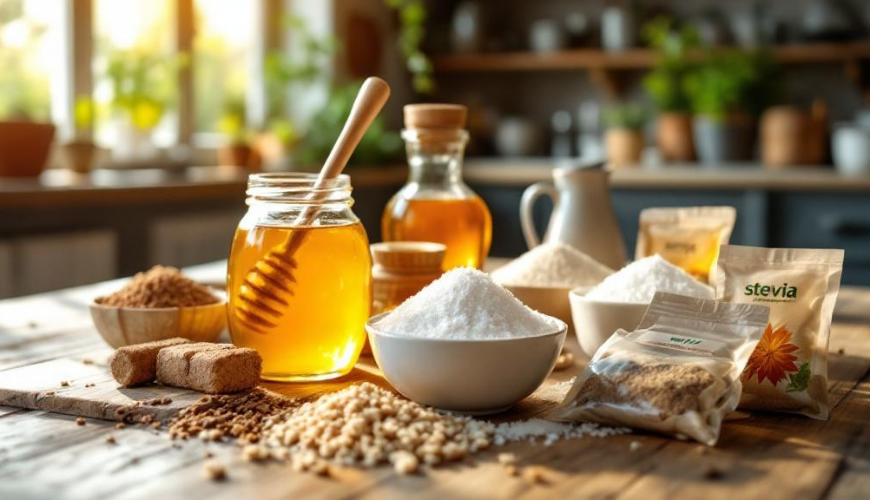
An entirely different category is represented by sweeteners that, while derived from nature, behave more like artificial ones – meaning they sweeten intensely and with virtually no calories. The queen of this group is stevia, or more precisely steviol glycosides extracted from the leaves of the plant Stevia rebaudiana. Stevia is 200 to 300 times sweeter than sugar, does not affect blood glucose levels, and has no caloric value. For diabetics and people trying to reduce their weight, it can truly be an excellent choice. Its weakness is a specific aftertaste – some people perceive a bitter or licorice undertone that bothers them. Quality also varies significantly from product to product; pure rebaudioside A extract tastes different from a cheap powder mixed with maltodextrin.
The category of natural sweeteners with low caloric value also includes sugar alcohols – erythritol, xylitol, sorbitol, and maltitol. Despite their name, they do not contain alcohol in the common sense of the word; it refers to a chemical structure. Erythritol has become extraordinarily popular in recent years because it contains only 0.2 calories per gram (compared to 4 calories for sugar), does not affect blood sugar, and does not cause tooth decay. Xylitol is similar, and there is also evidence that it actively inhibits the growth of cavity-causing bacteria – which is why you'll find it in many toothpastes and chewing gums. It is important to know, however, that sugar alcohols can cause digestive issues in sensitive individuals – bloating, diarrhea, and abdominal cramps, especially at higher consumption levels. It should also be mentioned that xylitol is highly toxic to dogs, so if you have a four-legged companion at home, keep products containing xylitol out of their reach.
A practical example from everyday life can illustrate the whole issue well. Imagine Martina, a thirty-year-old woman who decided to cut back on sugar. In the morning, she used to put two teaspoons of white sugar in her coffee, switched to stevia, and saved about 30 calories per day. But then she discovered that with her afternoon coffee she started buying a "healthy" bar sweetened with agave syrup and dates that contained 18 grams of sugar. Her total sweet intake paradoxically didn't change – it just shifted from one source to another. Martina's story shows something essential: more important than the type of sweetener is the total amount of sweetness in the diet and the ability to recognize where sugar is hiding.
And it truly hides everywhere. In ketchup, in bread, in yogurts labeled as "fitness," in breakfast cereals, in instant sauces, and even in some meat products. The food industry uses dozens of names for various forms of sugar – glucose-fructose syrup, maltodextrin, dextrose, invert sugar, barley malt – and for an uninformed consumer, it is nearly impossible to recognize them all. That's why one of the most effective steps toward healthier eating is simply learning to read labels and favoring foods with the shortest possible list of ingredients.
If you're looking for a practical guide on what to replace sugar with in the kitchen, here is a brief overview of options arranged by suitability for different situations:
- Stevia – ideal for beverages and desserts where you don't need the volume of sugar, only sweetness
- Erythritol – suitable for baking, where it partially replaces the volume of sugar; does not caramelize
- Xylitol – good for baking and beverages, closest to sugar in taste; watch the amount due to digestion
- Honey – great for dressings, marinades, and teas, but count the calories
- Maple syrup – interesting flavor for pancakes, oatmeal, or baking
- Coconut sugar – can be used as a white sugar substitute in a 1:1 ratio; has a caramel flavor
- Date syrup or paste – excellent for smoothies and raw desserts; contains fiber
Each of these alternatives has its advantages and limitations, and none of them is a universal solution. The key is to understand that switching to a "healthier" sweetener is not the same as reducing dependence on sweet taste. Our taste buds are remarkably adaptable – if we gradually reduce the intensity of sweetness in food, within a few weeks we adjust and begin to perceive the natural sweetness in fruits, vegetables, and nuts much more intensely.
The science of sweeteners is still evolving, and what we consider safe today may be reassessed in ten years – and vice versa. What doesn't change, however, is the fundamental principle: moderation and variety are the best strategy. There is no need to demonize sugar or blindly believe every new "super-natural" sweetener. It's enough to be informed, read product labels, listen to your own body, and remember that a truly healthy lifestyle doesn't rest on a single ingredient but on an overall approach to what we eat, how we move, and how we take care of ourselves.