
You can easily prepare fruit-scented preserves from plums, pears, and apples.
Fruit preserves hold a special place in Czech cuisine. They aren't just "some" sweet spread for pastries – they are concentrated fruit, the scent of late summer, and proof that something exceptionally good can be created without unnecessary additives. When you say plum preserves, most people think of pies, dumplings, or hearty pastries. But preserves aren't just made from plums, and it's certainly not true that their preparation has to be complicated or full of sugar. There are also pear preserves and apple preserves, each with its own character – milder, more fragrant, sometimes almost caramel-like. Perhaps it's their subtlety that makes them such a pleasant ingredient in a modern, healthier-leaning kitchen.
In a time when food waste is increasingly being addressed and more sustainable household practices are being sought, preserves are making a comeback. Surplus fruit from the garden, a box from the farmer, or even "uglier" fruits that would remain unsold can have a second life. Moreover, well-prepared preserves are naturally sweet, often *without the need to add refined [sugar](https://www.ferwer.cz/lexikon/latka/cukr)*, and thanks to long cooking, they last a really long time.
Why preserves aren't just a sweet childhood memory
Preserves are sometimes confused with marmalade or jam, but the difference is fundamental. Preserves are made by long, slow thickening of fruit – ideally without unnecessary additives. It's not about quick boiling with pectin, but patience, during which water evaporates from the fruit and the flavor naturally concentrates. The result is a dense, dark mass with a strong aroma and often a slightly caramel tone.
A simple sentence, which appears in various forms across cookbooks, aptly describes how to view preserves even today: "The less you add to the preserves, the more fruit there will be in them." And that's what's beautiful about them – clear ingredients and honest taste.
From a nutritional perspective, it's worth considering preserves as both a sweetener and an ingredient. A teaspoon in oatmeal, a few stirred-in streaks in white yogurt, or a thin layer on a pancake is sufficient. Since preserves are concentrated, there's often no need to add more sugar. And when made from well-ripened fruit, they can be surprisingly sweet on their own.
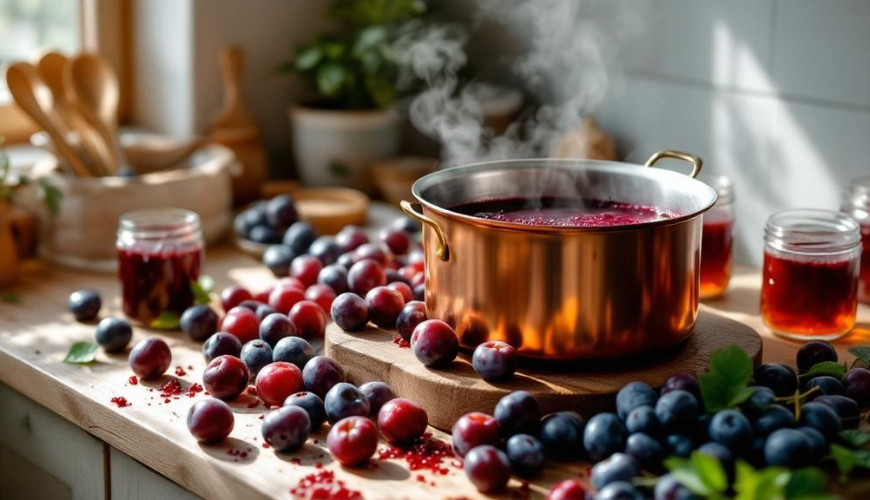
Anyone who has experienced an autumn afternoon in a kitchen where a pot of plums is slowly simmering on the stove knows that preserves are also about atmosphere. In real life, it often looks like this: the family brings a crate of overripe plums from the orchard, some are eaten immediately, some end up in a pie, and the rest would spoil without processing. Instead of throwing them away, the fruit is washed, pitted, put in a baking dish, and left to work slowly in the heat. The kitchen fills with fragrance, and suddenly the "surplus" becomes a supply for the entire winter – for pastries, sauces, or just on bread.
Preserves recipe: a basic method that works for plums, pears, and apples
When searching for a "preserves recipe," the internet offers hundreds of variants. The good news is that the basic method is surprisingly simple and can be adapted to what's available. The biggest difference lies in how watery the fruit is and how much time you give it. Preserves need time to develop their flavor.
The purest way is to simply process the fruit thermally and possibly flavor it with spices. Sugar isn't mandatory – it's often more of a habit than a necessity. With very sweet plums or pears, the resulting taste is full even without it. If added, it makes sense to use a smaller amount and a quality source (like cane sugar), but even that is a choice, not a rule.
Two methods are proven for home preparation:
- Slow baking in the oven, which minimizes sticking and stirring. The fruit cooks down and gradually evaporates water while naturally darkening and thickening.
- Cooking in a pot, which is faster but requires more frequent stirring and monitoring to prevent sticking.
In both cases, the quality of the fruit is key. Ideally, the fruit is fully ripe, even if a bit softer. On the other hand, unripe fruit has less sugar and more acidity, so the result is often flatter and tempts excessive sweetening.
Traditionally, spices like cinnamon, star anise, cloves, or a drop of rum are used. It's good to keep it simple: preserves should taste like fruit, with spices enhancing the aroma rather than overpowering it.
Plum preserves: a classic that never gets old
Plum preserves are probably the most well-known from Czech tradition. Plums have the ideal balance of sugar, acids, and pectin, so they naturally thicken and acquire a dark color. Many people make them in the oven: pitted plums are placed in a deep baking dish, can be lightly moistened (perhaps with a few tablespoons of water), and then baked at a low temperature for several hours. The time varies based on quantity and juiciness, but the magic is that the process doesn't require much intervention. Occasional stirring is enough.
Plum preserves are not only suitable for baking. They can be interestingly used in savory dishes: a teaspoon in a sauce for roasted meat or in a marinade can make the taste deeper and rounder. And for those who like the sweet and sour combination, a drop of apple cider vinegar can be added – not for the acidity itself, but for how it enhances the fruit tones.
Pear preserves: gentle sweetness and the scent of autumn
Pear preserves are often unjustly overshadowed by plum preserves, yet they can be incredibly fragrant. Pears tend to have more water, so cooking takes longer, and it's worth choosing aromatic, well-ripened varieties. The result is often lighter than with plums but gains a beautiful caramel hue with longer thickening.
Pear preserves are great where you don't want too strong a flavor. In porridge, curd, on pancakes, or as a gentle layer in Linzer cookies. And also in gingerbread – pear and cinnamon naturally complement each other. If spices are added, pears pair well with star anise or vanilla, but again, less is more.
A practical detail: pears often don't need to be peeled if they have thin skin and will be blended. For completely smooth preserves, they can be strained or blended with an immersion blender at the end. This leaves a beautifully creamy texture that spreads well.
Apple preserves: when there are too many apples and you don't want to make just cider
Apple preserves are ideal for years when there are more apples than can be eaten. Apples are available, inexpensive, and when chosen correctly, can create an excellent base. It's good to combine sweeter and more acidic varieties – the taste then isn't monotonous. Apples contain pectin, so they can thicken, but because they often have more water than plums, it requires time and patience.
Apple preserves are also excellent as an "intermediate step" for those who are a bit afraid of homemade preserves. They are less intense, so they forgive minor flavoring mistakes. They work great with a bit of cinnamon, or with lemon juice to enhance freshness. And for those who want to push the flavor further, a pinch of salt can be added – paradoxically, it helps bring out the sweetness and aroma.
Apple preserves have another advantage: they can be easily combined. When the apple base is ready, part of it can be mixed with pears or plums to create a homemade blend. For many households, this is a practical solution because fruit often ripens gradually, and there's not always enough for a full pot at once.
How to know when preserves are done?
It's not just about time. Preserves are done when they are significantly thick, hold their shape, and form a continuous layer on a spoon. When baking in the oven, a good indicator is that when stirred, the mass "tears" and a trace remains visible on the bottom of the dish for a moment. The color is darker than at the beginning and the aroma is significantly intense.
And then there's a small detail known by grandmothers: when you put a bit of preserves on a plate, there shouldn't be a watery juice around them after a while. If this happens, they need more thickening.
What influences taste more than sugar
It may surprise you that the biggest difference isn't made by sweetening, but by several other details: ripeness of the fruit, length of thickening, and method of heating. Slow heat gives the fruit time to caramelize its own sugars and develop its aroma. That's why homemade preserves are so different from quick jams – they aren't just sweet, but also deep.
If preserves are prepared more sustainably, it's worth considering energy as well. Baking in the oven can be combined with other baking (like bread or vegetables) to fully utilize the heat. And those who cook on the stovetop can choose a pot with a thick bottom and lower power – preserves don't need to boil, just simmer slowly.
The only list worth keeping handy: where to use preserves
- For baking: pastries, pies, Linzer cookies, gingerbread, turnovers
- For breakfasts: overnight oats, yogurt, curd, pancakes
- For sauces and marinades: with roasted vegetables, tofu, meat, in mustard dressings
- As a sweetener: in homemade granola, in smoothies, in tea instead of sugar
Preserves thus aren't just a "filling." In the kitchen, they function as a universal fruit concentrate that can be measured by the spoonful.
Speaking of shelf life, it's worth remembering that properly thick preserves and clean jars are essential. For those who want certainty, preserves can be briefly sterilized after filling. General principles of safe canning and hygiene are well described on the National Center for Home Food Preservation (University of Georgia) website: https://nchfp.uga.edu/ – it's one of the most cited sources for home preservation.
Finally, it's charming that preserves don't need to look perfect. A slightly rustic texture, natural color, and seasonal variability are part of the charm. Sometimes plum preserves will be as dark as night, other times pear preserves will be lighter and floral, apple preserves will remind of strudel in a single spoonful. And when a jar is opened in January, and the kitchen is filled with the scent of fruit again, it's hard not to ask: isn't this actually the most pleasant form of "quick" luxury – something homemade, simple, yet so distinctive?