
Collecting and storing your own seeds from the garden and balcony
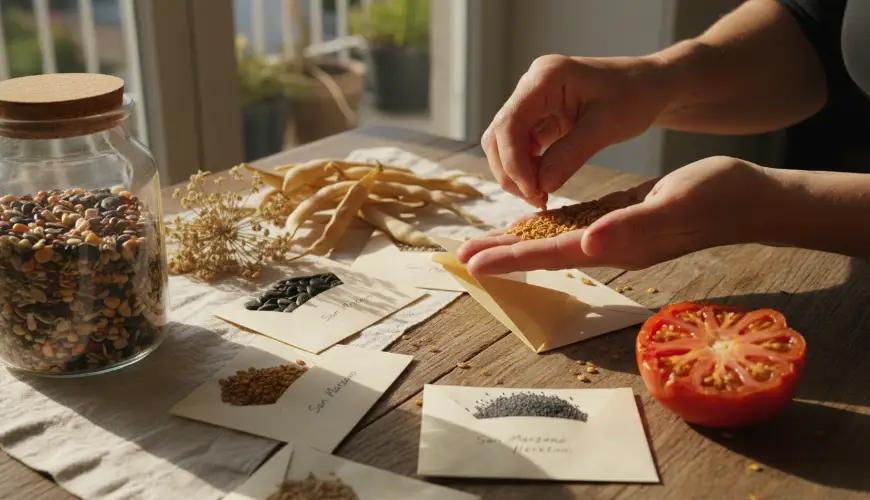
Every spring, millions of gardeners head to garden centres or browse seed company catalogues to buy seeds for the new season. Few stop to think that some of them – or even all of them – could be had for free at home, stored in small paper envelopes or jars from the previous summer. Collecting and saving your own seeds is one of the oldest agricultural skills practised by humanity for thousands of years, yet over recent decades it has almost entirely disappeared from ordinary households.
Fortunately, interest in it is awakening once more. Along with a growing emphasis on sustainable living, food self-sufficiency and ecological gardening, more and more people are realising that home-saved seeds are not just a money-saver – they are living heirlooms of varieties that carry the stories of particular gardens, climate conditions and generations of growers. And what's great: this is not a privilege reserved for those with a large garden. Collecting seeds from a balcony is just as achievable as collecting them from a bed behind the house.
Try our natural products


Why bother with your own seeds at all?
The answer is simpler than it might seem. Commercially sold seeds are reliable and well documented, but they are mostly hybrids labelled F1. These varieties deliver high and uniform yields, but seeds from their fruits will not germinate with the same characteristics the following year – or will not germinate at all. Manufacturers design them so that customers must buy them again and again. In contrast, so-called old or heirloom varieties pass their characteristics faithfully and predictably from generation to generation. It is precisely from these that it makes sense to save seeds.
There is, however, another, less obvious reason. When you grow tomatoes or basil on your balcony or in your garden year after year from the same seeds, the plants gradually adapt to local conditions – a specific microclimate, soil and watering regime. The result is a variety that is literally yours. Biologists call this local adaptation, and research by the Navdanya organisation, founded by Indian environmental activist Vandana Shiva, repeatedly shows that locally adapted varieties tend to be more resistant to disease and climate fluctuations than their industrial counterparts.
Do not underestimate the economic dimension either. A good season on a balcony with tomatoes, peppers, herbs and beans can yield enough seeds to cover the needs of an entire following season – with plenty left over to swap with neighbours or friends. Seed swaps have been growing in the Czech Republic in recent years and are becoming community events where people with a shared enthusiasm for biodiversity come together.
How to collect seeds, step by step
Before you start collecting, it is important to understand that not all plants are the same. It matters whether you are dealing with annuals, biennials or perennials, and also how a particular species pollinates. Tomatoes, peppers, beans and peas are so-called self-pollinators – they pollinate themselves, so the risk of crossing with another variety is minimal. Squash, cucumbers, basil and maize, on the other hand, are cross-pollinators and readily cross with other nearby varieties. This does not mean you cannot save seeds from them – you simply need to be more careful and, if necessary, isolate the fruits or hand-pollinate them.
The first step is choosing the right plant. Seeds should always be collected from the healthiest, strongest specimens bearing the best fruits. If you have ten tomato plants and one of them is particularly productive, drought-resistant and produces beautiful fruits, that is your ideal candidate. Never collect seeds from diseased or weak plants – you will be passing poor traits on to the next generation.
Fruits intended for seed saving must be fully ripe – ideally over-ripe. With tomatoes, this means leaving them on the plant longer than you would for eating. With peppers, wait until they have turned red or yellow to their final colour. Leave beans and peas to dry directly on the plant until the pods start to brown and rattle. With herbs such as coriander, dill or basil, wait until the seeds darken and the seed heads begin to dry out.
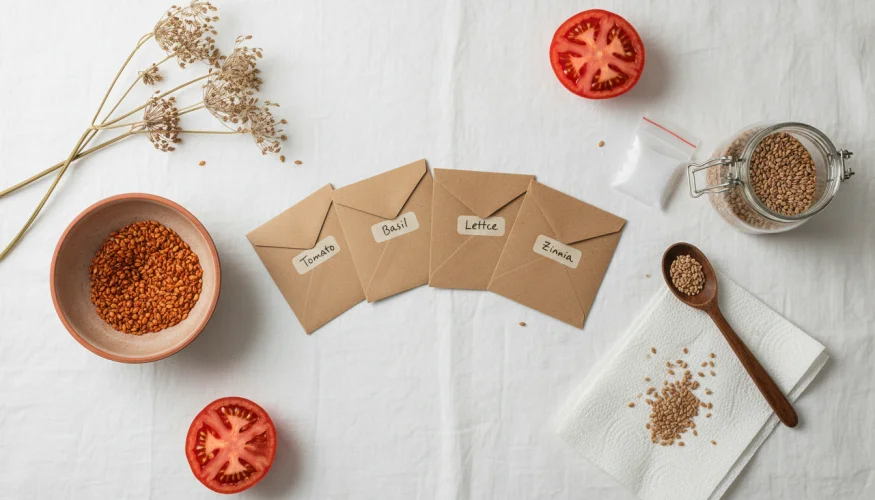
The extraction technique depends on the species. With tomatoes, the best approach is the so-called wet fermentation method: place the pulp with the seeds into a jar with a little water and leave it to ferment for 2–3 days at room temperature. Viable seeds will sink to the bottom, while empty, unsuitable seeds and pulp will float on the surface. Then pour the contents through a sieve, rinse the seeds under clean water and spread them on a paper towel or plate to dry. With peppers, squash or cucumbers, simply remove the seeds, rinse them and leave them to dry. Beans, peas, dill or basil are dried directly in their pods or seed heads, which you then shell or rub between your palms.
Drying is a critical stage that many beginners underestimate. Seeds must be truly dry before storage – otherwise mould and loss of viability are a real risk. Spread them in a thin layer on a flat surface and leave them to dry at room temperature in an airy spot, away from direct sunlight, for one to two weeks. Stir them occasionally. A good dryness test: if a seed bends rather than snaps, it is not ready yet.
Storing seeds: silence, cold and darkness are your friends
Once the seeds are dry, proper storage is the next step. The three main enemies of viability are heat, moisture and light. The ideal conditions for long-term storage are therefore a cool, dark and dry environment. A fridge or cellar are excellent choices, provided they are sufficiently dry. At temperatures of around 4–10 °C and low humidity, most seeds will retain their viability for many years.
For storage, use paper envelopes or bags – not plastic ones, because paper allows seeds to "breathe" and carries away any residual moisture. Write the variety name, the year of collection and any relevant notes about the plant on each envelope. This step is surprisingly important – in a year or two you will not remember the details. Then store the envelopes in a sealable box or jar with a lid, adding a silica gel sachet or a teaspoon of rice as a moisture absorber.
How long do seeds remain viable? That depends on the species. Onions, leeks and carrots have a viability of only 1–2 years. Tomatoes, peppers and cucumbers last 4–5 years. Beans, peas and squash retain their viability for 5–6 years when stored correctly. If you are unsure, carry out a simple germination test: place 10 seeds on a damp paper towel, roll it up and leave it in a warm spot for 7–10 days. If at least 7 germinate, the seeds are still good.
As inspiration for a systematic approach to managing seed stocks, the Seed Savers Exchange database – an American non-profit organisation that has been documenting and preserving thousands of heritage vegetable and fruit varieties since 1975 – is well worth exploring. Their methodologies are freely available and can be adapted to any household situation.
Take the example of Jana, a teacher from Brno, who started saving seeds four years ago from a single balcony measuring 4 × 2 metres. Today she has more than thirty envelopes of tomato, pepper, basil, coriander, bean and even melon seeds in her drawer. Every year she expands her "archive" and swaps seeds with friends through a local seed swap. She says that saving seeds has taught her to look at the garden differently – not as a source of food, but as a living system with its own rhythm and memory.
It is perhaps this perspective that is the most precious gift seed saving has to offer. As writer and farmer Wendell Berry said: "The care of the Earth is our most ancient and most worthy, and after all our most pleasing responsibility." Collecting and saving your own seeds is one of the most tangible ways to express that care – without the need for major investment, without a large plot of land and without complex technology.
For those who want to start but feel overwhelmed by information, the advice is simple: begin with one species. Tomatoes or beans are the ideal choice for a first attempt – they are self-pollinators, have large seeds that are easy to process, and retain their viability well. One successful collection will build confidence and the desire to continue. And in a few years you will find that your balcony or garden seed bank is one of the most precious treasures you have at home – not only for what it saves you, but for what it preserves.