

Easy bodyweight exercises for every beginner
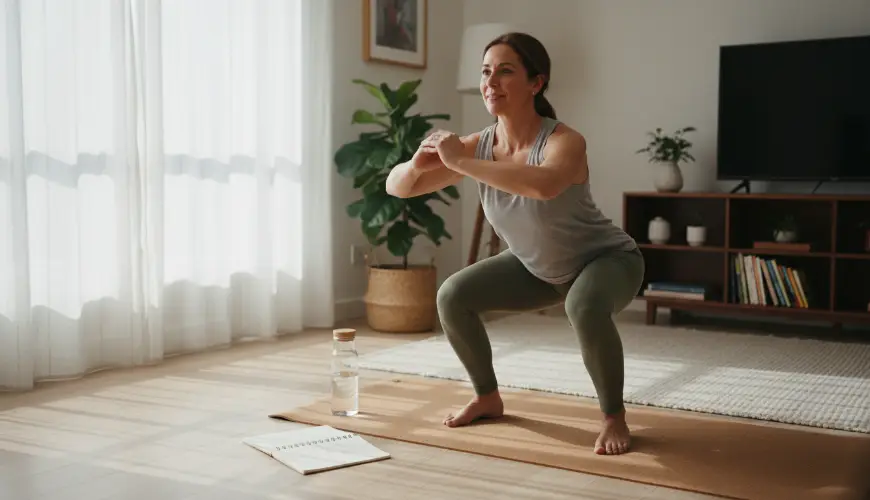
Everyone started somewhere. This sentence sounds like a cliché, but in the context of movement and fitness, it is one of the most important truths worth remembering whenever someone hesitates about entering the world of exercise. Bodyweight training is one of the most accessible forms of movement that exists – you don't need expensive equipment, a gym membership, or years of experience. And yet this very form of training is surrounded by unnecessary shame that discourages many people before they even begin.
Shame around exercise is a real problem. According to a survey by Sport England, more than a third of adults who are minimally active admit that one of the main barriers is fear of ridicule or of looking "silly". Yet bodyweight training – that is, training that uses only the weight of your own body – is precisely the type of movement that can be done at home, in a park, in a garden, or anywhere else where a person feels safe and comfortable.
So let's talk about what this form of exercise actually involves, why it is ideal for complete beginners, and how to get started with ease and without feeling like you have to prove anything to anyone.
Try our natural products


What does bodyweight training actually mean?
Bodyweight training, referred to in English as bodyweight training or calisthenics, is a way of moving in which the body works with itself. No dumbbells, no machines, no complicated equipment. Basic movements such as squats, push-ups, lunges, planks, and sit-ups form the backbone of this approach. These exercises are as old as humanity itself – soldiers, athletes, and ordinary people have been practising them for thousands of years, for one simple reason: they work.
What is particularly valuable about this approach for beginners is its scalability. Every exercise can be adapted to suit your current fitness level. A knee push-up instead of a classic push-up, a shallow squat instead of a deep one, a shortened plank – these are not compromises or failures; they are entirely legitimate variations used even by experienced athletes during rehabilitation or when returning from injury. Your body doesn't need to know whether you are exercising "correctly" according to some external standard. It needs to move, to be progressively challenged, and to rest.
Take Markéta, a forty-three-year-old accountant from Brno, who decided to start exercising after years of a sedentary job. The gym terrified her – she didn't know how to use the machines, was afraid of getting in the way, and was ashamed of her fitness level. She started at home with three exercises: a wall squat, a push-up against the kitchen counter, and marching on the spot. Within three months, she could do a regular squat, a knee push-up, and a thirty-second plank. She didn't need an instructor, she didn't pay for a membership, and no one saw her during the hardest moments. Today she exercises three times a week and says that the biggest obstacle was simply making that first decision.
How to start: without preparation, without perfection, without shame
The biggest myth around exercise goes like this: "First I'll get ready, then I'll start." People wait until they've lost weight before going to the gym. They wait until they've bought the right clothes before they start running. They wait for the right time, the right mood, the right circumstances. This waiting is the greatest enemy of movement, because the right time never arrives on its own.
Bodyweight training has the advantage of removing most of these excuses. You need nothing more than a floor and the determination to spend twenty minutes moving. Scientists from the American College of Sports Medicine have repeatedly confirmed that even short exercise sessions of ten to twenty minutes produce measurable health benefits when performed regularly. In other words – you don't need to train for an hour for it to make a difference.
For a complete beginner, the ideal approach is to start with four or five basic exercises and build a simple routine from them. Such a routine might look something like this:
- Squat (or a wall squat) – strengthens the legs, glutes, and core
- Push-up (against a wall, counter, or on your knees) – engages the chest, shoulders, and triceps
- Lunge – develops balance, leg strength, and coordination
- Plank (even just ten seconds) – stabilises the core and back
- Glute bridge – activates the gluteal muscles and releases the lumbar spine
Each exercise is enough to perform in one to two sets of eight to twelve repetitions. The entire workout takes fifteen to twenty minutes. That's all. No complex programmes, no stopwatches, no spreadsheets.
The transition to more demanding variations will come naturally as the body grows stronger and movement becomes a habit. There is no need to rush this or to compare your progress with anyone else's. As physiotherapist and movement author Kelly Starrett says: "Movement is a basic human need, not a performance to be judged."

Why shame around exercise is unnecessary – and how to overcome it
Shame around movement has deep roots. Society has long associated sport with performance, competition, and a certain type of body. Those who didn't meet these criteria felt like intruders in the world of fitness. Gyms used to be places dominated by a particular aesthetic, and for many people – especially women, older individuals, or people with higher body weight – walking into such an environment was a courageous act.
Exercising at home with bodyweight training elegantly sidesteps this problem. There is no one there to judge, comment, or compare. There is only a person and their body in a dialogue that can be surprisingly kind, if we approach it without expectations.
Psychologists working in the field of sports motivation, such as the research team from the University of British Columbia, have found that people who begin exercising in a private environment show higher long-term adherence – that is, a greater likelihood of sticking with physical activity. The reason is precisely the absence of social pressure and comparison. Without external evaluation, a person can listen to their own body, move at their own pace, and progress according to their own rules.
Shame also frequently stems from the mistaken belief that other people are watching us more than they actually are. Psychologists call this phenomenon the "spotlight effect" – the tendency to overestimate the degree to which others notice our mistakes or imperfections. In reality, people in gyms are mostly focused on themselves. And at home? This problem is eliminated entirely.
Another step towards overcoming shame is reframing what exercise means. If we perceive it as punishment for how we look, or as an obligation to meet a certain level of performance, it quickly becomes an unpleasant chore. But if we perceive it as caring for our own body – as natural as sleep, food, or rest – our entire relationship with movement changes. Exercise then isn't something we have to do. It's something we do for ourselves.
This shift in thinking is perhaps more important than any specific exercise or training plan. A body that moves from a place of self-love responds differently to one that moves out of fear or shame. Research in motivational psychology confirms this: intrinsic motivation – moving because we enjoy it or because it makes us feel good – is a far stronger predictor of long-term activity than extrinsic motivation, such as wanting to look a certain way or meet others' expectations.
In practice, this can mean something simple: choosing exercises that are enjoyable, or at least not unpleasant. If squats hurt your knees, there are alternatives. If push-ups are frustrating, you can start from the wall. Movement should be a challenge, but not suffering. The line between healthy discomfort and unnecessary hardship is highly individual – and only you can set it correctly.
Beyond the exercise itself, the environment we create around us also matters. Pleasant music, a ventilated room, comfortable clothing – these are small things that can transform the entire experience. It can also help to track your progress, even just in a simple notebook or phone app. Seeing that three weeks ago you managed five squats and today you can do fifteen is a powerful motivational factor that works independently of what others think.
Bodyweight training is also wonderfully compatible with an eco-conscious approach to life – it requires no plastic equipment, no energy consumption, and no commuting. If a sustainable lifestyle matters to you, this is a form of exercise that naturally aligns with that value system. All you might need is a quality yoga mat made from natural materials or comfortable clothing in organic cotton – your own body takes care of the rest.
Starting bodyweight training as a complete beginner is not an act of courage in any dramatic sense. It is more of a quiet, everyday commitment to yourself. A commitment that requires no audience, no approval, and no perfect conditions. It requires only the willingness to make the first move – even if that's just a squat by the kitchen counter in your pyjamas on a Tuesday morning. From there, you can go a very long way.