
Humidifier or dehumidifier, or when to reach for which one --- Humidity in your home affects not o
The air in your home affects your health far more than most people realize. Air that is too dry dries out mucous membranes, worsens allergy symptoms, and causes wooden furniture to crack. Air that is too humid, on the other hand, promotes mold growth, attracts dust mites, and can damage building structures. Yet many households either have no air humidity control device at all, or – and this may be even worse – are using the wrong one. So how do you know whether you need a humidifier or a dehumidifier?
The answer is not always straightforward, as it depends on the season, climate, type of building, and the specific room. But once you understand the basic principles, the decision becomes surprisingly easy.
Try our natural products
What air humidity actually means and why the right value matters
Relative air humidity expresses what percentage of the maximum possible amount of water vapor the air contains at a given temperature. The ideal value for living spaces is between 40 and 60 percent, as stated, for example, by the World Health Organization in its guidelines on indoor air quality. Below this threshold, the air begins to dry out mucous membranes and skin; above it, conditions favorable to mold and bacteria are created.
The problem is that human senses are quite unreliable when it comes to estimating air humidity. We may feel that a room is stuffy, or notice that the skin on our hands is cracking – but without measurement, we simply cannot determine the exact relative humidity. This is why the first step before purchasing any device is to get a simple hygrometer, i.e., an air humidity meter. It costs only a few hundred crowns and can save unnecessary expenditure on a device that the household does not need at all.
Let us take a specific example: Jana lives in a panel apartment in Prague and suffers from dry skin and frequent nasopharyngeal inflammation throughout the winter. She bought a dehumidifier because she had heard it was good for health – but her problems only got worse. It was not until she got a hygrometer that she discovered the humidity in her apartment drops to 25 percent in winter. She needed the exact opposite: a humidifier.
Humidifier: when it is time to add moisture to the air
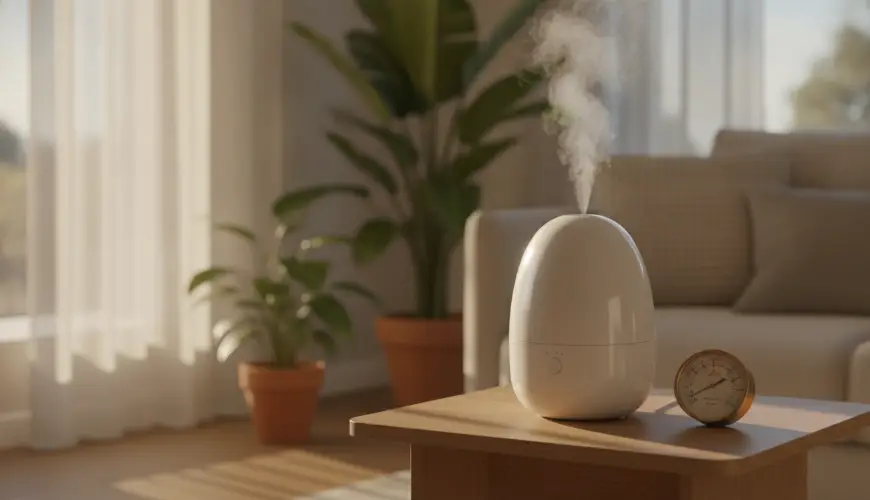
A humidifier, as the name suggests, adds moisture to the air. It is used when relative humidity drops below 40 percent – and this happens surprisingly often. In winter months, heating dries the air dramatically, because heated air can hold more water vapor, but that vapor is missing in enclosed rooms. The result is dry lips, burning eyes, irritated airways, and in extreme cases even recurring upper respiratory tract infections.
Humidifiers are particularly beneficial in households with young children or elderly people, who are more sensitive to air quality. Pediatricians and allergists regularly recommend them in the treatment of chronic rhinitis, asthma, or eczema. Dry air weakens the natural protective layer of mucous membranes, which otherwise serve as the first barrier against viruses and bacteria.
There are several types of humidifiers. Ultrasonic humidifiers disperse water into fine droplets using ultrasonic vibrations – they are quiet and energy-efficient, but require regular cleaning to prevent the spread of bacteria. Evaporative humidifiers work on the principle of natural evaporation through a filter and "regulate" themselves – when humidity is sufficient, evaporation slows down. Steam humidifiers boil water and release sterile steam, making them the most hygienic option, but they consume more energy.
So when should you reach for a humidifier? The signals are fairly clear: cracking lips and dry skin in winter, frequent bronchial or nasopharyngeal inflammation, static electricity on clothing and carpets, creaking wooden floors or furniture, or simply a hygrometer reading below 40 percent. A humidifier is especially suitable in winter, in attic apartments with insufficient insulation, and in households with central heating or air conditioning that dries out the air.
Dehumidifier: when the air needs to be dried instead
At the other end of the spectrum is the dehumidifier, whose job is to remove excess moisture from the air. It comes into play when relative humidity exceeds 60 percent – and this situation is surprisingly common in Czech households, particularly in summer, in basement areas, in bathrooms, or in newly built homes that have not yet fully dried out.
High air humidity is insidious in that it manifests gradually. At first, you may only notice that the bathroom is harder to ventilate, or that windows are framed with condensation. Then spots begin to appear on the ceiling or behind furniture. And eventually – mold. Research published in the journal Environmental Health Perspectives has repeatedly confirmed that long-term exposure to indoor mold increases the risk of respiratory diseases, allergies, and in some cases even neurological problems.
A dehumidifier works on the principle of condensation: it draws in humid air, cools it below the dew point, water droplets condense and drain into a reservoir, while the dry air is returned to the room. Modern devices are equipped with hygrostats, so they switch on and off automatically according to the set target humidity – there is no need to monitor every detail manually.
When is a dehumidifier the right choice? Typical situations include visible condensation on windows or cold walls, a musty or moldy smell in the room, the presence of mold in the bathroom or behind furniture, a feeling of stuffiness and heavy air even with an open window, or a hygrometer reading above 60 percent. A dehumidifier is indispensable in basement areas, laundry rooms, bathrooms without natural ventilation, and in areas with a humid climate – or simply every summer, when the outdoor air becomes saturated with moisture.
How to choose correctly between the two devices
As Danish architect Jan Gehl once noted, "the quality of the environment determines the quality of life." And the same applies to the air inside our homes – an environment in which, according to various studies, we spend up to 90 percent of our time.
The key to making the right decision is a combination of two things: measurement and observation. A hygrometer will provide hard data, but observing your own body and home will complete the picture. If you suffer from a dust mite allergy in summer that improves in winter, you are likely dealing with excess humidity and will need a dehumidifier. If, on the other hand, you get a sore throat every winter and your skin cracks, the air is too dry and a humidifier will be your ally.
It is also important to realize that both devices are not mutually exclusive – many households need a humidifier in winter and a dehumidifier in summer. It depends on the specific conditions. Panel apartments with central heating are typically too dry in winter, but in summer – especially on the ground floor or in the basement – they can be humid. Detached houses with good insulation tend to be more stable, but even there, the orientation of rooms, the number of occupants, or the presence of houseplants – which themselves increase humidity – all play a role.
The capacity of the device also plays an important role. A humidifier should be sized for the volume of the room where you plan to use it – a device that is too weak will not humidify a large room, while one that is too powerful may cause excessive humidity and condensation. The same rule applies to dehumidifiers, where capacity is expressed in liters of water removed per 24 hours. For a standard living room, a device with a capacity of around 10–16 liters per day is sufficient; for larger spaces or basements, a more powerful model is appropriate.
Maintenance is equally important. A humidifier that is not cleaned regularly can become a source of bacteria and mold – precisely what we are trying to prevent. The water tank must be emptied and disinfected, and filters replaced regularly. The situation is somewhat simpler with dehumidifiers, but here too the condensate reservoir must be emptied regularly and the filter cleaned.
When selecting a specific model, it is also worth paying attention to energy consumption. Modern devices with an energy class rating of A or A+ consume significantly less electricity than older or cheaper models. In the long run, investing in a quality device pays off not only in terms of health, but also economically.
Whether you ultimately choose a humidifier, a dehumidifier, or both, the device itself is only part of the solution. Proper ventilation, regular cleaning, and attention to the condition of your home are the foundations of a healthy indoor environment. Air humidity control devices are powerful tools – but they work best when you know why and when to use them.