
# How to brew the perfect cold brew at home
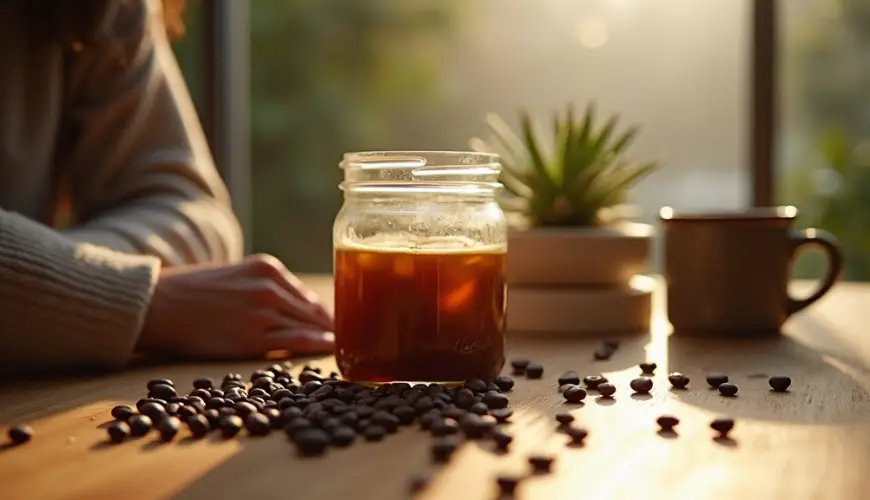
There are plenty of people who love coffee but can't stand it at the same time. More precisely – they can't stand the bitterness that sometimes lingers across the entire palate and for an hour after drinking reminds them that they may have overdone the dose. It is precisely for these people – and also for enthusiasts who want to get more out of their coffee – that a preparation method known as cold brew was born. It is a method that has conquered the world of coffee shops in recent years, but is gradually finding its way into home kitchens as well. And the best part? Anyone who has a jar, some coffee, and a little patience can genuinely master it.
Cold brew, or cold-steeped coffee, is not the same as the iced coffee many people imagine – that is, hot espresso poured over ice. It is a fundamentally different process in which coarsely ground coffee is steeped in cold or room-temperature water for 12 to 24 hours. The result is a concentrate or a ready-to-drink beverage with a surprisingly smooth flavour, low acidity, and a natural sweetness that needs no sugar. It is precisely this quality that attracts people who could never warm to regular coffee – whether because of the acidity, or because it caused them stomach discomfort.
Try our natural products



Why the cold process changes everything we know about coffee
The chemistry behind cold brewing is fascinating, even though one doesn't need to understand it in depth to enjoy the result. Hot water during traditional coffee preparation very quickly extracts a whole range of compounds from the coffee beans – including those responsible for acidity and bitterness. Cold water works more slowly and selectively. It primarily extracts sugars, oils, and more delicate aromatic compounds, while a large proportion of the acids and bitter substances remain unextracted in the coffee "puck". The result is a chemically different beverage, even if you use the same beans.
This is scientifically confirmed by, for example, a study published in the journal Scientific Reports, which showed that cold brew has significantly lower total acidity than hot coffee prepared from the same beans. For people with a sensitive stomach or acid reflux, this can be a real discovery. It does not mean, of course, that cold brew is a medicinal drink – but for many it is a more pleasant alternative that finally allows them to enjoy coffee without consequences.
It is also important to mention caffeine content. Cold brew has a reputation as a very strong drink, and for good reason – when prepared as a concentrate (which is the most common approach), its caffeine content can be significantly higher than that of a regular espresso. When diluted with water or milk, however, it reaches a comparable level. It therefore depends on how it is prepared and diluted. For those who are sensitive to caffeine, there is also a version made from decaffeinated beans, which retains all the flavour benefits of cold steeping.
Preparing cold brew at home is surprisingly straightforward. No special equipment is needed – all that's required is coarsely ground coffee (the grind is key; too fine a grind will cause cloudiness and over-bitterness), clean cold water, and a container. The most common ratio is approximately 1:8 to 1:10 (coffee to water) for a concentrate, or 1:15 for a ready-to-drink beverage. The mixture is left to steep in the fridge overnight or even longer, then filtered through a fine sieve or coffee filter, and it's done. The resulting drink keeps in the fridge for up to two weeks, which is another major advantage over regular coffee.
Cold brew and its place in everyday life
Take the example of Martina, a thirty-year-old teacher from Brno, who spent her whole life insisting that she simply "couldn't handle" coffee. The bitterness bothered her, the acidity made her feel unwell, and the sugar she added turned it into a drink that resembled a dessert more than a beverage. Then one day a friend gave her a jar of homemade cold brew. She wouldn't have said it was coffee if she hadn't known what it was. It was smooth, lightly sweet without any added sugar, with a pleasant flavour that was more reminiscent of chocolate and nuts. Since then she has been making cold brew at home every week – and she says it finally made her understand what people actually see in coffee.
There are many people like Martina. Cold steeping opens the door to people who have until now felt excluded from coffee culture – whether because of the taste or because of physical intolerance. At the same time, it offers experienced coffee enthusiasts a new way to explore the flavour profile of beans they know well. Because the cold process reveals different nuances than hot preparation, it can be surprising how differently the same coffee tastes when prepared by both methods.
The choice of coffee for cold brew naturally plays a role. Beans with a medium or darker roast are generally recommended, as they have naturally richer, chocolatey or caramel notes. Light roasts with fruity and citrus notes can come across as unbalanced in cold brew, although this is largely a matter of personal taste and experimentation. Interestingly, cold brew is one of the few methods where it is worth using even cheaper coffee – the gentle steeping process can yield surprisingly good results from average beans.
In terms of sustainability, cold brew has its advantages here too. Preparation requires neither electricity nor hot water, the steeping happens passively in the fridge, and the resulting concentrate saves on consumption because it is prepared all at once for several days. For those interested in a more eco-friendly lifestyle, this is a welcome bonus. The used coffee "puck" – the spent ground coffee left after filtering – is not waste either: it can be used as a natural scrub, a fertiliser for houseplants, or an addition to compost.
The world of cold brew is not limited to black coffee alone. There are a number of variations worth trying. A cold brew latte is created simply by adding plant-based or cow's milk to the concentrate – the result is creamy and naturally sweet. Some people add cinnamon, vanilla, or cocoa. A popular variant is the so-called "nitro cold brew", where the drink is infused with nitrogen and acquires a silky, beer-like texture with a dense foam – this style of serving is currently limited mainly to coffee shops and specialist venues, however.
But how do you choose the right coffee for home preparation? The origin of the beans and the way they are processed can serve as a basic guide. Ethiopian or Colombian beans are a popular choice for cold brew thanks to their natural complexity. It is important to reach for freshly roasted coffee from local roasters who state the roasting date – the fresher, the better the result. Supermarket blends in the vast majority of cases do not state the roasting date and are often several months old, which will be reflected in the final flavour.
"Coffee is not just a drink. It is a ritual, a way of slowing down, and a moment for yourself." – this idea, which circulates among coffee enthusiasts around the world, takes on a new dimension in the case of cold brew. Preparing a cold steep requires foresight and patience – the coffee must be prepared the day before, left to work undisturbed, and only then savoured. It is the opposite of the instant world, and perhaps that is precisely why cold brew has such a strong community of followers who see in it not just a drink, but a way of thinking.
For complete beginners who want to try cold brew without any investment, it is enough to start with what they have at home. Coarsely ground coffee (or even surprisingly well-functioning whole-grain ground coffee from a shop, as long as it is not too fine), a large jar or pitcher, and a fridge. The ratio, time, and type of coffee are variables to play with – and this experimentation is part of the fun. Results may vary, but even a less successful cold brew tends to be more drinkable than burnt coffee from an automatic machine.
It is also worth knowing that cold brew is not the preserve of expensive coffee shops or coffee snobs. It is a democratic method that requires no special skills or expensive equipment. Unlike espresso, where precise pressure, temperature, and extraction timing to the second all matter, cold brew is forgiving – even small deviations from the "ideal" procedure usually do not lead to a catastrophic result. That is precisely why it is an ideal entry point for anyone who wants to explore coffee more deeply but currently feels overwhelmed by the complexity of other preparation methods.
Coffee culture in the Czech Republic has changed significantly in recent years. Speciality coffee shops offering various preparation methods are multiplying in all larger cities, and interest in quality coffee is growing beyond them too. Cold brew is a natural part of this trend – a drink that can be prepared at home without any investment, yet one that simultaneously offers sufficient depth for those who want to go further. Information on various preparation methods and coffee selection is offered by, for example, the Specialty Coffee Association, an international organisation bringing together professionals from around the world, whose materials are also accessible to non-specialists.
Cold brew thus occupies an interesting position – it is accessible to complete beginners and experienced coffee lovers alike, it is accommodating towards sensitive stomachs and those seeking new flavour experiences, and it fits into a lifestyle that values quality, slowness, and conscious choices. All it takes is a start. A jar, water, coffee, a fridge, and a night of patience – and in the morning there is something well worth it.