

Seasonal syrups benefit both health and nature
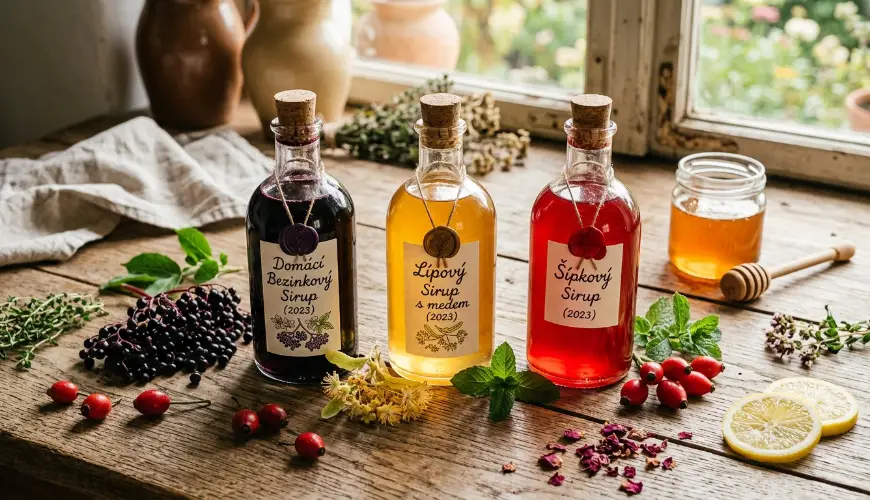
There is something soothing about looking into a pantry full of homemade syrups whose colours reflect every season. The deep purple elderberry syrup from September, the fresh light green sorrel syrup from spring, the golden linden syrup from early summer. This tradition runs deep in Czech cuisine and in recent years has been experiencing a significant renaissance – this time, however, with an emphasis on what is not in the syrup: no refined sugar, no artificial colourings, no preservatives. Why are so many people switching to seasonal syrups without sugar and without preservatives, and what lies behind that decision?
The answer is not simple, but it always begins in the same place – with the ingredients. When you read the label of an industrially produced syrup from a shop, you typically encounter a long list of ingredients, many of which are difficult to pronounce. Citric acid as an acidity regulator, potassium sorbate as a preservative, various forms of added sugar or high-fructose corn syrup. This is not a criticism of manufacturers – it is a technological necessity that ensures a long shelf life and consistent flavour throughout the entire year. But it is precisely this "stability" that stands in direct contradiction to what nature offers.
Try our natural products


Why ingredients matter more than they seem
The human body evolved over thousands of years in rhythm with nature. Spring brought the first green shoots rich in vitamins after winter, summer brought an abundance of fruit full of antioxidants, autumn brought roots and fruits with a high mineral content. Industrial food production broke this rhythm – today it is possible to buy strawberry syrup in January as well as in August, and in both cases it has exactly the same taste and composition. Seasonal syrups without added sugar respect this natural rhythm and restore to everyday eating an element that modern nutrition has largely lost.
Research repeatedly shows that excessive consumption of added sugars contributes to a whole range of health problems – from obesity and metabolic syndrome to an increased risk of cardiovascular disease. The World Health Organization recommends limiting the intake of free sugars to less than 10% of total daily energy intake, with further health benefits achievable by reducing this below 5%. Syrups sweetened with natural alternatives – such as honey, maple syrup, coconut sugar or stevia – do not automatically represent a "calorie-free" choice, but their glycaemic index and the way they are metabolised differs from refined sugar, which plays an important role for many people.
The situation is similar with preservatives. Substances such as potassium sorbate or sodium benzoate are considered safe at permitted doses, yet a portion of the expert community draws attention to their potential impact on the gut microbiome. The microbiome has become one of the most intensively researched topics in medicine over the past decade – and a growing body of evidence suggests that its balance influences not only digestion, but also immunity, mood and overall health. Syrups without preservatives place no unnecessary burden on this fragile ecosystem.
Take the example of thirty-year-old Kateřina from Brno, who decided to switch to a more natural diet after the birth of her second child. "I started reading labels and was surprised by everything that even an apparently innocent tea syrup contains," she says. She first began buying syrups from local producers at farmers' markets, then learned to make her own. Today she prepares supplies every summer from elderberries, raspberries and rosehips – without a single gram of white sugar, using honey from a local beekeeper instead. According to her own account, this change brought her not only a healthier diet, but also a deeper relationship with the seasons and the local landscape.
Kateřina's story is not exceptional. Interest in natural seasonal syrups is growing across generations and social groups, driven by a combination of health awareness, ecological thinking and a desire for authenticity at a time when most food is industrially processed.
Seasonal rhythm as the basis for choice
Each season brings different ingredients and different health benefits. In spring, these are primarily buds, shoots and the first herbs – nettle, sorrel, wild garlic or daisy. Spring syrups tend to have a light, fresh flavour and are traditionally associated with a "spring cleanse" of the body after winter. Nettle syrup, for example, contains high amounts of iron, vitamin C and chlorophyll, and although there are fewer scientific studies specifically on syrups, the nettle itself is a well-documented medicinal plant with proven anti-inflammatory effects.
Summer is the golden season for syrups made from elderberries, raspberries, strawberries, cherries or lavender. Elderberry syrup deserves special mention – it is probably the best-known and most widespread homemade syrup in Czech tradition, and its popularity has good reason. Black elder (Sambucus nigra) contains flavonoids and antioxidants which, according to numerous studies, support the immune system and may shorten the duration of colds. A syrup prepared without industrial sugar and preservatives, perhaps with honey and lemon, preserves these substances in a natural environment free of unnecessary additives.
Autumn belongs to rosehips, rowan berries, quinces and sea buckthorn. Rosehip syrup has been synonymous in Czech households since time immemorial with vitamin C and winter resilience – and the autumn preparation of supplies is one of the strongest cultural rituals associated with home fruit processing. Sea buckthorn syrup has experienced an unprecedented boom in recent years: sea buckthorn is considered one of the richest natural sources of vitamin C in existence, with a content that can be up to fifty times higher than that of oranges. Syrup made from sea buckthorn without added sugar is admittedly strong and sour in flavour, but as an addition to hot tea or a drink with sparkling water it is unbeatable.
Winter and the turn of the year is the time for syrups made from spices and roots – ginger syrup, cinnamon syrup, turmeric syrup, or combinations of these ingredients with citrus fruits. These syrups have a distinctly warming character and their anti-inflammatory properties are fairly well researched scientifically, particularly in the case of ginger and turmeric.
A natural question that arises when choosing a syrup is: how do you identify a truly quality product when you do not want to or cannot make it yourself? There are a growing number of producers on the market offering seasonal syrups without sugar and without preservatives, but quality varies. The key is to keep an eye on several things at once.
First and foremost, the ingredients – the shorter the list of ingredients, the better. A quality natural syrup should contain the main ingredient (fruit, herb, root), a natural sweetener (honey, maple syrup, coconut sugar or stevia) and possibly water and lemon juice as a natural preservative. Nothing more. The second thing is the origin of the ingredients: local and seasonal ingredients are a guarantee of freshness and a lower ecological footprint. Certifications such as organic or fair trade can be a further guide, although they are not the only guarantee of quality.
The production technology is also important. Industrial syrups are often produced at high temperatures that destroy heat-sensitive vitamins and enzymes. Gently processed syrups – prepared at lower temperatures or cold-processed – preserve more of the nutritional value of the original ingredient. Producers of quality natural syrups generally mention this detail on the packaging or on their websites.
Worth mentioning is also the ecological dimension of the whole matter. Industrial syrup production raises questions not only about ingredients, but also about packaging, transport and agricultural practices. Seasonal syrups from local producers or homemade production significantly reduce the ecological footprint and support local farmers and beekeepers. As the writer and ecologist Wendell Berry wrote: "Eating is an agricultural act." Every purchase decides what kind of agriculture and what kind of food production we support.
Home production of seasonal syrups is not as complicated as it might seem. A basic recipe for elderberry syrup without sugar requires only fresh elderflowers or elderberries, honey, lemon and water. The process is straightforward: the ingredients are left to steep or briefly simmered, strained, and the finished syrup is stored in the refrigerator or in sterilised jars. Shelf life without preservatives is admittedly shorter – typically a few weeks in the refrigerator or a few months in the freezer – but this very "brevity" is part of the philosophy of a seasonal approach to food.
For those who do not have the time or conditions for home production, the good news is a growing range of quality natural syrups. Online shops focused on healthy living and ecological products offer an increasingly varied selection of seasonal syrups from trusted producers – from small family farms to certified organic brands. When making a choice, it is worth reading reviews, asking about the origin of the ingredients and not hesitating to write directly to the producer if the ingredients or production process are not sufficiently described on the packaging.
Seasonal syrups without added sugar and without preservatives are not merely a fashionable trend – they are a return to something that existed long before industrial food production. They are little bottles full of a specific place, a specific season and specific care. And that is a value that no stabiliser or preservative can replicate.