
Even a small bathroom can be functional and beautiful
The bathroom is often the smallest room in many Czech households – and yet it is expected to serve as a sanctuary, a place for relaxation, and a functional space all at once. It is no wonder that people living in panel-block flats or older apartments struggle daily with the question of how to gain more space in a small bathroom. Fortunately, there are tried-and-tested approaches that require neither knocking down walls nor major investments – all it takes is a little ingenuity, an eye for detail, and a willingness to reconsider established habits.
Consider the situation of Lenka from Brno, who shares a three-room panel flat with two children. Her bathroom is just under five square metres, and yet it must accommodate a bathtub, a washing machine, a medicine cabinet, and shelves for three sets of towels. For a long time, Lenka struggled with the feeling that there was no room to turn around in the bathroom. But then she gradually started changing small things – she replaced a bulky wall-mounted cabinet with a mirror featuring integrated storage, moved the washing machine to the hallway, and placed a narrow shelving tower in the freed-up spot. The result? The same bathroom, but suddenly it feels completely different. No structural alterations, no large budget.
Try our natural products



Space begins in the mind – and then on the walls
One of the most common mistakes in small bathrooms is underestimating vertical space. People naturally think horizontally – they look around at the floor and tell themselves there simply is no room for anything else. Yet the walls from floor to ceiling offer enormous potential that goes untapped. Tall narrow shelves, hanging baskets, or magnetic strips for small items can store a surprising amount of things without taking up a single centimetre of floor space.
Corner shelves are particularly effective, as they make use of otherwise dead space in the corners of the room. A corner shelf above the toilet or in the corner of a shower enclosure is a classic example of a solution that costs very little but adds storage space where no one would expect it. Similarly useful are hanging organisers on the inside of cabinet doors or on a curtain rod – simple hooks on which hairdryers, brushes, or cosmetic bags can be hung.
The next step is to consider what truly needs to be in the bathroom. Many households store things there that do not actually belong – a month's supply of toilet paper, large reserve bottles of shampoo, or even tools and cleaning products. The bathroom should contain only what is actively used in it. Supplies belong in a storage room, hallway, or under the bed – and the freed-up space in the bathroom immediately makes itself felt as a welcome breath of fresh air.
An interesting perspective on the psychology of space is offered by research into the effects of clutter on mental wellbeing – a study published in the journal Personality and Social Psychology Bulletin showed that cluttered spaces increase levels of cortisol, the stress hormone. In other words, a tidy and well-organised bathroom literally improves your mood – even when it is small.
The illusion of space: light, colours, and clever surfaces
Architects and interior designers know that space is not just a physical reality, but also a visual experience. In a small bathroom, colours, materials, and lighting therefore play a key role. Light tones – white, cream, light grey, or pastel blue – optically enlarge a room because they reflect light and feel more airy. Dark colours, on the other hand, absorb light and can make even a larger bathroom feel cramped.
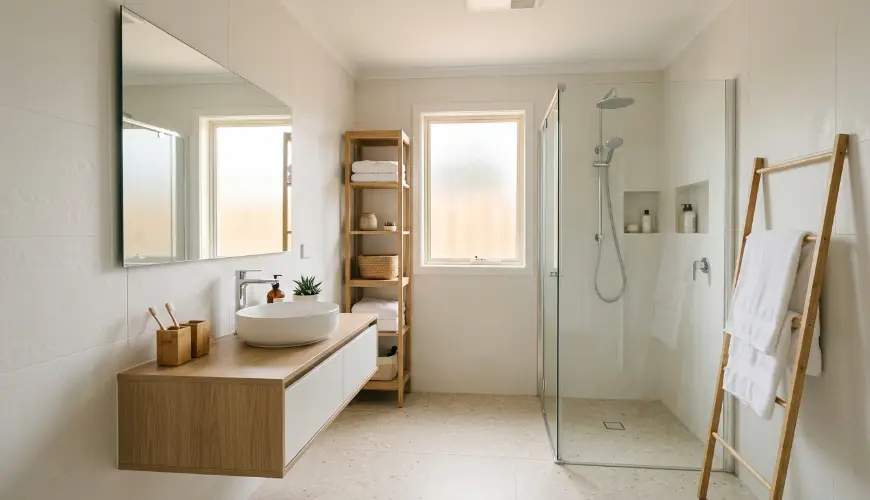
Large mirrors are an absolute necessity in small bathrooms. It is not just about the practical aspect – a mirror doubles the visual depth of the room and carries light to where it is lacking. A popular trick is to place a mirror opposite a window if the layout allows, or to choose mirrored cladding for an entire wall. The effect is immediate and dramatic.
Both natural and artificial lighting are also important. A small bathroom with a single weak light bulb feels like a cellar – whereas the same room with well-positioned lights or LED strips under the cabinets looks modern and spacious. If the bathroom has a window, it is worth keeping it as unobstructed as possible – a light frosted film or blinds instead of heavy curtains will let in light while maintaining privacy.
Surfaces also play their part. Glossy tiles or lacquered surfaces reflect light better than matte ones, and therefore optically enlarge the space. Large-format tiles with fewer grout lines also look cleaner and calmer than a mosaic of small pieces, which keeps the eye busy and visually reduces the space. This principle applies to both floors and walls.
The transition from visual tricks to practical adjustments is a natural one – because the best results come from combining both. A bathroom that looks spacious thanks to light colours and mirrors, while also cleverly using every corner for storage, is truly both functional and pleasant.
Fittings that save space without compromise
Choosing the right furniture and accessories is perhaps the most important decision in a small bathroom. A classic freestanding bathtub may look luxurious, but in a bathroom of five square metres it is practically unusable. A built-in bathtub against the wall takes up less visual space, and if you add a front panel with storage drawers, you gain valuable space for towels or bath toys.
An even more space-efficient option is a shower enclosure – and if it is separated by a glass wall rather than an opaque screen or curtain, the room is not visually divided into two parts. Clear glass maintains the visual continuity of the space and turns a small bathroom into a single unified whole. Frameless shower enclosures are for this reason very popular in modern minimalist design.
The washbasin is another area where space can be saved. Corner basins, narrow console basins, or basins built directly into a worktop with storage space underneath – these are all options that save space without sacrificing comfort. Under-basin cabinets are among the most valuable storage spaces in the entire bathroom, as they make use of space that would otherwise remain empty.
Ladder towel rails also work excellently as supplementary storage solutions – instead of a conventional rail, they hold several towels at once, take up minimal wall space, and can also serve as a decorative element. Similarly practical are magnetic or self-adhesive wall hooks, which require no drilling and can be repositioned as needed.
The washing machine is a special case – in many smaller flats, it has no option but to stand in the bathroom. If this is your situation, consider placing a tumble dryer directly on top of the washing machine in a so-called tower arrangement. This solution does require a special stacking kit, but it takes up only half the floor space of two separately standing appliances. An alternative is a combined washer-dryer, which is more expensive but can be a real lifesaver in a small space.
As Danish architect Jan Gehl once said: "The quality of a space is not about its size, but about how well it serves the people who use it." And it is precisely this idea that underpins every smart approach to a small bathroom – it is not about having a large space, but about making the existing one work as well as possible.
In practice, this is reflected, for example, in the approach to small details. Instead of ten different bottles of shampoos, conditioners, and shower gels, products dispensed from wall-mounted dispensers take up only a fraction of the space and the bathroom immediately looks tidier. Bamboo organisers or shower caddies are not only functional but also aesthetically pleasing – and if you are looking for more eco-friendly alternatives to plastic accessories, the range of sustainable bathroom products available today is wider than ever before.
Sustainability and space-saving go hand in hand – fewer items in the bathroom means fewer plastic packages, fewer unnecessary purchases, and an overall more mindful approach to consumption. Solid shampoo bars, toothpaste tablets, or bamboo toothbrushes take up almost no space while significantly reducing the amount of waste generated. It is a small change with a double benefit – the bathroom is more organised and the household is more eco-friendly.
Scent and atmosphere also play an important role. Even a small bathroom can be a place where you truly unwind – if it is tidy, well-lit, and pleasantly fragrant. Natural diffusers, soy wax candles, or dried herbs hung near the shower add atmosphere without taking up a single extra centimetre. And it is precisely this combination – functionality, tidiness, and a pleasant atmosphere – that is what a small bathroom is truly all about.
There is no need to wait for a renovation, a larger flat, or a big budget. All it takes is looking at your bathroom with fresh eyes, reconsidering what truly belongs there, and gradually introducing changes that make sense. Every freed-up centimetre, every clever shelf or clear shower screen brings you closer to the goal – a bathroom that is small, yet at the same time spacious, well-organised, and pleasant.