
Cauliflower as meat or 5 recipes for meat eaters
There exists a vegetable that can mimic the texture, flavour, and visual impression of meat so convincingly that even an experienced eater won't tell the difference on the first bite. That vegetable is cauliflower – and its ability to transform into a full-fledged meat substitute continues to surprise even the greatest sceptics. Yet this is no modern invention of the foodie community. Cauliflower has been used in kitchens around the world for centuries; it's only in recent years that it has been receiving the attention it deserves.
You may know the scenario: you arrive at a family Sunday lunch, there's a dish on the table with something roasted, fragrant, coated in a crispy breadcrumb crust – and only after the third bite do you learn that you've just eaten cauliflower. Exactly this kind of situation happened to Petra from Brno, who decided to try cauliflower schnitzel for her partner, who would have sworn he couldn't live without meat. Not only did he go back for seconds, but he also asked for the recipe. Such is the power of properly prepared cauliflower.
Try our natural products




Why does cauliflower substitute meat so well?
Several things work together to create this surprising effect. Cauliflower has a relatively neutral flavour that adapts wonderfully to marinades, spices, and cooking methods. Its cellular structure caramelises at high temperatures, creating a golden crust that resembles seared meat both visually and in taste. When sliced into thick steaks or larger pieces, a portion looks visually substantial and filling – and the brain plays a significant role in how we perceive food.
Nutritional content also plays an important role. Cauliflower is rich in vitamin C, B vitamins, folic acid, and fibre, while its caloric value is significantly lower than that of meat. According to the Harvard T.H. Chan School of Public Health, vegetables from the cruciferous family, which includes cauliflower, are among the foods with a demonstrably positive effect on long-term health. That alone is a good reason to give it a chance.
But back to cooking. The key to success lies in understanding a few basic principles. Cauliflower must be dry before searing – excess moisture is the enemy of a crispy crust. It must be well seasoned, because on its own it is rather bland. And it must have enough space in the pan or oven to roast rather than steam. If you meet these three conditions, the result will surprise you.
Below you'll find five specific recipes that prove cauliflower as a meat substitute is not a compromise – it is a fully-fledged culinary choice.
1. Cauliflower steak with herb butter
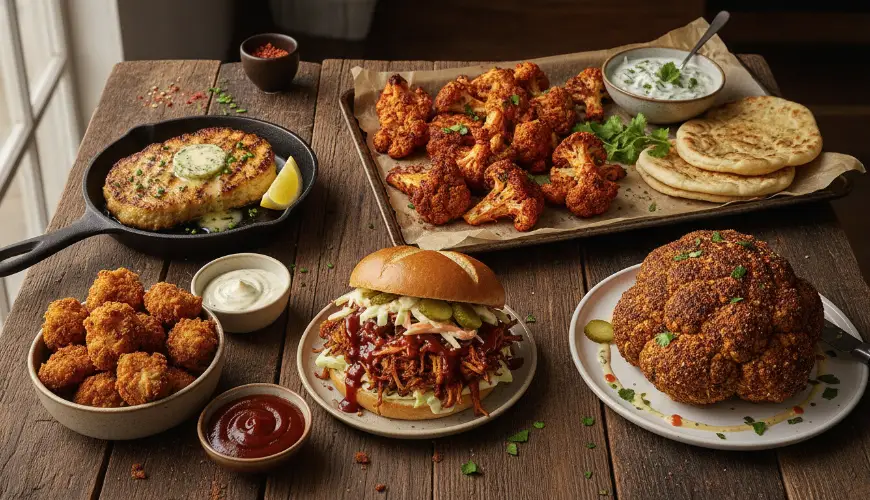
This preparation is perhaps the most straightforward demonstration of what cauliflower can do. Thick slices – ideally two to three centimetres – are cut from a whole head of cauliflower, keeping the stalk intact so they hold together. These "steaks" are brushed with a mixture of olive oil, smoked paprika, garlic, salt, and pepper, and left to marinate for at least half an hour.
They then go onto a preheated cast-iron pan or grill plate. High temperature is crucial – we want quick searing on the outside while the inside remains tender and creamy. Each side needs approximately four minutes. The finished steaks are then transferred to the oven for another ten minutes at 200 °C to cook through to the centre.
The serving makes as much difference to the experience as the preparation itself. Herb butter – or its vegan alternative made from coconut fat with chives and lemon zest – is placed on the hot steak and allowed to melt slowly. The result is elegant, satisfying, and utterly convincing.
2. Tandoori cauliflower from the oven
Indian cuisine knows how to work with spices, and tandoori marinade is one of its greatest treasures. Traditionally used to prepare chicken, it works just as well with cauliflower – perhaps even better, as the porous structure of the vegetable absorbs the marinade beautifully.
The marinade consists of yoghurt (or coconut yoghurt for a vegan version), tandoori spice, turmeric, ginger, garlic, lemon juice, and a little oil. Larger cauliflower florets are left to marinate for at least an hour, ideally overnight. They then go onto a baking sheet lined with parchment paper in an oven preheated to 220 °C.
After twenty to twenty-five minutes, they come out golden, with slightly charred edges – exactly as they would look from a tandoor oven. They are served with raita, fresh coriander, and naan bread. This recipe is a wonderful illustration of how global cuisines naturally work with plant-based food without any sense of "missing out" on anything.
3. Crispy cauliflower nuggets
Cauliflower nuggets are perhaps the quickest way to win over both children and sceptical adults. The method is simple: smaller florets are coated in a three-step breading – flour, egg (or aquafaba for a vegan version), and breadcrumbs mixed with parmesan or nutritional yeast, salt, garlic, and paprika.
Frying in a sufficient amount of oil takes just a few minutes until the coating is golden and crispy. Alternatively, they can be prepared in an air fryer oven, where at 200 °C they achieve a similar result in twenty minutes with significantly less fat. Served with homemade mayonnaise, barbecue sauce, or tzatziki, they become a favourite dish that no one will think twice about in terms of what they're made from.
This recipe is also a great example of how healthy vegetables can be made appealing to those who would otherwise refuse them. The format influences the perception of the content – and nuggets are a format that works for almost everyone.
4. Cauliflower "pulled" with BBQ sauce
Pulled pork is a classic of American barbecue. Its plant-based cauliflower version is a surprisingly faithful copy, both in texture and flavour. The secret lies in a combination of boiling and roasting.
Large pieces of cauliflower are first boiled in salted water with a splash of vinegar and smoked paprika – just until al dente, so they don't fall apart. They are then gently pulled apart with a fork or by hand into longer strands and mixed with a generous amount of homemade or good-quality shop-bought BBQ sauce. This mixture goes onto a baking sheet in the oven at high temperature, where the sauce caramelises and the pieces develop slightly crispy edges.
The result is served in a brioche bun with coleslaw and pickles – and it resembles an American burger so convincingly that you'll recognise the difference with your mind rather than your taste buds. This recipe is particularly popular at summer barbecues, where it tends to be the first thing to disappear.
5. Whole roasted cauliflower in a spiced crust
If you want to place something on the table that immediately draws attention and admiration, a whole roasted cauliflower is the right choice. It looks monumental, yet its preparation is surprisingly straightforward.
A whole head of cauliflower is blanched in boiling salted water for approximately eight minutes to soften it from the inside. Once cooled, it is coated with a paste of olive oil, harissa or chilli, garlic, cumin, coriander, salt, and lemon juice. Prepared this way, it goes into the oven at 190 °C for forty to fifty minutes, and can be brushed with the remaining paste once more during roasting.
The finished cauliflower has a dark golden, slightly charred crust and a creamy, tender texture inside. When carved at the table, it creates exactly the effect we're hoping for – guests reaching for a larger portion before anyone has said a word. Tahini sauce, fresh yoghurt, or a simple green salad work wonderfully as accompaniments.
How to start eating more plant-based food without major compromises
The transition to a more plant-based diet doesn't have to be dramatic or painful. Recipes like these – where meat is not replaced by an abstract concept but by a specific, delicious ingredient – are the most natural path. As British chef Yotam Ottolenghi, one of the pioneers of modern vegetable cuisine, says: "Vegetables don't have to be a side dish. They can be the star of the plate."
And that is exactly what cauliflower can do. The key is not giving up meat at all costs, but remaining open to new combinations and techniques. Many people find that after trying these recipes, they don't reach for meat out of conviction, but simply because there's something even better on the table.
For those who want to go further and connect healthy eating with a sustainable lifestyle, the Ferwer platform, for example, offers a range of products and inspiration for more eco-friendly everyday choices – from food to kitchen equipment that makes the whole cooking process more enjoyable.
Cauliflower as meat is not a trend that will disappear in a year. It is proof that good cooking doesn't need compromises – it just needs a little curiosity and a willingness to experiment. And who knows, perhaps even your biggest sceptic will one day catch themselves preparing tandoori cauliflower for Sunday lunch.