

# Which houseplants really clean the air
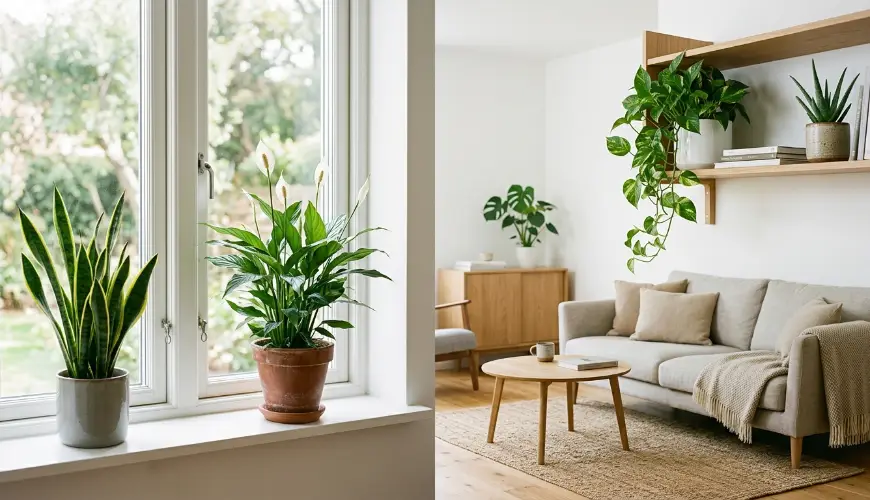
Almost everyone who has ever thought about improving the air quality in their home has come across one and the same tip: get some houseplants. The internet is full of articles promising that a few pots of flowers will transform your living room into clean mountain air. But is it actually true? And if so, which plants genuinely purify the air – and which are merely beautiful decorations without much practical function?
The answer to these questions is more complex than it might seem. Over the past few decades, a surprisingly large body of research has accumulated on this topic, and its conclusions are not always as clear-cut as proponents of green interiors would like to claim. Let's take an unvarnished look at the whole matter.
Try our natural products

Where does the myth of plants as air purifiers come from?
The whole story began in 1989, when NASA published a study examining the ability of plants to remove toxic substances from enclosed spaces. The research was originally aimed at developing air purification systems for space stations, where air circulation is virtually non-existent. Scientists tested various plant species in hermetically sealed chambers and found that some of them were capable of absorbing harmful substances such as benzene, formaldehyde, and trichloroethylene.
The study's results quickly spread through popular media and took on a life of their own. But what worked in a laboratory chamber with a volume of a few litres does not necessarily have the same effect in a living room of twenty square metres with open windows and a draught. This is precisely where the problem begins. A review of the original NASA study and subsequent research, summarised by National Geographic, shows that the direct transfer of laboratory results to a real domestic environment was, at the very least, exaggerated.
A 2019 study published in the Journal of Exposure Science & Environmental Epidemiology went even further. Researchers at Drexel University in Philadelphia calculated that for plants to effectively clean the air in a typical room, you would need to place approximately 680 of them there – just to achieve an effect comparable to what simply opening a window for ten minutes provides. That number is somewhat sobering, but it does not mean that plants are useless indoors.
Which plants actually have demonstrable effects?
Despite the reservations mentioned above, there are species for which science has confirmed at least some capacity to influence indoor air quality. These are not miracles, but plants that, under the right conditions, do more than just look attractive.
Golden pothos (Epipremnum aureum), also known as pothos or devil's ivy, has long been among the most frequently cited species. It is undemanding, grows quickly, and in laboratory tests has demonstrated the ability to absorb formaldehyde, which is commonly released from furniture, floor coverings, and cleaning products. Spider plant (Chlorophytum comosum) is in a similar position – it was, in fact, one of the stars of the original NASA study.
An interesting category consists of plants that work differently from absorption – specifically by increasing air humidity. Weeping fig (Ficus benjamina) or various species of palm, such as the areca palm (Dypsis lutescens), help maintain optimal air humidity, which in well-heated flats should be between 40 and 60 percent. Excessively dry air in itself causes irritation of the mucous membranes, fatigue, and impairs concentration – so this indirect function also has its value.
Snake plant (Sansevieria trifasciata), also known as mother-in-law's tongue, deserves special attention. This undemanding succulent is unique in that, unlike most plants, it carries out photosynthesis at night and produces oxygen in the dark. For this reason, it is traditionally recommended for the bedroom. Science confirms this property, even though the amount of oxygen produced is negligible in the context of an entire room. Nevertheless – if you are looking for a plant for the bedroom, the snake plant is a logical choice.
Aloe vera can boast similar nocturnal activity, and additionally belongs to the plants with demonstrated effects in absorbing formaldehyde and benzene. As a bonus, it can also be used practically – aloe vera gel from the leaves is a proven remedy for minor burns or skin irritation.
Among other candidates, peace lily (Spathiphyllum) repeatedly appears in the scientific literature. This elegant white plant was among the highest-rated species in the NASA study and demonstrated the ability to absorb several types of volatile organic compounds (VOCs). It also flowers, is relatively undemanding, and tolerates partial shade well – making it an ideal candidate for bathrooms or hallways.
Which plants do not purify the air – and why that is fine
It is fair to say that the vast majority of common houseplants have no measurable effect on indoor air quality. A cactus on the windowsill, an orchid on the table, or a bonsai in the corner of the room are excellent choices from an aesthetic standpoint, but they are not particularly effective at purifying air. This does not mean they are useless – it simply means one must have realistic expectations.
An interesting real-life example is the situation of Markéta, a thirty-year-old graphic designer from Brno, who two years ago acquired an entire collection of houseplants with the aim of improving air quality in her flat in a panel block. "I bought various species, read lots of articles, and waited for the air quality in the flat to improve significantly. In the end, I found that the biggest difference was made by regular ventilation and a humidifier – but the plants stayed, and I love them for their beauty and the sense of calm they bring to the flat."
Markéta's story is actually quite typical. And experts would agree with her. As biologist and science communicator Bill Wolverton, who was behind the original NASA study, noted: "Plants are not a substitute for ventilation, but they can be a complement to it." In other words – if we expect miracles from plants, we will be disappointed. But if we view them as one of many tools for improving wellbeing indoors, they have their place.
There are also plants that can, under certain circumstances, do more harm than good. Common ivy (Hedera helix) performed very well in the NASA study, but its leaves and berries are toxic – to both children and pets. Similarly, allergy sufferers should exercise caution with some flowering species that can release pollen and worsen allergy symptoms. The rule here is: choose with the composition of your household in mind.
How to get the most out of houseplants
If plants are not miraculous air purifiers, then why have them at all? The answer lies in a combination of smaller, but real benefits that together make sense. Plants increase air humidity, can absorb a certain amount of pollutants, produce oxygen, and – not insignificantly – have a demonstrably positive effect on mental wellbeing. Research repeatedly confirms that the presence of greenery indoors reduces stress, improves mood, and increases productivity. A study published in the Journal of Physiological Anthropology found that interaction with houseplants genuinely reduces both physiological and psychological stress.
If you want to get the most out of your plants, it makes sense to follow a few practical principles:
- Choose species with demonstrated effects – peace lily, golden pothos, snake plant, or aloe vera are safe bets
- Pay attention to plant health – a sick or poorly tended plant fulfils no function and may in fact be a source of mould
- Combine plants with ventilation – no plant can replace regular air exchange
- Adapt your selection to the space – different species belong in the bathroom than in the bedroom or kitchen
- Think about safety – if you have children or animals at home, check the toxicity of your chosen species
Particularly important is care for the soil and roots. Waterlogged soil can be a breeding ground for mould, which will actually worsen the air in the room. Experts therefore recommend choosing quality substrates with good drainage and avoiding overwatering – less is genuinely more in this case.
For those who want to go even further, there is also the option of so-called active biofilters – systems that combine plants with a fan and a special substrate and are capable of genuinely filtering air in measurable quantities. These systems are still largely at the experimental stage, but research in the area of so-called living walls shows promising results. It is a fascinating intersection of biology, design, and ecology that could in future change the way we think about indoor greenery.
The truth about houseplants and air purification is therefore this: reality is more nuanced than internet myths suggest. Plants are not industrial air purifiers – but they are living organisms with real, if modest, benefits. And perhaps that is as it should be: nature does not belong in the living room in order to solve our problems, but to remind us that we are part of it. And that is a reason that needs no scientific research to justify it.