

# What is paternal depression and why isn't it talked about
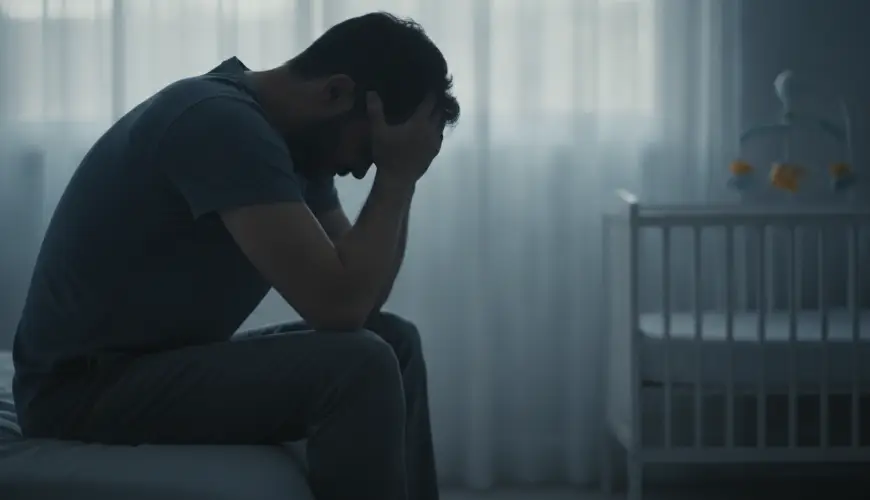
When someone mentions postpartum depression, most people automatically picture a mother. An exhausted woman holding a newborn, tears without apparent reason, a feeling of alienation from her own child. This image is deeply rooted in our culture – and rightly so, because postpartum depression in women is a real and serious problem that is, fortunately, receiving increasing attention. What society overlooks, however, is the fact that depression after the birth of a child does not only affect mothers. Paternal depression is a real, scientifically documented phenomenon that is almost never discussed – and that silence can be very dangerous.
Imagine this situation: Marek is a new father of a three-month-old son. On the surface, everything looks great – a healthy baby, a happy partner, a stable job. And yet every morning Marek wakes up with a heaviness in his chest that he cannot name. He does not feel the joy everyone talks about. Instead, there is irritability, fatigue, and a strange sense that this whole new life does not really concern him, that he is watching from the outside. Marek thinks he is simply tired. Or selfish. Or a bad father. Would it occur to him that he might have depression? Almost certainly not.
Try our natural products





Numbers That Surprise
Research consistently shows that approximately 10 to 18 percent of fathers suffer from postpartum depression – and some studies report even higher numbers depending on the sample studied and the methodology used. A meta-analysis published in JAMA covering more than 28,000 fathers found that the prevalence of depressive symptoms in men was highest in the period between the third and sixth month after the birth of a child. These are numbers that cannot be ignored – and yet they remain practically unknown in everyday medical practice and in public awareness.
The problem is partly structural. The postpartum care system is logically focused on the mother and child. The father comes to check-ups as a companion, not as a patient. No one systematically asks him how he feels, how he sleeps, whether he experiences feelings of alienation or hopelessness. Screening tools such as the Edinburgh Postnatal Depression Scale, which are routinely used with women, are almost never applied to men. The result is that paternal depression largely goes undiagnosed – and therefore untreated.
There is another crucial factor at play: cultural expectations. From an early age, men are taught to be strong, self-sufficient, and not to show weakness. Admitting that you feel bad at a time when you are supposed to be rejoicing over a new life requires a courage that goes directly against what society expects of fathers. "Be a support for your wife." "You'll manage." "It just takes men longer to get used to a baby." These words, well-intentioned as they are, can cause profound isolation for a man suffering from depression.
How Paternal Depression Manifests
Depression in men in general – not just postpartum depression – tends to look different than it does in women. While women more often describe sadness, crying, and feelings of worthlessness, men tend to express their depression through irritability, aggression, risk-taking behaviour, workaholism, or increased alcohol consumption. This is precisely why those around them – or even they themselves – may not recognise it as depression. It looks like a "bad mood", "work stress", or "difficulty adapting to a new role".
Typical symptoms of paternal depression include persistent fatigue that is disproportionate to the degree of sleep deprivation, loss of interest in things that previously brought joy, a sense of alienation from both partner and child, difficulty concentrating, anxiety, or conversely, emotional numbness. Some men describe feeling "out of it", as though they are watching their own life from the other side of a glass. Others experience intense fear – about the child's health, the family's financial situation, or whether they will be good fathers.
It is important to note that paternal depression does not necessarily arrive immediately after the birth of a child. It can develop gradually over the course of the first year, sometimes even longer. And it can be triggered by a wide range of factors – lack of sleep, changes in the relationship with a partner, financial pressure, one's own childhood experiences, or previous episodes of depression or anxiety.
Psychologist and author James Levine once summarised it this way: "Fathers are the invisible patients of modern medicine." And this invisibility has real consequences – not only for the men themselves, but for entire families.
What This Means for the Family and Child
Paternal depression is not just a matter concerning one individual. Research consistently confirms that a father's mental health has a direct impact on a child's development. Studies published in the journal Pediatrics show that children of fathers suffering from depression have a higher risk of developmental, behavioural, and emotional difficulties. A depressed father communicates less with his child, is less involved in caregiving, may be unpredictable or emotionally unavailable – and all of this leaves its mark on the child, even when the child is still very young.
No less significant is the impact on the relationship between partners. The arrival of a child is a major test for every couple. Communication changes, intimacy recedes, and each partner undergoes their own transformation. If one of them is simultaneously struggling with depression – and the other does not know, because the first cannot or will not name it – tension in the couple can quickly escalate. Partners of depressed fathers often describe feeling alone, misunderstood, and frustrated by their partner's apparent indifference. And the men, at the same time, feel misunderstood, isolated, and unable to explain what is happening to them. A vicious cycle of silence is created.
Yet solutions exist. Paternal depression, like depression in general, responds very well to treatment – whether through psychotherapy, in more serious cases through pharmacotherapy, or a combination of both. The key prerequisite, however, is that the problem must first be named and recognised. And for that to happen, it needs to be talked about – in doctors' offices, in maternity hospitals, in the media, and within families.
There are concrete steps that can help:
- Awareness in healthcare – involving fathers in mental health screening as part of postpartum care
- Open communication within couples – without the assumption that "dad will manage on his own"
- Support groups for fathers – already operating with good results abroad, still rare in the Czech Republic
- Psychological help – without stigma, without a sense of failure
In terms of practical resources in the Czech Republic, support is offered by organisations such as the Centre for Family Life or various non-profit organisations focused on men's mental health. In cases of acute difficulties, it is always appropriate to contact a general practitioner or psychiatrist.
Why Silence Is So Dangerous
Let us return to Marek. If his condition did not improve and no one helped him name what he was experiencing, what would happen? He would likely continue to isolate himself. Perhaps he would immerse himself further in work. Perhaps his relationship with his partner would gradually deteriorate. And his son would grow up with a father who is physically present but emotionally unavailable – without anyone knowing why.
This situation plays out in thousands of families. These are not exceptional cases – this is a systemic problem rooted in a combination of cultural stigma, insufficient awareness, and a healthcare system that simply overlooks fathers as potential patients.
Paternal depression exists. It is scientifically proven, relatively widespread, and treatable. The only thing standing in its way is silence – and that silence can be broken. It begins with a simple but fundamental shift: stopping the assumption that the arrival of a child is automatically a purely joyful event for fathers, with no shadows. Stopping the expectation that men are above it all. And beginning to ask them – sincerely and without prejudice – how they are actually feeling.
Because the answer may be surprising. And listening to it can change an entire family's life.