

Vegetable broths as the basis of every good dish
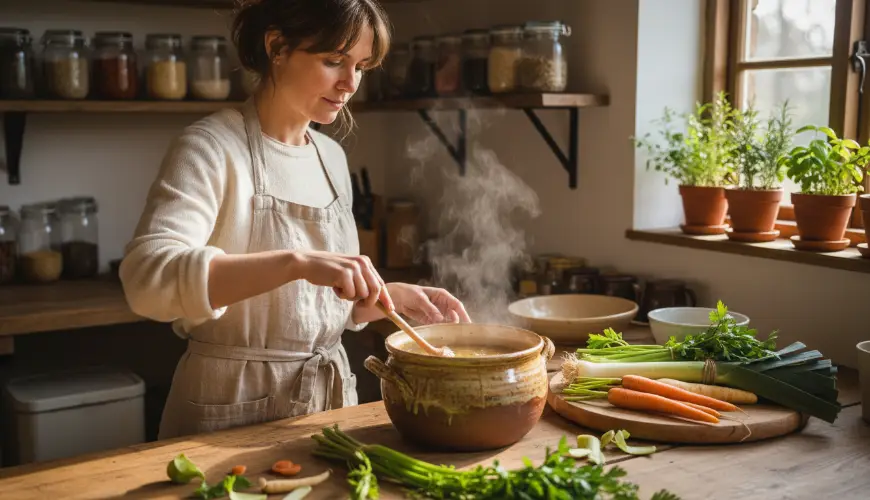
Is there anything humbler yet more useful in the kitchen than a pot of quietly bubbling vegetable broth? And yet it is precisely this unassuming foundation that most home cooks overlook, replacing it with store-bought cubes or leaving it out altogether. What a shame – because vegetable broth is one of the most versatile, healthiest, and most economical helpers that a modern kitchen can offer.
While meat-based broths attract attention as a symbol of traditional cooking and nourishing care for one's health, their vegetable cousin remains somewhere in the shadows. And yet it has something to offer not only vegans and vegetarians, but also anyone who wants to cook deliciously, affordably, and with care for the planet. All it takes is a shift in perspective – and an understanding of what vegetable broth actually is, what it brings to food, and why it makes sense to incorporate it into a regular kitchen routine today.
Try our natural products






What's Actually Inside the Pot
At first glance, it's simple: vegetables, water, seasoning, and time. But it is precisely in that simplicity that the power lies. During slow cooking, minerals, vitamins, aromatic compounds, and natural glutamates are released into the water, giving the dish depth and fullness of flavour. A well-made vegetable broth has a rich, complex taste that cannot be compared to instant substitutes packed with salt, additives, and artificial flavourings.
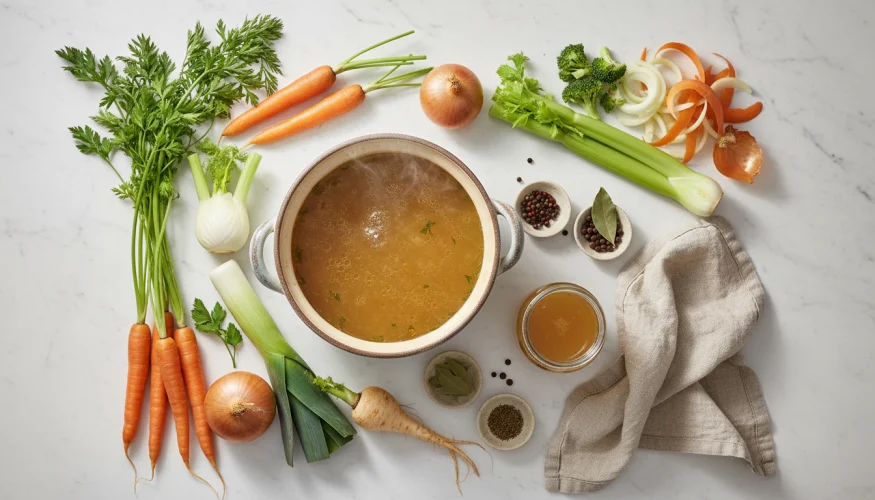
The foundation of a good broth is typically onion, carrot, celeriac, and parsley root – a classic quartet that has proven itself across generations. Additional ingredients are added depending on what the broth is meant to support: leek for gentle sweetness, fennel for anise notes, tomatoes for acidity and colour, mushrooms for earthy depth, or seaweed for an umami quality reminiscent of fish stock. It is precisely this versatility that makes vegetable broth something more than just a liquid for soup.
Nutritional science offers an interesting perspective here as well. According to information published by the Harvard T.H. Chan School of Public Health, a varied consumption of vegetables plays a crucial role in the prevention of chronic diseases – even when the vegetables are part of a broth. Minerals such as potassium, magnesium, and calcium are released into the liquid during cooking and remain bioavailable. Broth can thus be an inconspicuous yet valuable contribution to overall nutrition.
Imagine a typical Wednesday after work: half a celeriac sitting in the fridge, three slightly shrivelled carrots, a leftover piece of leek, and a few parsley stalks. Most people would throw this vegetables away without much thought. But from these seemingly leftover scraps, within an hour and a half, a broth emerges that will serve as the base for soup, sauce, or risotto for an entire week. Nothing is wasted, nothing goes to waste – and the result tastes better than anything from a packet.
Broth as a Pillar of Sustainable Cooking
At a time when food waste is increasingly discussed as a global problem, vegetable broth takes on an entirely new dimension. According to data from the Food and Agriculture Organization of the United Nations (FAO), approximately one third of all food produced for human consumption is wasted worldwide. A large portion of this waste comes directly from households – and vegetables are one of the most frequently discarded components of our diets.
Vegetable broth is a natural response to this problem. Carrot peelings, parsley tops, broccoli stalks, cabbage cores, spinach stems, or the outer leaves of celeriac – everything that would otherwise end up in the bin can instead end up in the pot. The result is not only less waste, but also a broth enriched with compounds found in precisely these less commonly used parts of vegetables. While fibre does not transfer into the liquid, minerals and aromatic compounds do.
This approach even has a name: "zero waste cooking." It is a philosophy spreading not only among environmentalists and activists, but increasingly making its way into ordinary households and professional kitchens alike. Michelin-starred chefs such as Dan Barber, whose Blue Hill Farm restaurant in New York has become a symbol of sustainable gastronomy, have long demonstrated that the best dishes are made from scraps. "Food that tastes good must be good for the land," says Barber – and vegetable broth is living proof that this idea works at home too, in an ordinary pot on an ordinary stove.
But sustainability doesn't end with waste. Making vegetable broth has a significantly lower carbon footprint than making meat-based broth. Vegetables as a raw material place considerably less burden on the environment than meat, and if we also use local and seasonal produce, we further reduce emissions associated with transportation. Broth made from local vegetables purchased at a farmers' market or delivered in a box from a regional grower is thus a small but meaningful step towards a more responsible way of life.
How to Prepare and Use Broth Properly
Making vegetable broth requires no special skills or equipment. The basic process is surprisingly simple, but there are a few principles that determine whether the result will be exceptional or merely average.
There is no need to peel the vegetables – the skins are full of flavour and nutrients. What matters is rinsing the vegetables beforehand and removing any dirt. Many experienced cooks recommend briefly roasting the vegetables dry or with a little oil before adding them to the water – this develops more complex, caramelised flavours and gives the broth a deeper colour and aroma. Cold water should then be added to the pot, not hot, as gradual heating helps the compounds release from the vegetables more effectively.
Cooking time is typically between 45 minutes and two hours. Unlike meat-based broth, longer cooking does not improve vegetable broth – on the contrary, it can cause the broth to turn bitter, especially if it contains more brassica vegetables such as broccoli or cabbage. The golden rule is therefore to cook slowly, over a low heat, and not to exceed the recommended time.
When it comes to seasoning, the basics are whole peppercorns, bay leaves, allspice, and salt. Herbs such as thyme, rosemary, or parsley add freshness. It is better to add salt at the end or leave it out entirely and season only the finished dish – unsalted broth is more versatile and easier to work with in recipes that already contain plenty of salt from other ingredients.
The finished broth is best strained through a fine sieve or muslin cloth and left to cool. It will keep in the fridge for approximately five days, and in the freezer for up to three months. A handy trick is to freeze it in ice cube trays or small containers – this way, exactly as much as a recipe requires is always on hand.
There are countless ways to use it. Vegetable broth forms the base for:
- soups and cream soups – from classic carrot soup to a sophisticated leek and potato soup
- risotto – where it replaces water and fundamentally influences the final flavour
- sauces and braised dishes – as the liquid that cooks along with the ingredients and reduces into a delicious sauce
- cooking grains and pulses – rice, quinoa, or lentils cooked in broth instead of water taste more pronounced and fuller
- dressings and marinades – broth reduced by evaporation to a syrup provides an intense flavour base
Each of these uses adds a layer of flavour to the dish that plain water could never achieve. And this is where one of the great secrets of professional cooking lies: the difference between a good and an exceptional dish is often simply the quality of the broth used.
Returning to homemade broth is also a return to a slower, more mindful way of cooking – an approach that respects ingredients, time, and the final result. It is not about complexity, but about a conscious choice. A pot of broth quietly simmering on the stove on a Sunday afternoon is a small investment that pays off all week long. And perhaps that is where its greatest value lies: it reminds us that good food does not come from instant solutions, but from care, patience, and respect for what we have at hand. Vegetables that would otherwise end up in the bin are transformed into a foundation upon which an entire week of tasty, nutritious, and sustainable cooking rests – and that is something that is certainly worth taking seriously.