
How to raise a child with a pet
Having a pet in a family with a child is one of the most beautiful life experiences imaginable. A dog wagging its tail at the door, a cat purring contentedly on the sofa, or a rabbit hopping across the carpet – all of this creates an atmosphere of a home full of warmth and vitality. At the same time, it is every parent's responsibility to ensure that this coexistence is safe, harmonious, and enjoyable for everyone involved. And this is precisely where many people struggle – how to set the right rules, where the boundaries lie, and what to do to make sure a child and a pet become true friends rather than a source of stress.
Research repeatedly confirms that children who grow up with animals develop stronger empathy, a sense of responsibility, and social skills. According to a study published in the journal Anthrozoös, children who regularly care for an animal show higher levels of emotional intelligence and find it easier to form relationships with their peers. This alone is a compelling argument for getting a child a four-legged or furry companion. Yet the reality of family life with an animal is not always as idyllic as it looks in family photo albums.
Try our natural products


Preparation begins before the pet enters the home
One of the most common mistakes parents make is underestimating the preparation phase. The animal arrives home, the child is excited, the parents hope everything will somehow "fall into place" on its own – and then comes the first scratch, the first pulled tail, or the first broken vase. The key to a successful relationship between a child and a pet is systematic preparation that begins before the animal even arrives.
First, it is necessary to choose a suitable breed or species with regard to the child's age, the size of the home, and the family's lifestyle. Golden retrievers and Labradors are renowned for their patience with children, while some smaller breeds can be more nervous and less tolerant of loud and uncoordinated children's behaviour. Cats are generally more independent and better able to manage their own space, though this also depends on the individual character of the specific animal. Smaller animals such as hamsters, guinea pigs, or rabbits are more suitable for older children who already understand how to handle them with care.
Before the pet arrives, it is also important to have an open conversation with the child about what caring for an animal involves. Simply saying "you'll have a puppy" is not enough. It is necessary to explain specifically that an animal feels pain, fear, and joy, that it needs food, water, exercise, and rest, and that it cannot be put away like a toy in a box when you lose interest. This preparatory conversation is the cornerstone of a healthy relationship between a child and an animal.
The story of little Eliška, whose parents got her a rabbit for her birthday, illustrates this situation very clearly. At first everything was fine – Eliška loved the rabbit, fed it, and cuddled it. But no one had explained to her beforehand that a rabbit needs time to rest and cannot be carried around constantly. After a few weeks, the rabbit started running away from Eliška and she felt rejected. A single calm explanation beforehand could have prevented this unnecessary disappointment.
How to establish clear rules and boundaries for both sides
Once the animal enters the household, the phase begins that will determine what the coexistence looks like going forward. Rules must be established immediately and followed consistently – and this applies both to the child and to the animal itself. Animals, just like children, need a clear structure and a predictable environment in order to feel safe.
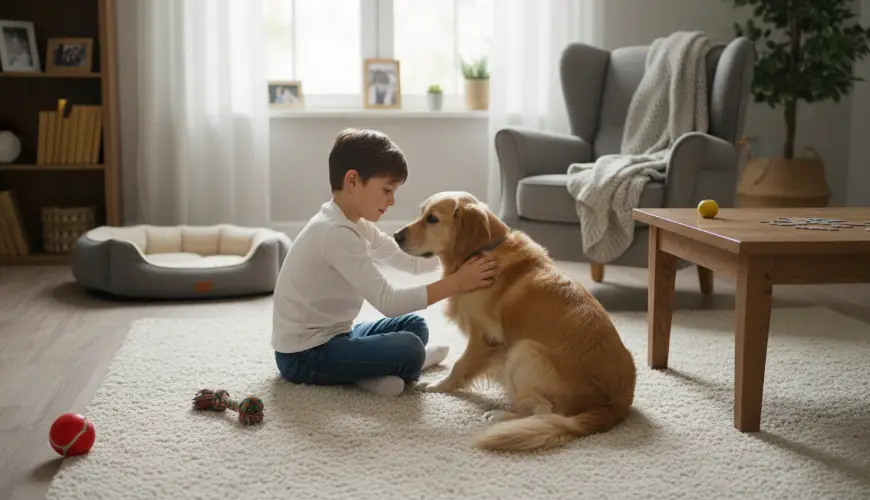
For the child, the basic rules of interacting with the animal should be explained in a way that is easy to understand. Among the most important is the rule against disturbing the animal while it is eating or sleeping, as these are the situations where most incidents occur. It is also important to teach the child how to pet an animal correctly – slowly, calmly, without sudden movements. Young children tend to hug animals around the neck or pull their ears, which can be unpleasant or even painful for the animal. As ethologist and animal behaviour expert Temple Grandin says: "Animals are geniuses at reading emotions, but their responses to stress are not always predictable." Every parent would do well to take these words to heart.
For the animal, it is important to have its own space where it can retreat and where the child will not disturb it. A dog or cat should have its own place – a bed, a basket, or a designated corner – where the child is strictly forbidden from entering. This safe haven is psychologically extremely important for the animal and significantly reduces the risk of an aggressive reaction caused by overstimulation or stress.
Adult supervision is absolutely essential during the first months of coexistence. No child up to approximately six years of age should be left alone with an animal unsupervised, even if the animal appears calm and friendly. This is not a matter of distrust towards the animal or the child – it is simply a matter of prevention. Situations can develop quickly and unexpectedly, and the presence of an adult is the simplest safeguard.
The hygiene aspect is also part of creating a safe environment. Regular veterinary check-ups, vaccinations, and deworming are fundamental not only for the animal's health but also for the protection of the entire family. Children are more susceptible than adults to zoonoses – diseases transmissible from animals to humans – so this area should not be neglected. Information on the most common health risks associated with pets is provided in a clear and accessible format by, for example, the State Veterinary Administration of the Czech Republic.
An important part of the coexistence is also how the child gradually takes on responsibility for caring for the animal. It is neither realistic nor appropriate for a three-year-old to feed the dog on their own – but a five-year-old can feed the animal under a parent's supervision, a seven-year-old can independently refill the water bowl, and a ten-year-old can participate in regular walks. Gradually involving the child in caring for the pet develops their sense of responsibility and deepens the mutual bond. The animal will also quickly recognise who looks after it and will form a stronger attachment to that person.
Parents should also not forget that the arrival of a new pet can be a source of stress for an existing household animal. If a family already has one animal and is getting a second, or if a newborn is joining the household, attention must also be paid to the reactions of the existing pet. Gradual introductions, respecting territorial boundaries, and giving sufficient individual attention to the original animal are steps that can make the whole transition significantly easier.
One of the less discussed but very practical aspects of a child and pet living together is the choice of suitable household products. Cleaning products, air fresheners, or pesticides used to protect plants can be toxic to animals – and indirectly pose a risk to children who come into contact with those animals. Switching to ecological and natural cleaning products free of aggressive chemicals is therefore a step that will protect both the pet and the entire family. Similarly, toys and accessories for animals should be made from safe materials free of harmful substances.
The emotional dimension of the whole relationship must not be overlooked either. Children naturally form strong bonds with animals, and a pet becomes a confidant with whom they share joys and worries. This relationship has therapeutic potential – it helps children manage stress, anxiety, and loneliness. At the same time, it also brings painful experiences, such as an animal's illness or death. These situations are also part of upbringing, and parents should neither avoid them nor trivialise them. An honest conversation about what is happening, appropriate to the child's age, is always better than avoidance or sugarcoating reality.
Safe coexistence between a child and a pet is not a matter that is resolved once and for all – it is a living, evolving relationship that develops alongside the child's growth and the changing needs of the animal. What worked for a toddler may not be appropriate for a school-age child, and what applied to a puppy may not apply to an older dog. Ongoing attentiveness, a willingness to adapt the rules, and open communication throughout the whole family are what make this relationship truly functional and enriching. And that is precisely where the greatest reward lies – in those moments when a child and their four-legged friend sit side by side, and neither of them needs anything more than what they already have.