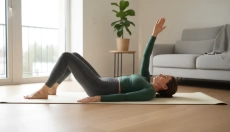

Rest that truly recharges body and mind

The Modern Person Is Tired
The modern person is tired. Not just physically, but deeper – in that hard-to-name dimension where exhaustion from decision-making, information overload, and the feeling that the day slipped by without leaving anything of value all blend together. And yet – or perhaps precisely because of this – more and more people are struggling with a paradox: they rest, but don't feel rested. They spend weekends on the sofa, scroll through social media, watch series after series, and on Monday morning they're just as exhausted as they were on Friday afternoon. What's going on?
The answer lies in a distinction that psychology knows well, but which has only recently entered everyday language. There is rest that truly recharges – and then there is rest that merely fills time. Both look similar from the outside. Both take place outside of work. But their impact on the body, mind, and overall wellbeing differs fundamentally.
Try our natural products




Why Passive Distraction Isn't Enough
Research in the psychology of leisure has long shown that not every activity that "doesn't look like work" brings genuine regeneration. Psychologists Mihaly Csikszentmihalyi and Reed Larson were already studying in the 1980s how people experience different types of leisure activities, and their findings were surprising: passive entertainment – television, aimless internet browsing, idle lying around – does reduce immediate stress, but brings no sense of renewal or meaning. In contrast, activities requiring a certain degree of engagement and attention – sport, handicrafts, gardening, cooking, reading a book – led to significantly higher feelings of satisfaction and energy.
This is not an argument against laziness, nor a call for constant productivity. It is rather an invitation to reflect on what we actually expect from rest and what truly gives us something. Scrolling through Instagram may be pleasant for five minutes, but after an hour a person typically feels a vague emptiness – and yet continues, because stopping requires a decision that is itself exhausting. This phenomenon, sometimes referred to as "digital decision fatigue", is one of the reasons why modern rest so often fails.
Imagine Markéta, a thirty-four-year-old graphic designer from Brno, who plans a weekend "for herself" after a demanding week. She spends Friday evening on Netflix, Saturday morning procrastinating with her phone in hand, goes shopping in the afternoon – and on Sunday evening realises she doesn't feel any better than she did two days ago. Yet technically she was "resting". The problem isn't what she did, but what she didn't do: nothing that would truly engage her attention, body, or senses in a way that allows the brain to genuinely switch off.
What Recharging Rest Actually Means
Rest that truly regenerates has several common characteristics – and surprisingly, not all of them are "comfortable" in the traditional sense. It might involve movement in nature, creative activity, quiet concentration, a deep conversation with someone close, or simply conscious doing-nothing without a screen in front of one's eyes. The key is presence – a state in which the mind is not divided between the past, the future, and notifications, but is fully anchored in what is happening right now.
The Japanese concept of shinrin-yoku – literally "forest bathing" – is in this regard one of the best-researched examples of truly recharging rest. Studies published in the academic journal Environmental Health and Preventive Medicine have repeatedly demonstrated that time spent in a natural environment – without a phone, without a goal, with only conscious attention to one's surroundings – reduces cortisol levels, blood pressure, and the subjective sense of stress more significantly than an equally long period spent in an urban environment. Nature here does not function as a backdrop, but as an active component of regeneration.
Physical activity works similarly – but not every kind. Research repeatedly shows that movement in the natural environment brings significantly greater psychological benefit than the same activity in an enclosed space. Running through a forest or walking along a river activates different sensory channels, brings unpredictable stimuli, and requires a degree of presence that is absent in a gym with screens on every wall.
The body itself also plays an important role. True rest is not merely a matter of the mind – it is also a physical matter. Quality sleep, sufficient movement, a healthy diet, and conscious care for one's own environment are the fundamental pillars of regeneration, which mutually influence one another. It is no coincidence that people who pay attention to the quality of their everyday environment – from the materials their clothing or bed linen is made from, to the composition of cleaning products in the home – often describe an overall higher sense of wellbeing. The body perceives stimuli constantly, even when we are not consciously aware of it.
As the writer and philosopher Henry David Thoreau once put it: "Nature is itself a remedy. You only need to allow it to work." This idea, formulated in the 19th century, today finds support in dozens of scientific studies.

How to Tell One from the Other
So how can we tell whether what we are doing is truly recharging us, or merely filling time? There is a simple but reliable test: how we feel an hour afterwards. If after an hour of scrolling, passive watching, or aimless browsing we feel tired, empty, or mildly irritable, the rest didn't work. If, on the other hand, after an hour of walking, reading, cooking, or gardening we feel a certain lightness, focus, or even energy – that is a signal we chose well.
This approach does not require a radical lifestyle change. It requires no meditation retreat or expensive equipment. It requires only a little awareness and a willingness to experiment. Small steps have a surprisingly large impact: putting the phone down for an hour and doing something with your hands, going outside without headphones and simply walking, cooking a meal from scratch instead of reheating a ready-made product – these are all forms of rest that the body and mind experience differently from passive consumption of content.
The environment in which we rest also plays a role. A cluttered, chaotic flat with plastic objects everywhere sends different signals than a space where surfaces are natural, the air is clean, and sensory stimuli are muted. The conscious choice of natural materials in the home – wood, cotton, linen, ceramics – is not merely an aesthetic preference, but also a practical way of creating an environment that supports calming in and of itself. The body responds to textures, scents, and visual stimuli, even when we are unaware of it, and an environment we perceive as safe and natural makes the transition into genuine rest easier.
Interestingly, even clothing plays a role. People who switch from synthetic materials to natural ones – organic cotton, linen, or wool – often describe feeling physically more comfortable even during moments of rest. The skin breathes, the body doesn't overheat, and this seemingly minor detail contributes to the overall quality of regeneration. Sustainable fashion is thus not only a matter of ecology, but also of personal wellbeing.
People who switch to ecological cleaning products or natural cosmetics think similarly – not primarily for ideological reasons, but because they feel the difference. Fewer chemical smells in the home, fewer irritating substances on the skin, more space for senses that are not overloaded with artificial stimuli. This is part of a broader view of a healthy lifestyle, where rest is not an isolated ritual once a week, but ongoing care for the conditions in which we live every day.
Let us return to Markéta. What if she tried a different approach next weekend? Saturday morning without a phone, breakfast cooked slowly and with enjoyment, an afternoon walk in the park without headphones, an evening with a book or board games with friends. Sunday morning devoted to tending to houseplants or baking bread – an activity that requires presence but is not stressful. The result would likely be different from a weekend spent on screens – not because she would be "trying harder to rest", but because she would have chosen forms of rest that genuinely give the brain and body what they need.
Rest is not a luxury or a reward for productivity. It is a fundamental biological and psychological need – just as important as sleep or nutrition. And just as with nutrition, not every calorie is equal: we can eat a great deal and still suffer from malnutrition if we eat the wrong things. With rest it is identical. We can have "time off" and still be exhausted, if we spend that time in ways that don't truly recharge either body or mind.
Learning to distinguish between rest that genuinely regenerates and rest that merely fills time is one of the most valuable skills of our era. We do not live in an age of stimulus scarcity – we live in an age of stimulus excess. And in such a world, the ability to consciously choose calm, presence, and quality over quantity is increasingly proving to be the key to long-term wellbeing, health, and contentment.