

# How to Simply Make Healthy Oat Milk at Home
Plant-based milk alternatives have been experiencing a massive boom in recent years. Among them, oat milk has carved out a special place for itself – a drink that, with its gentle sweetness and creamy texture, is winning over more and more people around the world. While picking up a carton at the store is convenient, making oat milk at home offers a whole range of benefits that few people know about. It's not just about saving money – it's about control over ingredients, an eco-friendly approach to life, and a surprisingly simple ritual that can become a pleasant part of your daily routine.
Oat milk itself is made through a fairly straightforward process – soaked or raw oats are blended with water and then strained. The result is a lightly sweet, gently thickened drink that tastes great in coffee, cereal, smoothies, or for baking. Although it seems simple, this drink has a fascinating history and scientific background that make preparing it at home make even more sense.
Try our natural products
Why make oat milk at home at all?
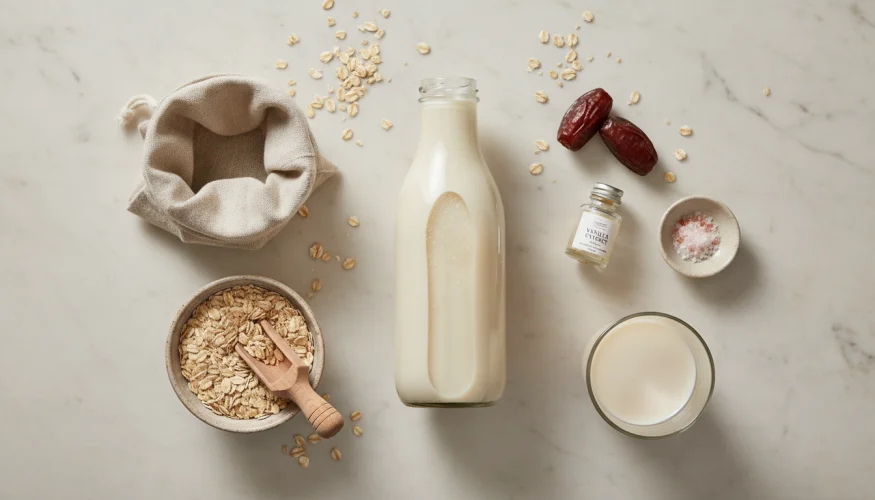
The answer to this question starts with the ingredients in commercial products. Most oat milks available in supermarkets contain, in addition to oats and water, rapeseed or sunflower oil, thickeners, emulsifiers, and various additives that ensure a long shelf life and stable texture. Although these additives are generally considered safe, many consumers prefer to know exactly what they are drinking. Homemade oat milk contains only what you add yourself – typically oats, water, a pinch of salt, and optionally a few dates or some vanilla for natural sweetness.
Money also plays an important role. A litre of quality oat milk in a shop costs on average between 50 and 80 crowns. Home production works out to approximately 10 to 15 crowns per litre, with oats being among the cheapest foods available. For a family that regularly consumes plant-based milk, this can mean savings of hundreds of crowns per month.
We must not forget the ecological dimension either. Commercial oat milk comes in Tetra Pak packaging, which is recyclable, but processing it is energy-intensive. Home production eliminates all packaging – all you need is a glass bottle that can be reused repeatedly. According to data from Our World in Data, oat milk has one of the lowest carbon footprints of all commonly available milks, and home preparation amplifies this effect even further.
There is one more, less obvious reason: taste. Freshly prepared oat milk tastes different from the kind in a carton – it's more vibrant, more natural, and you can adjust its consistency to your own preference. Once you've tasted it fresh, it's hard to go back.
How to make homemade oat milk step by step
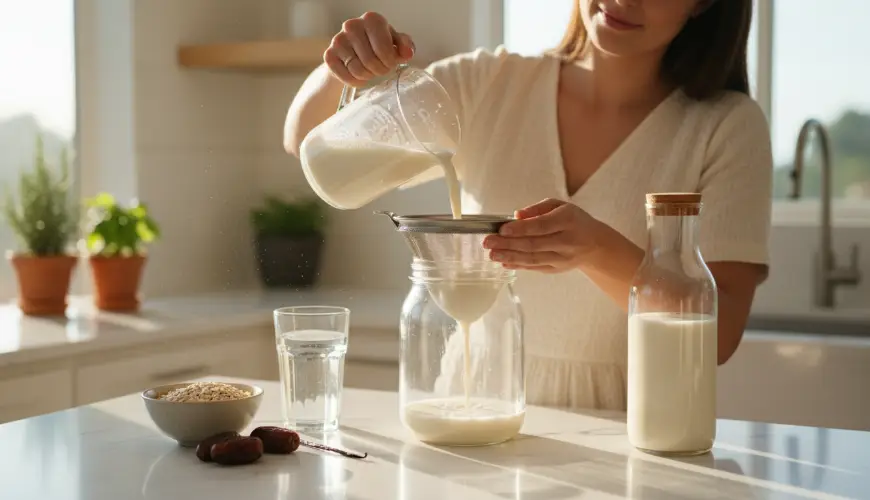
Making homemade oat milk requires no special equipment or culinary skills. The basic recipe can be managed by anyone who has a blender and a piece of cheesecloth or a nut milk bag for straining. Nevertheless, there are a few tricks that make the difference between an average and a truly good result.
The base is 100 grams of oats per litre of water. Experienced makers recommend using rolled oats, not instant – these contain additives and their starch is released too quickly during blending, causing a slimy texture. The oats don't need to be soaked beforehand, although a brief soak of 15 to 30 minutes can improve the final flavour. However, it's important to discard the soaking water and rinse the oats – this removes some of the beta-glucans responsible for the slimy consistency.
Blending should only take 30 to 45 seconds. Longer blending breaks down the starch chains and the result is a thick, gluey milk that resembles porridge more than a drink. After blending comes straining – ideally through a special nut milk bag or fine cheesecloth. The bag is gently squeezed, but never too forcefully, so that excess starchy pulp doesn't get into the milk.
To the finished milk you can add a pinch of Himalayan salt, which enhances the natural sweetness, a tablespoon of maple syrup or honey, a little vanilla extract, or even a pinch of cinnamon. Oat milk flavoured this way will keep in the fridge for three to four days, and before each use it's enough to shake the bottle, as natural sedimentation is normal and desirable in homemade versions – it's actually proof of the absence of emulsifiers.
Imagine Lucie, a mother of two from Brno, who switched to homemade oat milk two years ago. At first she was sceptical – it seemed like unnecessary extra work. After her first attempt, however, she discovered that the whole process takes less than ten minutes, and she actually enjoys it. Today she prepares oat milk twice a week, her children love it in hot chocolate, and she herself appreciates knowing exactly what her family is drinking. She adds the leftover oat pulp from straining to pancakes or homemade muesli bars – nothing goes to waste.
What science says about oat milk
Oat milk is not just a passing trend. Its popularity is backed by a solid scientific foundation. Oats are one of the most thoroughly researched grains, and their health benefits are documented in numerous studies. The key component is beta-glucans – a soluble fibre that has been shown to lower LDL cholesterol levels and support gut health. Research published in the journal Nutrients confirms that regular consumption of beta-glucans from oats contributes to a reduction in cardiovascular risk.
Homemade oat milk naturally contains fewer beta-glucans than whole oats, as some of the fibre remains in the strained pulp. Even so, it is a nutritious drink with a low saturated fat content and natural sweetness derived from the enzymatic breakdown of starches. Unlike cow's milk, it contains no lactose, making it a suitable alternative for people with intolerance.
It is important to mention, however, what homemade oat milk does not offer. Commercial versions are typically enriched with calcium, vitamin D, and B vitamins, which are naturally absent or only present in small amounts in homemade milk. Those who rely on plant-based milk as their main source of these nutrients should bear this in mind and compensate by obtaining them elsewhere – for example through leafy greens, legumes, or fortified foods.
As British nutritional advisor Tim Spector said: "The best diet is one that is varied, minimally industrially processed, and tailored to your body." Homemade oat milk fits perfectly into such an approach – it is a minimally processed food whose ingredients you have complete control over.
An interesting aspect is also the use of the leftover pulp from straining, known as oat pulp. This substance is rich in fibre and can serve as an ingredient in biscuits, breads, porridges, or as a base for homemade granola. Zero waste isn't just a slogan – in this case, it's a genuinely achievable goal.
For those who want to transition to home production gradually or are looking for quality equipment, Ferwer offers a carefully selected range – from glass storage bottles to nut milk bags and eco-friendly kitchen tools that make the whole process simpler and more enjoyable.
Homemade oat milk is in many ways a symbol of a broader shift taking place in society. People are increasingly interested in the origin of their food, its impact on their health, and its effect on the planet. Switching from a shop-bought carton to a self-prepared drink may seem like a small step, but in the context of everyday life it is a conscious decision – a decision to know what we eat, to protect the environment, and at the same time to enjoy something that tastes better. And that is exactly the kind of change that is worth making.