
How soil protection in the garden will improve your harvest
Everyone who has ever dug their hands into the soil and planted their first seedlings knows that a garden is a living organism. It is not just a place where tomatoes and cucumbers grow – it is a complex ecosystem whose heart is the soil. And it is precisely the soil that fewer and fewer people today care for as it deserves. Protecting soil in the garden is not some science accessible only to agronomists – it is a set of simple habits that any gardener can adopt, regardless of the size of their plot.
Modern gardening is increasingly returning to its roots. Chemical fertilisers and pesticides, which dominated the second half of the 20th century, are now fading into the background, replaced by methods that respect the natural processes in the soil. Research by the Food and Agriculture Organization of the United Nations (FAO) repeatedly confirms that healthy soil is one of the most precious natural resources on the planet and that its degradation threatens the food security of entire regions. What holds true on a global scale also holds true at the level of a small family garden.
Imagine a situation familiar to many gardeners: in the first year you harvest abundantly, in the second year less so, and by the third year you wonder why your tomatoes are turning yellow and your courgettes have stopped producing. The problem is not in the seeds or the weather – it is in the soil, which is gradually losing its vitality. This is exactly what Jana from the Vysočina region experienced: she had been tending her beds in the same way for several years, adding more fertiliser each season to achieve the same results as at the beginning. It was only when she started combining mulching, composting and crop rotation that she understood that soil is not a passive substrate – it is a living matter that needs to be given to, not merely taken from.
Try our natural products

Mulching: a simple trick that changes everything
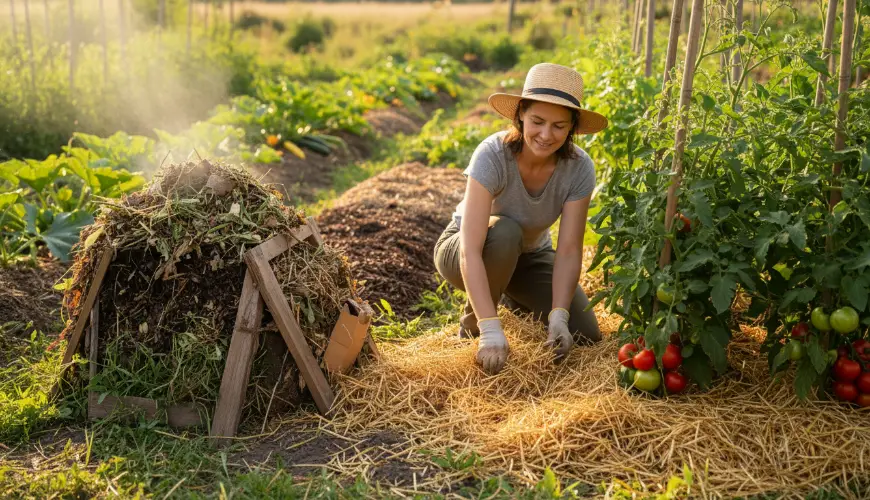
Mulching is probably the quickest way to significantly improve the condition of your soil without much effort. It involves covering the surface of beds with a layer of organic or inorganic material that serves several functions at once. Mulch prevents water evaporation, protects the soil from overheating in summer and from frost in winter, suppresses weed growth, and gradually breaks down, enriching the soil with organic matter.
There is a wide range of materials suitable for mulching. The most readily available are wood chips, straw, mown grass, leaves or bark. Each has slightly different properties – straw breaks down quickly and supplies nitrogen, wood chips last longer and are better suited under shrubs and fruit trees, while leaves are ideal for beds with perennials. It is important to apply mulch in a sufficient layer – ideally five to ten centimetres – and to renew it every season.
Perhaps the most valuable property of mulch is its effect on soil organisms. Under a layer of organic material, earthworms, fungi and bacteria thrive – organisms responsible for converting organic matter into nutrients available to plants. As British gardener and writer Charles Dowding, pioneer of the no-dig method, puts it: "Soil doesn't need us to dig it. It needs us to feed it." And mulch is one of the most effective ways of doing just that.
Practical tip: if you do not have enough mulching material of your own, try contacting a local arborist or your city's parks and greenery department. Tree maintenance companies often offer wood chips free of charge or for a nominal fee, as they would otherwise have to pay for its disposal.
Compost: gold from garden waste
Composting is another pillar of garden soil care and at the same time one of the most elegant examples of circular thinking in practice. Compost transforms organic waste – vegetable scraps, mown grass, branches, coffee grounds or cardboard boxes – into humus rich in nutrients that fundamentally improves both the structure and fertility of the soil.
Properly prepared compost acts as a natural fertiliser, a soil structure improver, and even a form of protection against certain plant diseases. Scientific studies published in the journal Bioresource Technology have repeatedly demonstrated that regularly adding mature compost to soil increases its water retention capacity, improves aeration and promotes biodiversity among soil microorganisms.
A compost bin does not need to be a complicated structure. It is enough to set aside a corner of the garden where organic materials can be layered – ideally by alternating so-called green components (nitrogen-rich materials such as grass or kitchen scraps) and brown components (carbon-rich materials such as dry leaves or cardboard). The correct ratio is approximately one part green to three parts brown. Compost needs to be aerated occasionally by turning and kept slightly moist – not wet, but not dried out either. Within four to eight months, a dark, crumbly material smelling of forest earth will form, ready to enrich the beds.
An interesting aspect of composting that is less often discussed is its impact on the carbon footprint of a household. According to data from the Czech Statistical Office, biodegradable waste accounts for approximately one third of municipal waste. Home composting significantly reduces the amount of waste sent to landfill, where it would decompose producing methane – a greenhouse gas with twenty times the warming potential of carbon dioxide.
Crop rotation as the foundation of long-term fertility
Crop rotation is a practice thousands of years old. Even medieval farmers knew that a field on which the same crop is grown continuously will eventually stop yielding well. Modern science has proved them right and explained why: each plant draws different nutrients from the soil and at the same time leaves behind specific substances that can promote or suppress certain diseases and pests.
The principle of crop rotation is that a different group of plants is grown on a given bed each year. The basic rotation divides vegetables into four groups: fruiting vegetables (tomatoes, peppers, cucumbers), root vegetables (carrots, parsley, beetroot), leafy and brassica vegetables (cabbage, broccoli, kohlrabi), and legumes (peas, beans, broad beans). Each group has different nutrient requirements and a different effect on the soil microbiome, so rotating them regularly keeps the soil in balance.
Legumes play a special role in the rotation. Through symbiosis with bacteria of the genus Rhizobium, they are able to fix atmospheric nitrogen and enrich the soil with it – effectively acting as a natural fertiliser. After a year in which beans or peas have grown on a bed, the soil is ready to receive more demanding crops such as brassicas or tomatoes.
Crop rotation also has a practical preventive dimension. Many diseases and pests are tied to specific plant families. Root-knot nematodes attacking carrots or potato blight multiply in the soil when they find the same host year after year. If crops are regularly rotated on a bed, pests do not find conditions for development and their populations naturally decline – without the need for chemical sprays.
Practical planning of crop rotation does not have to be complicated. It is enough to keep a simple notebook or use one of the free gardening apps, such as Groww or the Czech platform Zahradník online, which offer bed planning with crop rotation recommendations.
These three approaches – mulching, composting and crop rotation – complement and reinforce one another. Mulch protects the soil and adds organic matter, compost enriches it with nutrients and microorganisms, and crop rotation ensures biological balance. None of them is sufficient on its own, but in combination they form a system capable of transforming an average garden into a place of extraordinary fertility.
It is also worth mentioning what to avoid when caring for soil. Excessive digging and tilling disrupts soil structure and destroys mycorrhizal networks – the fine fungal threads connecting plant roots that play a key role in nutrient uptake. Unnecessary soil compaction from walking on beds or using heavy machinery restricts aeration and water infiltration. And of course chemical fertilisers and herbicides, which may increase yields in the short term but in the long run impoverish soil life and reduce natural fertility.
Gardening with regard to the soil is neither a fashionable trend nor an elite hobby for the environmentally conscious – it is a return to common sense. Soil that is well cared for repays that care many times over: with richer harvests, more resilient plants, less need for watering and lower costs for fertilisers. And perhaps most importantly of all – such a garden becomes a place that is a pleasure to work in and to spend time in. That is surely worth a little attention and a few handfuls of compost.