
# How to Deal with Children's Creations Without Feeling Guilty
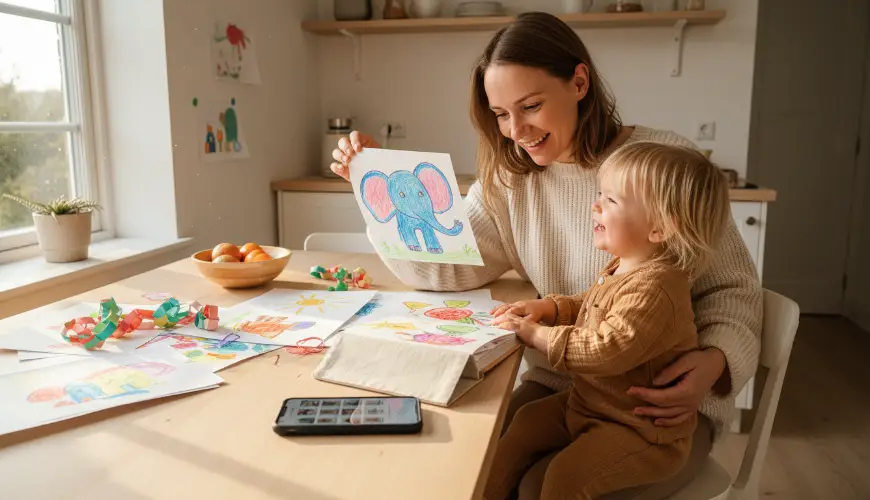
Every parent knows it. On the fridge hangs a drawing of a family with oversized heads, on the shelf sits a ceramic mug with an uneven rim, and in the drawer accumulate dozens of cut-outs, stickers and drawings that can't even be identified for what they're supposed to represent. Children's creations come home from nursery and school in such quantities that they could literally line an entire flat. And yet each one was made with the love, enthusiasm and concentration that the little creator devoted to this particular piece of paper or plastic. So how do you deal with it without parents feeling a wave of guilt every time they open the bin?
It's not just a practical problem of insufficient space. It's an emotional burden that quietly accumulates along with the papers on the table. Parents find themselves trapped between two powerful feelings – love for their child and their creations on one hand, and common sense and the need for order on the other. Psychologists and family life counsellors repeatedly point out that the guilt associated with throwing away children's work is completely normal and is shared by the vast majority of parents. You are not alone in this.
Try our natural products
Why it's so hard to get rid of creations
The root of the problem lies deep in the psychology of parenthood. A child's creation is not just a piece of paper – it is tangible proof that your child was growing, learning, creating and experiencing the world in their own way. Research in developmental psychology shows that children process emotions through artistic creation, develop fine motor skills and practise the ability to express thoughts they cannot yet verbalise. Each picture is therefore essentially a small diary – and who would want to throw away their child's diary?
Add to this the fact that children themselves can be very attached to their creations. A three-year-old who brings home a drawing and proudly shows it off is experiencing one of the first moments of public recognition of their work. The parent's reaction at that moment shapes the child's relationship with their own creativity for many years to come. It's no wonder, then, that parents would rather leave a creation hanging on the fridge for another six months than risk disappointment on a two-year-old's face.
But the reality is that creations accumulate at an exponential rate. The average child will bring home from nursery and primary school over their entire school career hundreds, perhaps thousands of drawings, models and handmade works. It is physically impossible to keep everything – and it isn't necessary either.
The key shift comes when parents realise that preserving a memory does not necessarily mean preserving a physical object. This distinction is liberating. A memory lives in the mind, in the heart, in a photograph or in a story – not necessarily in a cardboard model of a castle that will fall apart in three months anyway.
Smart ways to preserve children's creations while also tidying up
Before we get to the topic of throwing things away, it's worth going through the options for meaningfully archiving creations or giving them a new lease of life. Modern parents have a range of creative solutions at their disposal that work far better than a pile of papers in a box under the bed.
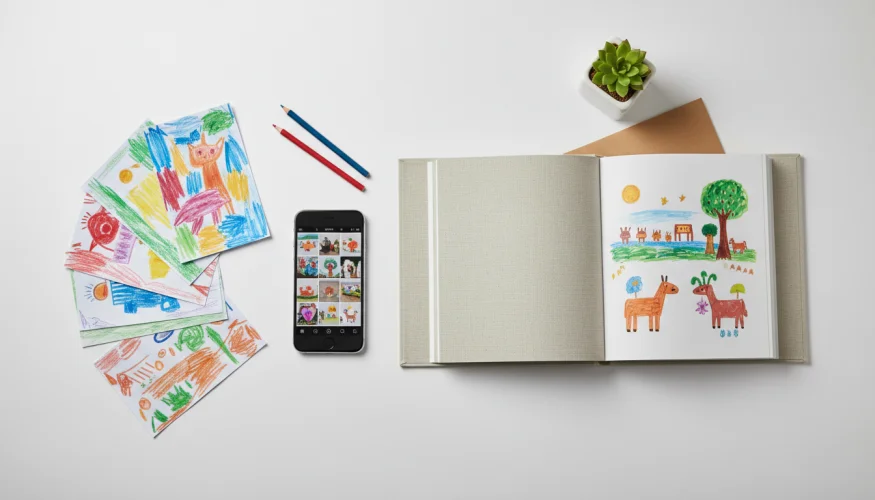
One of the simplest yet most effective methods is a digital archive. All you need to do is photograph the creation in good light, or scan it, and save it to a folder organised by the child's age. There are even specialist apps such as Artkive or Keepy, designed specifically for archiving children's artwork, which also allow you to create printed books from the photos. The resulting book can then be a surprisingly moving gift for a birthday or as a memento of finishing primary school. The child gets a beautiful artefact, you get rid of the physical clutter, and the memory is preserved.
Another option is a selective approach – instead of trying to keep everything, sit down with your child every now and then and together choose three to five creations that are truly important to them. This process also has an educational dimension: the child learns to evaluate their own work, to distinguish what they feel has turned out well, and to accept the fact that not every piece needs to survive forever. It is essentially a first lesson in curatorship, as anyone in the field of arts education would say.
For those who want to go even further, there are creative ways to transform creations into everyday life. A child's drawings can be used as a design for printing on a T-shirt, mug, puzzle or bag. Some companies even offer transferring children's drawings onto jewellery or cushions. This approach is in keeping with the philosophy of sustainable consumption – instead of accumulating things, a single meaningful, functional item with a personal story is created. And incidentally, a mug featuring your child's drawing makes a far nicer gift for grandparents than any bought trinket.
Interesting inspiration also comes from the Japanese philosophy of wabi-sabi, which celebrates the beauty of imperfection and impermanence. According to this worldview, there is no need to cling to physical objects – the value of things lies in the moment of their creation and experience, not in their permanent preservation. Applying this perspective to children's creations can be truly liberating.
When and how to dispose of creations ecologically and mindfully
The moment will come when a parent decides it's time to tidy up. And this is where the sensitive part comes in – how to handle the creations in a way that isn't merely throwing them in the bin, but rather a mindful and, where possible, ecological farewell.
Paper creations that are not too heavily soiled with paint or glue can easily be placed in the blue paper recycling bin. A simple rule applies here: if the material was paper, it can become paper recycled material again. There is no reason for a guilty conscience – paper is recycled, given a new life, and your child incidentally receives their first lesson in the circular economy.
More complex are mixed-material creations – where paper, plastic, fabric, metal or ceramic are combined. Here it is appropriate to disassemble the creation into its parts and sort each component separately. Ceramic and plaster models, if damaged, belong in building rubble or at a recycling centre. Textile creations, if still functional, can be donated to charity collections or community centres.
Creations made from natural materials are a special case – dried leaves, twigs, pine cones or pebbles. These can be returned to nature without any issue – composted or simply scattered in the garden or forest. Nature will take care of the rest.
Imagine, for example, a situation where a six-year-old brings home a large model of a volcano made from papier-mâché, poster paint and aluminium foil. The volcano takes up half a shelf, starts to crumble after three weeks, and the parents are puzzling over what to do with it. The solution? Photograph it from all angles, hold a small farewell ceremony – perhaps looking through the photos together with the child and talking about how the volcano was made – and then disassemble it. The papier-mâché goes to compost, the foil to metal recycling, the leftover paint to waste. The child learns that things have their time, and the memory lives on in the album.
As Danish psychologist and parenting author Iben Dissing Sandahl says: "Children don't need us to keep their things – they need us to keep their stories." This sentence is perhaps the best compass parents can have when sorting through their children's creations.
Mindful waste management and a sustainable approach to the home are not just fashionable trends – they are practical tools for living more lightly and with less burden, both physical and emotional. Organisations such as Zero Waste Europe have long pointed out that a large proportion of household waste comes precisely from things to which we have a strong emotional attachment, yet never actually use. Children's creations are a prime example of this.
There is yet another way to give creations meaning even after their "lifespan" – passing them on. Nursery schools, children's hospitals, community centres or care homes for the elderly often welcome colourful pictures as decorations. The creation thus gains a new audience, a new space and a new story. For a child, knowing that their picture is hanging somewhere where other people can see it can actually be a prouder experience than having it hidden away in a drawer at home.
The guilt of throwing away children's creations is natural, but it is not obligatory. Parents who establish a clear system – archive digitally, keep only the most precious items physically, recycle or donate the rest – will find that the sorting process becomes a pleasant ritual rather than an unpleasant chore. And children who are involved in this process learn one of the most important life skills: that the value of things lies not in their quantity, but in the story they carry.