

Just 10 minutes of exercise a day is enough when you want to break up sitting and feel better.
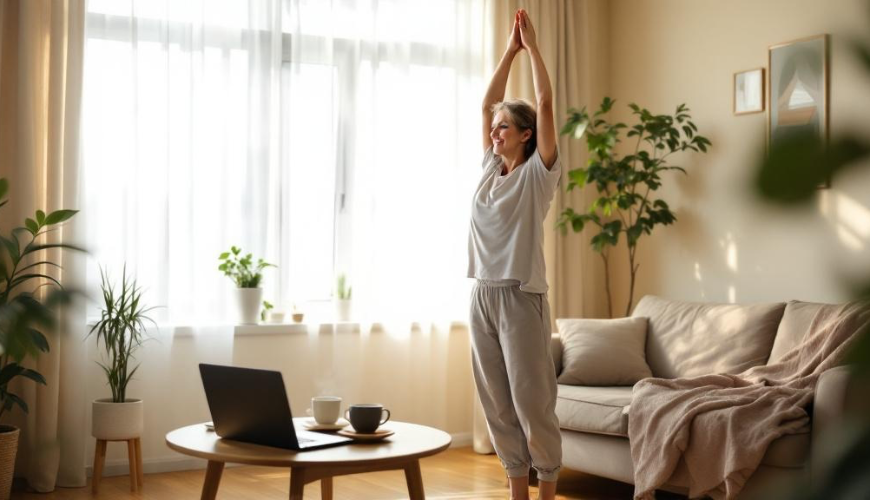
Everyday movement has a peculiar reputation: people often envision it as a sweaty T-shirt, an hour in the gym, and a discipline that "some have and others don't." However, the reality is much more mundane. In recent years, there has been increasing talk that just 10 minutes of movement a day is enough for the body and mind to start changing for the better. It's almost suspiciously simple — and that's precisely why it works. Ten minutes is not a commitment that requires new equipment, childcare, or a reorganization of life. It's more like a small daily ritual that can be squeezed in between morning coffee and the first work email, between meetings, or before dinner.
Does it sound a bit like a marketing trick? The question "is 10 minutes of movement a day enough?" is valid. However, the answer is rarely black and white: ten minutes a day probably won't prepare anyone for a marathon, yet it can be precisely the minimum that breaks long hours of sitting and gets the body moving. And importantly — when something is small and realistic, people do it more often. Regularity often wins over one-off heroics.
Try our natural products





Why 10 Minutes of Movement a Day Might Be Enough
Two things happen to the body simultaneously: it needs enough stimuli to remain functional, and it can quickly adapt to what we do most often. If the most frequent activity is sitting, the body "learns" to sit: some muscles shorten, others weaken, joints stiffen, and the head gets used to a fatigue that paradoxically doesn't improve with rest. A short movement block acts as an interruption of this pattern — as a reminder that humans are built for walking, squatting, raising arms above the head, twisting the torso, and a brisker breath.
There's no need to immediately reach for extremes. Authoritative sources have long emphasized that even smaller doses of activity make sense and that every minute counts. This is well summarized, for example, by the World Health Organization's (WHO) recommendations on physical activity and sedentary behavior, which, alongside "ideal" weekly doses, remind us that less is still better than nothing. And this is where the ten-minute slot makes perfect psychological and practical sense: it's an entry point that reduces resistance.
It's also important that short movement can be done at various intensities. Sometimes the goal is to raise the heart rate, other times to loosen stiff backs and necks, or to calm the mind after a demanding day. The body doesn't just count burned calories — it responds to rhythm, breath, cycles of tension and relaxation, and to joints moving in a range they don't use during the day.
In practice, another thing often becomes evident: when someone says "just ten minutes," they often find after a few days that they don't want to stop. Not because they've become a fitness fanatic, but because they suddenly feel a bit lighter. And even if not — ten minutes is still a success that can be maintained.
A quote that circulates in various forms in this context captures it surprisingly accurately: "It's not about doing everything. It's about doing something — regularly." The body gains more from regularity than it seems.
How to Move Healthily Every Day Without Disrupting Your Schedule
Healthy movement isn't just about performance. It's more about moving in a way that the body can sustain in the long term — without pain, overexertion, or a sense of punishment. When it comes to tips for healthy movement, most people expect a complicated plan. Yet often, it only takes changing a few small things: what exactly will happen in those ten minutes, when it will happen, and how to know it was "just right."
The basic rule sounds surprisingly simple: movement should be pleasantly challenging, not destructive. If someone is out of breath to the point where they can't say a complete sentence, it might be unnecessarily intense for a ten-minute daily routine (especially at the beginning). Conversely, if the breath doesn't change at all and the body remains in "sitting mode," the effect will be more mobilizing than conditioning — which is also fine. Healthy daily movement can take different forms and serve different purposes on different days.
A simple structure works well: first, wake up the body, then give it a bit of brisk work, and finally calm it down. It's not necessary to keep it military-style, more like using it as a framework. And because life is variable, it's useful to have several options in reserve depending on mood, space, and energy.
Ten Minutes That Make Sense: A Simple Formula
Sometimes it takes very little: a few movements familiar from school and some attention to breath. If specific inspiration is needed, a ten-minute routine might look like this — with no equipment, at home in the living room, in the hallway, or even at the office:
- 2 minutes brisk walking in place or around the apartment (perhaps with shoulder rotations)
- 3 minutes alternating squats on a chair and standing up (controlled, no "falling" down)
- 2 minutes mobility: cat stretch for the back, chest stretches, trunk twists while standing
- 2 minutes core strengthening: plank against a table/wall or "dead bug" on the floor
- 1 minute calming: slower breathing, neck relaxation, a few deeper belly breaths
This composition isn't dogma; it's just an example of how moving healthily every day can be translated into something that doesn't take forever. And importantly: it can be scaled. A squat can be just sit–stand. A plank can be against the wall. Walking can be up the stairs. When someone feels better, they can increase the pace or range of movement.
Real-Life Example: Ten Minutes Between Two Worlds
Imagine a typical workday for someone working from home. The laptop opens in the morning, time starts running, and suddenly it's noon. The back stiffens, the head feels heavy, and energy drops — yet there's no time to "go exercise" because a meeting awaits. Exactly at this point, ten minutes can work as a transition: instead of scrolling the phone, a timer can be set, a window opened, and a quick combination of brisk walking, a few chair squats, and chest stretches can be done. The person returns to the computer with warmer hands, a freer breath, and often a better mood. Not because they've become a different person, but because the body received the signal "we are alive, we move, we breathe."
This "micro-break" often has a side effect: in the evening, it's not so hard to go for a short walk. And even if not — the day already had one meaningful dose of movement.
What Makes Movement Healthy (and What Makes It a Trap)
Healthy movement is such that makes a person feel better rather than worse. Short-term fatigue may appear, but it shouldn't be the kind of fatigue that takes away the desire for the next day. The body also deserves respect: if something stings, pulls uncomfortably, or pain worsens, it's sensible to ease up, change the movement, or consult a specialist. For inspiration on a safe return to activity, materials like the NHS – exercise guidelines can be consulted (the British National Health Service provides clearly written basics for a broad audience).
Healthy movement is also not just "strength training" or "cardio." For the body, mobility is important (so that joints don't lose range) and strength (so that everyday tasks aren't a struggle). In modern life, one more component is almost underestimated: the ability to regularly interrupt long periods of sitting. Even two minutes of walking every hour counts — and when a ten-minute session is added, the difference is often noticeable.
Tips for Sustainable Healthy Movement
When "sustainability" is mentioned, most people think of ecology. Yet equally important is the sustainability of habits: the kind that doesn't burn energy, doesn't create pressure for performance, and accounts for some days being challenging. That's precisely why "ten minutes" has become such a popular framework — it's a dose that can be maintained even in a week when everything is falling apart.
The first practical tip is surprisingly simple: link movement to something that already happens. After brushing teeth in the morning, after making tea, after coming home from work, before a shower. When movement has a "hook" in the routine, it doesn't require as much willpower. The second tip: have a prepared version for days when energy is low. On that day, ten minutes can just be gentle stretching and walking around the apartment. It still fulfills the purpose — the body moved and the mind received the signal that the habit continues.
The third tip is about the environment: make movement as uncomplicated as possible. Keep a mat handy, have comfortable clothing that allows movement without thinking. Here, a healthy lifestyle naturally meets what makes sense from an ecological perspective: quality, comfortable, and long-lasting clothing typically leads to more frequent movement, as nothing pinches, scratches, or restricts. Similarly, eco-friendly home care can boost the desire to move — when the home doesn't smell of aggressive chemicals and the air is more pleasant, it's easier to open a window for ten minutes and get moving indoors.
Finally, one tip that sounds almost too simple: change "all or nothing" to "something is better than nothing." Sometimes, ten minutes can't fit in one go. Then it can be split into two five-minute sessions. Sometimes even that doesn’t fit. Then three minutes of brisk stair walking and a few neck stretches are enough. The body remembers continuity.
It might be worthwhile to ask one question that often reveals the simplest path: what is the smallest change that can realistically be made today? Because precisely these small changes form a habit that lasts. And when, after weeks, it becomes clear that why 10 minutes of movement a day is enough is not just a nice phrase but an experience, movement begins to naturally expand — not as an obligation, but as something that improves the ordinary day.
After all, ten minutes is the time it takes to cook pasta or go through a few messages on the phone. The difference is that after one of these activities, the body usually feels the same as before, whereas after the other, it often breathes a bit more freely and the day suddenly doesn't seem so heavy. And that's the magic of a small, daily dose of movement that doesn't require perfection — just a space in the calendar that already exists.