
Why New Furniture Smells and What to Do About It
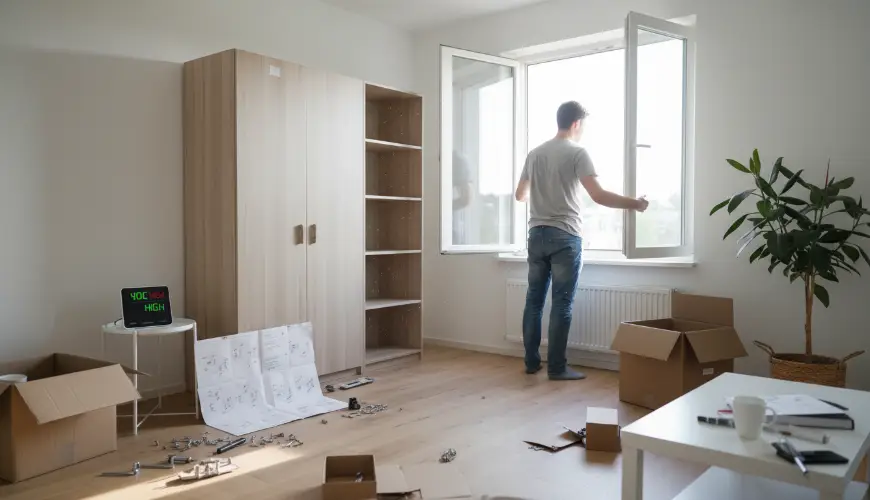
Anyone who has ever bought a new wardrobe, sofa or bed from a furniture store knows that characteristic smell. Strong, slightly chemical, sometimes even pungent – and lingering for weeks after unpacking. Although many people are content with the explanation that “new things just smell that way,” the truth behind this phenomenon is considerably more complicated and well worth attention. New furniture does not smell for no reason – it releases chemicals into the air, most notably formaldehyde, with consequences that can directly affect the health of the entire household.
Formaldehyde is a colorless gas with a pungent smell that occurs naturally in small quantities in nature and in the human body. The problem arises when its concentration indoors exceeds safe levels. And this happens quite inconspicuously in many homes every day. The World Health Organization classifies formaldehyde as a Group 1 carcinogen, a substance proven to cause cancer in humans. Nevertheless, it is still widely used in furniture manufacturing – particularly in binders for particleboard, plywood, MDF and laminate surfaces.
Try our natural products






Where does formaldehyde in furniture come from?
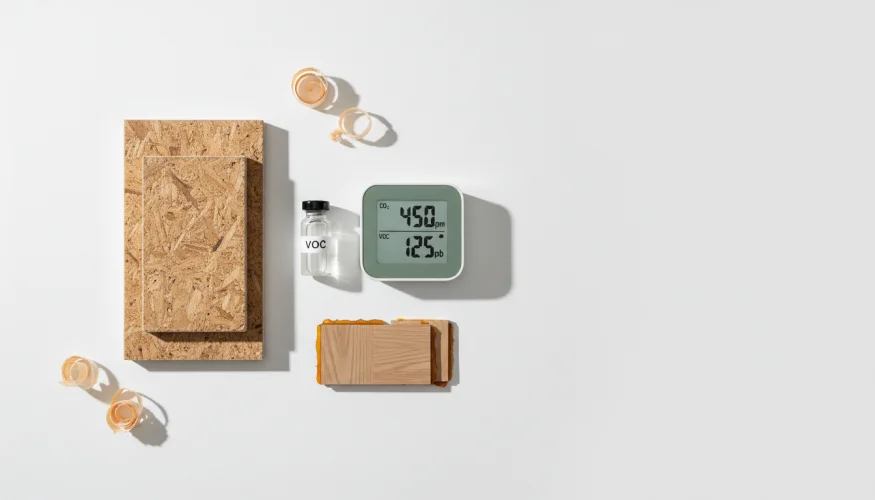
Understanding the origin of formaldehyde in furniture requires a brief look at the manufacturing process. Most modern furniture in the mid- and lower-price ranges is not made from solid wood, but from so-called composite wood materials. These are made by pressing wood chips, sawdust or fibers together using synthetic resins – most commonly urea-formaldehyde or phenol-formaldehyde resins. These resins are the main source of formaldehyde release, technically known as “off-gassing” or volatile organic compound emissions (VOCs).
The release of formaldehyde does not begin only after furniture is purchased – it is already taking place during manufacturing, transportation and storage. However, in the enclosed space of a home, where furniture remains for years, gaseous emissions accumulate and their concentration can reach significant levels. This depends on many factors: the room temperature (heat speeds up emissions), humidity, the age of the furniture and, of course, how well the interior is ventilated.
It is worth noting that the problem is not exclusive to cheap furniture. Even mid-priced products can contain materials with significant amounts of formaldehyde if the manufacturer does not use certified low-emission resins. The situation has improved in recent years, however – particularly thanks to consumer pressure and increasingly stringent European legislation.
Besides formaldehyde, furniture also releases other volatile organic compounds – such as toluene, benzene and xylene – which come from varnishes, paints, adhesives and impregnating agents. Together, these substances form a cocktail that can cause headaches and irritation of the eyes, nasal passages or respiratory tract in poorly ventilated rooms. Long-term exposure to higher concentrations of formaldehyde has been scientifically linked to an increased risk of nasopharyngeal cancer and leukemia.
How to identify problematic furniture and what to do next
Smell is the first and most reliable warning sign. The stronger and more chemical the smell, the more likely it is that the furniture is emitting larger quantities of volatile compounds. Smell alone, however, is not a reliable measure – some people are less sensitive to odors, and formaldehyde emissions do not always have a strong smell. There are therefore more practical ways to assess the situation.
The first step is to look for certifications and labels. In Europe, the EN 717 standard establishes emission classes for wood-based panels – class E1 indicates low formaldehyde emissions, class E0 indicates even lower emissions, and CARB Phase 2 certification (originating in California) is now recognized worldwide as one of the strictest standards. When buying furniture, it pays to actively seek out this information – reputable manufacturers provide it in technical data sheets or directly on the product packaging.
A second option is to choose solid wood furniture, which is naturally free of synthetic binders. Solid wood does emit natural resins and terpenes, but their health effects are incomparably lower than those of synthetic chemicals. Similarly, you can choose furniture made from bamboo or recycled materials, or products carrying environmental certifications such as FSC (Forest Stewardship Council) or the European Ecolabel.
Consider a specific situation: a family moves into a new apartment and puts a new wardrobe, bed and desk from a conventional furniture store in the child’s room. During the first few weeks, the parents notice that their child wakes up with a stuffy nose, complains of headaches and is tired. Doctors find no infection or allergy during an examination. Only after speaking with an indoor environmental quality specialist does it become clear that formaldehyde concentrations in the child’s room are more than twice the recommended levels. The solution is thorough ventilation, moving some of the furniture to another room and purchasing an air purifier with a HEPA filter and activated carbon. This scenario is not unusual – allergists and pulmonologists across Europe are reporting similar stories with increasing frequency.
So how can the situation be addressed in practice? There are several proven steps that can significantly reduce exposure to formaldehyde and other volatile compounds:
- Intensive ventilation – new furniture should be exposed to as much fresh airflow as possible for at least the first few weeks; open windows and cross-ventilation are the simplest and cheapest solution
- Raising the room temperature – heat speeds up off-gassing and helps “burn off” emissions faster; a short-term increase in temperature combined with ventilation can shorten the period of intense odor
- Using an air purifier – devices combining a HEPA filter with activated carbon capture both particles and gaseous volatile compounds, including formaldehyde
- Coating or film – sealing furniture surfaces with a special coating or film can physically prevent further gases from being released from the material
- Houseplants – some studies suggest that plants such as ficus, dracaena or ivy can absorb small amounts of formaldehyde from the air; the NASA Clean Air Study described this effect back in 1989, although its practical benefits under real-world conditions are still a subject of expert debate
The most effective solution, however, remains prevention – making an informed choice of furniture before buying it. As American activist and author Paul Hawken aptly remarked: “The best waste is the waste that is never created.” The same applies to chemical emissions – the best exposure is the one that never happens.
The market has seen a growing number of alternatives in recent years. Scandinavian furniture manufacturers have long led the way in low-emission materials and transparent labeling. Interest in second-hand and vintage furniture is also growing – and not just for environmental reasons. Older pieces of furniture that have undergone a natural off-gassing process over years or decades release virtually no volatile compounds anymore. Buying quality used furniture can therefore, paradoxically, be a healthier choice than buying a brand-new product from a store.
It is also worth noting that indoor air quality is a more serious issue today than ever before. People spend an average of over 90% of their time indoors – and according to the US Environmental Protection Agency (EPA), indoor air quality can be up to five times worse than outdoors. Furniture is just one source of pollution – add carpets, curtains, cleaning products, candles, printers and building materials, and the indoor environment becomes a truly complex issue that deserves attention.
Knowing what lies behind the characteristic smell of new furniture is the first and most important step toward a healthier home. Formaldehyde and other volatile organic compounds are not a scare story invented by environmentalists – they are real chemical compounds with measurable health effects, supported by extensive scientific literature. At the same time, the situation is not hopeless. A combination of informed purchasing, proper ventilation and suitable air-cleaning devices can significantly reduce the risks. And with the growing availability of environmentally friendly and low-emission products on the market, healthier choices are becoming more accessible than ever – without the need to compromise on the aesthetics or functionality of the home.