

What Is Shoulet and How to Make It at Home
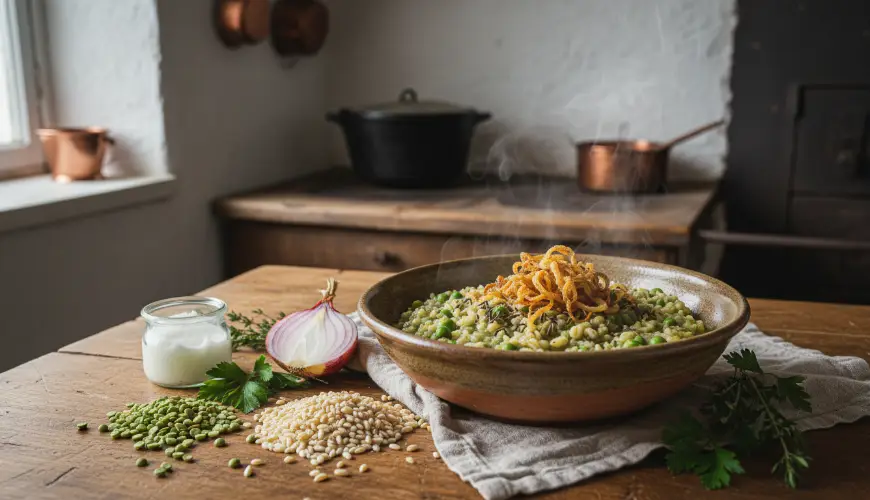
Some dishes survived for centuries, fed generations, and then one day simply disappeared from the menu. Šoulet is one such dish. A thick, hearty porridge of peas and barley, whose aroma rose from pots in rural farmhouses as recently as a hundred years ago, is little known today. Yet it is a dish with something to offer not only historians, but also anyone looking for food that is nutritious, simple, and deeply flavorful.
Most Czechs today are unfamiliar with the name šoulet. Yet as recently as the 19th century, this dish was a perfectly ordinary part of peasant cooking in Bohemia and Moravia. It was made from whatever was on hand - dried peas, barley or buckwheat groats, sometimes with a piece of smoked meat or some lard. It was a dish of the poor, but also of wise householders who knew how to make much from little. Today, as forgotten foods are being rediscovered and interest in traditional Czech cuisine grows, šoulet is returning to public awareness as a culinary gem that has been overlooked for far too long.
Try our natural products




What šoulet is and where it comes from
Šoulet is essentially a thick cooked porridge, or rather a slow-cooked mixture, usually based on dried split or whole peas and groats - most often barley, although buckwheat or wheat groats were also used in different regions. The name itself is intriguing, and its origin is not entirely clear. Some linguists connect it with the German word Schmalz (lard) or with related dishes from Central European rural traditions. Others trace its roots to the Yiddish word cholent, meaning a traditional Jewish Sabbath stew that is slow-cooked overnight. Whatever its etymology, šoulet as a Czech country dish has a distinct history of its own.
In the Czech lands, šoulet was part of what was known as “heavy cooking” - food that had to keep people full all day. Farmers who worked in the fields from dawn needed an energy-rich meal that would sustain them for a long time. Peas and barley fit the bill perfectly. Dried peas were also among the most readily available and inexpensive foods, and could be stored all winter without spoiling. Groats, or hulled and polished cereal grains, were similarly durable and accessible. Together they formed the basis of a diet that was simple, yet surprisingly well balanced nutritionally.
The recipe for šoulet varied from house to house and region to region. In southern Bohemia, more lard and smoked meat were added; in some parts of Moravia, caraway and onions were used, while elsewhere garlic was added. The common denominator was long, slow cooking - šoulet could not be rushed. Both the peas and the groats needed time to soften and meld together, creating the distinctive thick, creamy consistency that characterizes the dish. This slow preparation is what fascinates many cooks today - šoulet is an ideal dish for a slow cooker or for baking in the oven.
An interesting example comes from the notes of a housewife in the Plzeň region in the late 19th century, preserved in a regional archive. She describes how šoulet was always cooked in a large batch because “it is even better the next day.” This observation is no accident - like many stews, šoulet develops a richer, deeper flavor after resting overnight, as the flavors fully meld.
Nutritional value ahead of its time
Today, when we talk about plant proteins, legumes as the future of nutrition, and a return to whole grains, šoulet is almost a symbol of what our ancestors knew long before scientific studies. Peas are rich in plant protein, fiber, iron, and B vitamins. Barley provides complex carbohydrates, magnesium, and beta-glucan, a substance that research suggests helps lower cholesterol and supports the immune system. The combination of peas and barley creates a dish with a low glycemic index that keeps you full for a long time without burdening digestion as much as, for example, a fatty goulash would.
According to the World Health Organization, legumes should be a regular part of a balanced diet precisely because of their protein, fiber, and micronutrient content. Šoulet is almost a textbook example of a healthy traditional dish - long before nutritionists began taking an interest in plant-based diets, Czech farmers ate peas with barley and thrived on them.
It is worth noting that similar dishes exist in many cuisines around the world. Italian minestra di farro combines spelt with legumes, Middle Eastern mujaddara mixes lentils with rice, and Indian khichdi brings rice and beans together. All these dishes share a common philosophy: simple, affordable ingredients, slow preparation, and a result that is greater than the sum of its parts. Šoulet naturally belongs to this family.
As ethnographer and traditional Czech cuisine expert Marie Úlehlová-Tilschová says in her book Česká strava lidová: “The simple meals of country folk were not a sign of poverty of spirit, but evidence of a practical wisdom that could create something nourishing from what was available.”
How to cook šoulet today
Bringing šoulet back into the modern kitchen is not difficult. The basic ingredients are readily available - dried split peas, pearl barley, onion, lard or butter, salt, pepper, and caraway seeds are things you can find in any store. Preparation requires only a little patience and a willingness to let the pot do the work for you.
It is a good idea to soak both the peas and the barley beforehand - ideally overnight for the peas and for at least an hour for the barley. After soaking, the peas and barley are cooked until tender, then combined with onion fried in lard, seasoned with salt and pepper, and flavored with caraway. The result is a thick, fragrant porridge that can be served as a meal on its own or as a side dish with smoked meat. For a version closer to the original recipe, add pieces of smoked pork belly or ribs, simmering them with the peas to give the dish a pronounced smoky flavor.
Modern variations of šoulet can also be entirely plant-based - good-quality vegetable oil or coconut oil replaces the lard, while smoked paprika or sun-dried tomatoes are added instead of smoked meat for depth of flavor. The result is surprisingly rich and satisfying even without animal products. For those interested in eco-friendly cooking and sustainable eating, šoulet is an ideal dish - local ingredients, minimal waste, and no exotic ingredients.
If you would like to try a version of šoulet close to the original recipe, here is a basic list of ingredients for four servings:
- 250 g dried split peas
- 150 g pearl barley
- 1 large onion
- 2 tablespoons lard or butter
- 1 teaspoon crushed caraway seeds
- salt and pepper to taste
- optionally, 200 g smoked pork belly or ribs
The peas and barley are soaked separately, then cooked until tender, combined with fried onion, and seasoned. The whole process takes about two hours, most of which is spent waiting - just as housewives did centuries ago.
Why šoulet deserves to be remembered
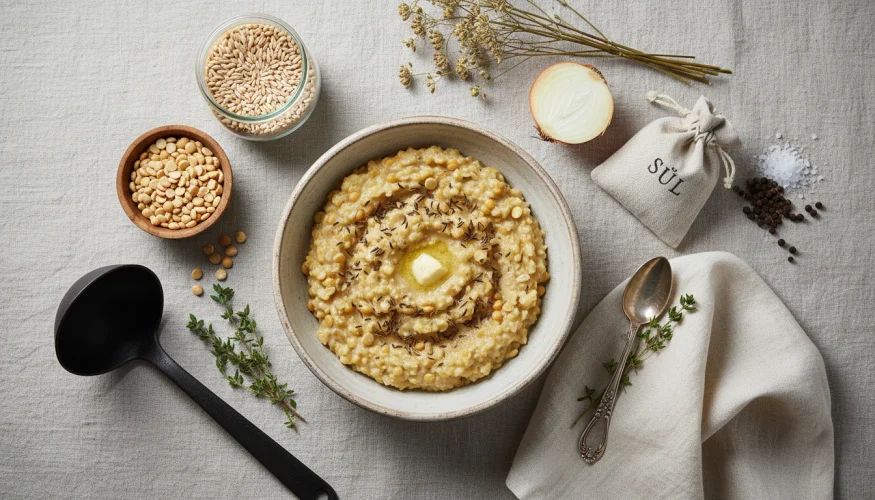
Rediscovering forgotten food is more than a passing trend. It is a way to reconnect with our roots and with what shaped Czech culture and identity over the centuries. Šoulet is more than a recipe - it is a story of thrift, the wisdom of rural life, and how simple ingredients can become something truly worthwhile.
At a time when supermarkets offer thousands of products from around the world and ordering food through an app is easier than cooking it, it is worth pausing to remember what Czech cuisine achieved without any exotic ingredients. Šoulet is proof that exceptional food does not require exceptional ingredients - it requires only time, care, and respect for tradition.
Food historians and chefs working to revive forgotten Czech cuisine, as well as initiatives such as Czech Cuisine promoted by CzechTourism, point out that many traditional dishes fade from public awareness not because they are bad, but simply because people stopped cooking them. It takes just one generation failing to pass on a recipe for a dish to disappear. Šoulet nearly suffered that fate.
Fortunately, interest in traditional Czech cuisine is growing. Farmers’ markets, regional restaurants, and chefs who draw inspiration from historical sources are slowly bringing forgotten dishes back to the table. Šoulet occasionally appears on the menus of restaurants specializing in Czech folk cuisine, and those who try it once usually come back for more.
There is something deeply satisfying about enjoying a bowl of thick, fragrant šoulet on a cold autumn day - knowing that your ancestors ate the same dish, that the same aroma of peas and caraway rose from farmhouse kitchens throughout Bohemia and Moravia. Food has a memory, and šoulet is one of those dishes that carries it especially strongly. It is worth awakening that memory.