
Why slow furniture saves money and the planet
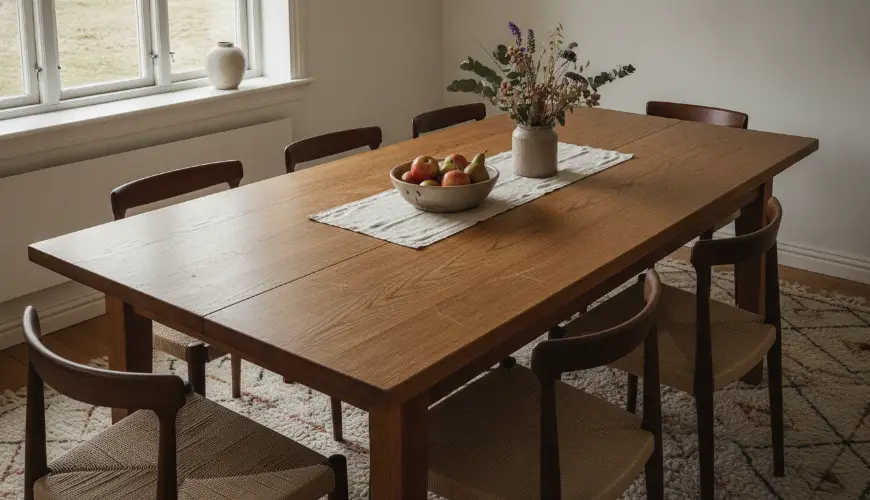
There is an old Danish dwelling that has passed through the hands of three families and still stands. A solid oak dining table, a little scratched, with the patina of decades worn into its growth rings – but it stands firm, as if it had just come out of a carpenter's workshop. This is neither coincidence nor luck. It is the result of a conscious choice made by its first owner sometime in the 1950s, when it was not yet assumed that furniture would be replaced every five years. Today, this approach is returning under a new name: slow furniture.
The concept of slow furniture draws from the same philosophy as slow food or slow fashion – deliberate deceleration, an emphasis on quality over quantity, and mindful decision-making about what we bring into our homes. In an era when global chains offer cheap sets at the price of instant gratification, more and more people are asking themselves: what do I actually want to have at home in twenty years? And what will my children inherit from me?
Try our natural products




Why cheap furniture ends up costing more
At first glance, the maths seems simple. A cheap sofa for four thousand crowns versus a quality piece for forty thousand – the choice seems obvious. But this calculation ignores one crucial factor: time. A cheap sofa lasts an average of three to five years before it starts losing its shape, seams crack, and the foam crumbles. A well-crafted piece with a wooden frame and natural materials can easily serve for thirty, forty, or – as that Danish table demonstrates – even sixty years.
The economic picture is therefore precisely the opposite of what it first appears. But it is not just about money. Every discarded piece of furniture goes somewhere – most often to a landfill or incinerator. The cheap furniture industry is one of the largest producers of household waste. According to data from the European Environment Agency, furniture and home accessories account for a significant share of municipal waste in EU countries, with a large portion of this waste coming from products designed with a short lifespan. Slow furniture is therefore not only an economically sound choice, but also a gesture towards the planet.
Shifting from thinking "what is cheap right now" to thinking "what will last a lifetime" is not always easy. It requires a change of perspective – and a little patience. But patience is at the very heart of the entire slow furniture philosophy.
How to recognise furniture that will outlast generations
The key to making the right choice is knowing what to look for. And that is not nearly as complicated as it might seem. Experienced carpenters and designers agree on several basic criteria that reliably distinguish a piece built for life from one built for a few seasons.
The first and most fundamental indicator is material. Solid wood – oak, beech, walnut, cherry – is an investment that pays off. Unlike chipboard or MDF, solid wood changes with age but does not fall apart. The surface can be sanded, treated, repaired. The patina that forms on it is not a flaw – it is a story. The same applies to metal frames made of steel or cast iron, which, with proper care, can outlast their owners by entire decades.
The second criterion is the method of joinery. Classic carpentry joints – mortise and tenon, dovetail joints, solid metal screw connections – are significantly more durable than glued or nailed joints. When inspecting a piece, it is worth checking the corners, drawers, and areas of greatest stress. If a drawer slides smoothly and firmly, if corner joints do not creak or wobble, that is a good sign.
The third factor is timeless design. This criterion tends to be underestimated, but it is crucial. Furniture that in five years will look like a relic of a bygone trend will likely end up at a flea market or recycling centre – regardless of how well it is crafted. Clean lines, neutral colours, classic shapes – these are attributes that survive decades without losing their value. It is no coincidence that furniture by Scandinavian designers of the 1950s and 1960s, such as Hans Wegner or Arne Jacobsen, is more sought-after today than it was at the time.
The fourth aspect, which is too often overlooked, is repairability. Can the piece be repaired if it gets damaged? Are spare parts available? Is it constructed in a way that a skilled amateur could handle the repair, or does it require specialist equipment and original components that will no longer be available in ten years' time? Furniture designed with repairability in mind is part of the principles of the circular economy, and its value extends beyond aesthetics and function.
Imagine a family that buys a solid oak bed with an upholstered headboard. After ten years, the upholstery wears out – but the frame is still perfect. Instead of throwing out the entire bed, they have the headboard reupholstered by a local craftsman. The cost is a fraction of the price of a new bed, the result is just as beautiful, and the piece lives on. This is slow furniture in practice.
The fifth and final criterion is origin and ethical production. Where was the furniture made? Under what conditions? Where does the wood come from? Certifications such as FSC (Forest Stewardship Council) guarantee that the wood comes from sustainably managed forests. Local production means shorter transport routes, support for local craftspeople, and easier options for complaints or repairs. Knowing the story of your furniture is just as important as knowing its price.
Where to look and how to buy
Mindful furniture selection begins long before entering a shop or opening a website. It begins with the question: what do I actually need? Impulse purchases are the enemy of a slow approach to furnishing. Patient searching, exploring options, and a willingness to wait for the right piece – these are the virtues that pay off.
One of the best options is local carpenters and small workshops. Custom-made production is not always as expensive as it seems – and it brings a fundamental advantage: the piece is exactly as you want it, in the right size, from the material you have chosen, with joints you know. You also have direct contact with the maker, which makes potential repairs or modifications easier.
The second route is the market for quality second-hand furniture. Antique shops, flea markets, online platforms such as Bazoš, and specialist vintage stores are full of hidden treasures. Solid furniture from the second half of the twentieth century was often made with a level of care that is today absent even from higher-priced pieces. Buying an old, well-preserved piece and having it restored if necessary is an economically and ecologically sound solution.
The third option is brands that explicitly build their philosophy around durability and transparency. There are manufacturers on the market that offer decades-long warranties, provide spare parts and servicing, and whose products are certified in terms of sustainability. Finding such brands takes time, but the result is worth it.
When it comes to the purchase itself, a few practical rules apply. Never buy without the possibility of a personal inspection or at least detailed documentation of the materials and construction. Ask about weight – a heavier piece of solid wood is generally a better choice than a lightweight piece made of filler. Pay attention to smell – a strong chemical odour may signal cheap adhesive or varnish with a high content of volatile organic compounds, which are bad both for health and for the longevity of the piece.
As British designer Jasper Morrison once remarked: "Good design is not about how things look. It is about how they work and how long they last." This thought is at the heart of the entire slow furniture philosophy.
It is also worth mentioning the psychological dimension of mindful selection. Furniture into whose purchase you have invested time, energy, and careful deliberation occupies a different place in your home than a piece bought impulsively in a sale. A relationship forms with it. It becomes part of the home, not merely its furnishing. And it is precisely this relationship that ensures the piece survives – because you protect it, repair it, and pass it on.
The generation that grew up in a culture of instant consumption is gradually discovering that true freedom lies not in the ability to buy anything at any time for as little money as possible, but in the ability to surround oneself with things that have value and a story. Slow furniture is not about deprivation – it is about choosing thoughtfully. It is about preferring one perfect table over three mediocre sofas. It is about slowing down, reflecting, and making a conscious decision.
The Danish table from the opening of this piece now stands in a small flat in Prague. Its current owner bought it at a Vienna flea market for a fraction of its value, had the surface sanded and oiled. She now dines at it with her two children. Perhaps one day it will pass to them. And perhaps to their children after that. That is the meaning of slow furniture – things that endure and carry within them more than just function.