

A Healthy Homemade Nutella Alternative Made with Hazelnuts and Dates
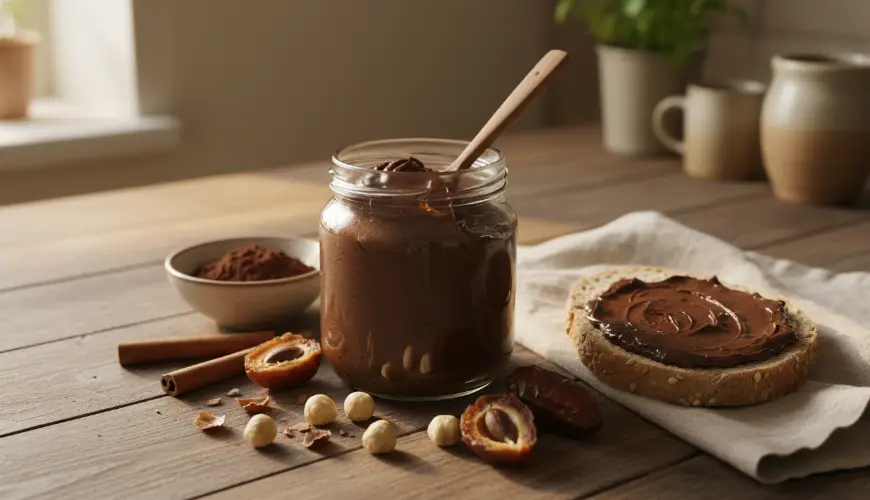
Few foods can evoke such strong emotions as Nutella. Sweet and creamy, with the unmistakable aroma of chocolate and hazelnuts – for many, it is the taste of childhood, a morning ritual at the breakfast table, or a reward after a demanding day. But if you look at the ingredients in the popular store-bought hazelnut spread, you’ll find that sugar comes first and hazelnuts account for a mere thirteen percent. What if we told you that you can make a spread at home that tastes just as rich, yet is made from ingredients whose origins you know and whose benefits for the body are incomparably greater?
Homemade hazelnut and date spread is the answer to enjoying a sweet treat without guilt. It’s not a compromise or a sacrifice – it’s a rethinking of what sweetness and creaminess can mean when you choose the right ingredients.
Try our natural products

Why the ingredients in industrial spreads are a problem
Industrially produced chocolate spreads are designed to be as cheap as possible to manufacture and to have the longest possible shelf life. That means a large proportion of their volume consists of refined sugar and palm oil. Palm fat provides the ideal consistency at room temperature, but its production is associated with widespread tropical deforestation, as documented by WWF. What’s more, from a nutritional standpoint, such a spread offers mostly empty calories – a rapid rise in blood sugar, inevitably followed by fatigue and a craving for more sweets.
A homemade hazelnut and date spread works on an entirely different principle. Hazelnuts naturally contain healthy unsaturated fats, vitamin E, magnesium, and a host of antioxidants. Dates, meanwhile, provide natural sweetness along with fiber, potassium, and iron. The resulting treat doesn’t just taste good – it actually gives your body something of value.
Take Lucie, for example, a working mother of two children aged five and eight. Every morning, she struggled with the fact that her children refused to eat anything other than white bread with Nutella. One day, she tried making a homemade version with hazelnuts, dates, and a little cocoa. The children didn’t notice the difference – or rather, they did, but they liked it. And for the first time, Lucie didn’t have to wonder how many teaspoons of sugar she had just spread on a slice of bread.
How to make homemade hazelnut spread with dates
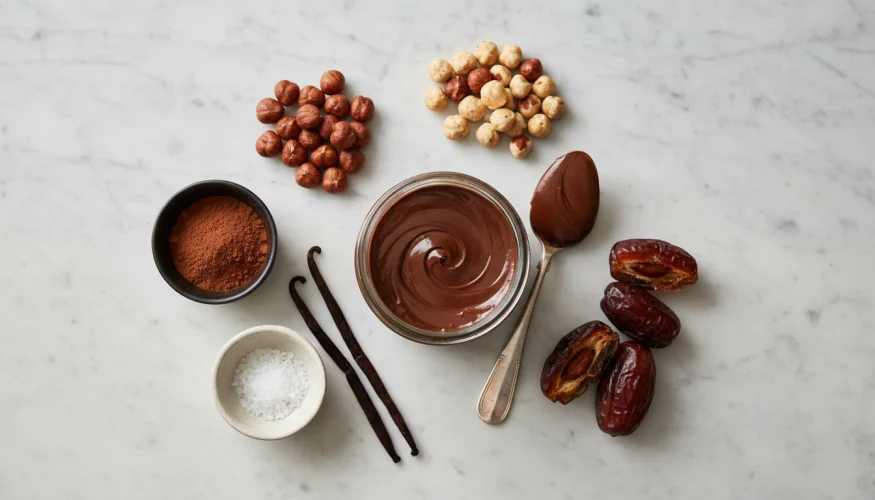
Making this spread is surprisingly simple and requires no special equipment other than a good blender or food processor. The foundation is roasted hazelnuts, which you peel and blend into a smooth paste. Roasting is the crucial step – heat releases the nuts’ natural oils, making the resulting texture considerably creamier.
Dates serve as a natural sweetener. Medjool dates work best, as they are naturally softer and juicier. Ideally, soak them in warm water for twenty minutes before use so they blend more easily. You can adjust the ratio of nuts to dates to suit your taste – as a general rule, eight to ten medium-sized dates are enough for two hundred grams of nuts.
Next comes quality cocoa – ideally unroasted raw cocoa, which retains the maximum amount of antioxidants. A pinch of salt, and perhaps some vanilla or cinnamon, gives the spread a depth and complexity that will surprise even the biggest skeptics. Some people also add a teaspoon of coconut oil for an even silkier consistency, although well-roasted hazelnuts release their own oil.
The entire blending process takes approximately five to ten minutes, depending on the power of your appliance. First, you’ll get a coarse meal, then a crumbly paste, and finally – if you persevere – a truly smooth, glossy spread. The finished spread will keep in a sealed jar in the refrigerator for about two weeks, although in most households it disappears much sooner.
As Michael Pollan, the American journalist and advocate of healthy eating, once wrote: “Eat food. Not too much. Mostly plants.” Homemade nut spread embodies this philosophy to the letter – every ingredient is real, unprocessed, and recognizable.
Nutrition, sustainability, and conscious shopping
The nutritional benefits of homemade spread are well supported. Hazelnuts are among the most extensively studied nuts in terms of their effects on cardiovascular health. Research published in the scientific journal Nutrients shows that regular consumption of hazelnuts has a positive effect on LDL cholesterol levels and supports heart health. Dates, meanwhile, contain fiber that slows the absorption of sugars into the bloodstream, so the sweetness they provide does not cause as sharp a blood sugar spike as refined sugar.
But the sustainability aspect is also important. Hazelnuts are one of the more environmentally friendly nut crops – hazelnut trees do not require intensive irrigation as almonds do, for example, and they also thrive in temperate climates. If you choose European-grown nuts, you can significantly reduce the carbon footprint of your purchase. Although dates come from regions of the Middle East and North Africa, their cultivation has traditionally been part of local ecosystems and does not require pesticides to the same extent as other tropical crops.
Conscious shopping for ingredients is just as important as the preparation itself. Choosing organic hazelnuts without added preservatives, dates without added sugar, and fair-trade cocoa – these are all small decisions that together make a big difference. At the Ferwer online store, you’ll find just such ingredients, allowing you to make your spread with a clear conscience from the first spoonful to the last.
Another aspect often overlooked in discussions of homemade alternatives to industrial foods is worth mentioning: the economics. At first glance, homemade nut spread made from quality ingredients costs more than a store-bought jar. But in reality, you’re paying for real nuts, not sugar and palm oil. And if you consider nutrient density – that is, how many nutrients you get for every crown spent – the homemade version comes out significantly ahead.
The world of homemade spreads has expanded considerably in recent years. Alongside the classic combination of hazelnuts and cocoa, there are countless variations – a spread with almonds and honey, a cashew and raspberry version, or tahini with carob as a cocoa-free alternative. Each combination offers a different nutritional profile and flavor experience, but they all share one thing: you know exactly what you’re eating.
For those who decide to experiment, it’s worth knowing that the quality of the finished spread depends primarily on the quality of the nuts and your patience while blending. A spread blended for too short a time will be grainy and dry, whereas properly processed hazelnuts release enough oil to create a truly smooth spread. If your blender isn’t up to the task, don’t be afraid to add a teaspoon of neutral oil – cold-pressed sunflower oil, for example.
It’s interesting to see how this trend of homemade nut butters and spreads intersects with the broader movement toward getting back to basics in the kitchen. People are rediscovering that processed foods are not inevitable, but a choice – and that an hour and a little curiosity are often all it takes to create something tastier and healthier than anything they could buy at the store.
Homemade hazelnut and date spread is more than just a recipe. It’s a way of thinking – the belief that food can be delicious, nutritious, and ethically sound at the same time. And that these three things don’t contradict one another, but complement one another beautifully. The next time you reach for a jar of chocolate spread, perhaps you’ll pause for a second and think: what if I tried making it myself?