

Try Chasteberry for Natural PMS Support
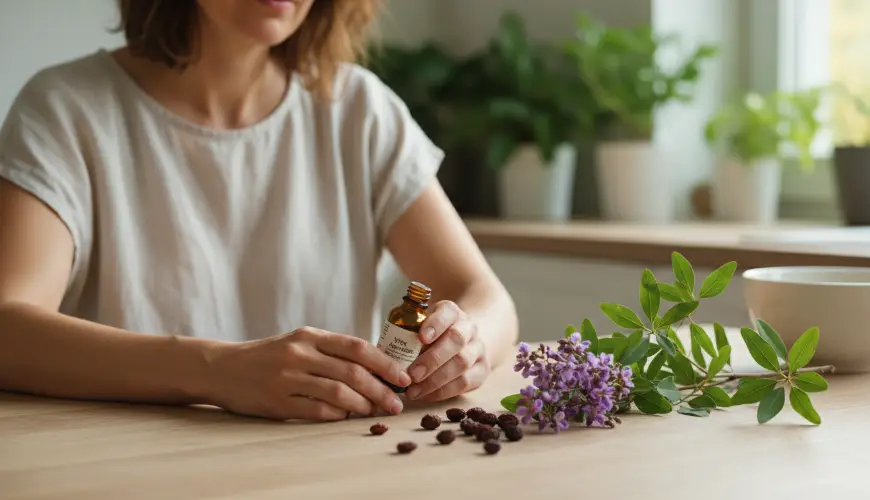
For centuries, women have turned to nature when modern medicine was not enough or simply was not available. One herb that has earned a firm place in this regard not only in folk medicine but also in modern phytotherapy is chaste tree – an unassuming shrub with purple flowers whose fruits have a surprisingly powerful effect on the female hormonal system. At a time when more and more women are interested in natural ways to bring their bodies into balance, chaste tree is returning to the spotlight.
The plant’s scientific name is Vitex agnus-castus, and it originates in the Mediterranean region, where it grows along rivers and coastlines. Historically, it was known as the “chaste tree” – according to legend, monks used it to suppress sexual desire, which is also the origin of its Latin name. Today, however, most women know it for an entirely different reason: as natural support for problems associated with the menstrual cycle.
Try our natural products






How chaste tree affects the female hormonal system
To understand why chaste tree works, it is worth pausing for a moment to consider what actually happens in a woman’s body. The menstrual cycle is controlled by a delicate interplay of hormones – primarily estrogen, progesterone and prolactin. If this balance is disrupted, problems such as irregular cycles, painful periods, premenstrual syndrome (PMS) or even missed ovulation can arise.
Chaste tree acts primarily on the pituitary gland, a gland in the brain that controls hormone production. It contains substances that affect dopamine receptors, thereby indirectly reducing prolactin levels. Elevated prolactin is one possible cause of low progesterone in the second half of the cycle, which manifests in a range of unpleasant symptoms. Through this mechanism, chaste tree helps restore natural hormonal balance – not by supplying hormones directly, but by gently regulating their production.
Scientific research also supports this mode of action. Studies published in the scientific journal Phytomedicine have repeatedly shown that extracts from chaste tree fruit reduce PMS symptoms to a statistically significant degree compared with a placebo. It is therefore not merely a folk tradition – there is also solid scientific evidence behind this herb.
It is important to note that chaste tree does not work immediately. Unlike medicines that act quickly and decisively, the herb needs time for its effects to become apparent. Most experts recommend taking it for at least three months, ideally for six months, so that the results can fully develop. This may be challenging for women who are impatient, but it is precisely this slow action that also ensures it is gentle on the body.
Chaste tree and PMS: what women and science say
Premenstrual syndrome is estimated to affect up to three quarters of women of reproductive age, and for some, the symptoms are severe enough to significantly disrupt daily life. Irritability, fatigue, headaches, breast tenderness, mood swings or depression in the weeks before menstruation – these are symptoms that many women know all too well.
Take thirty-year-old Kateřina, who works as a project manager, as an example. Every month, approximately ten days before her period, she would become oversensitive, sleep poorly and suffer from severe breast pain. She tried various approaches – from dietary changes to psychotherapy. It was only after her gynecologist recommended it that she began taking a standardized chaste tree extract. After three months, she noticed a significant improvement, and after six months she described her condition as “finally normal.” Stories like this are not uncommon.
“Vitex agnus-castus is one of the best-studied herbs in the field of women’s health, and its effectiveness for PMS is supported by clinical studies,” says Professor Rudolf Bauer, a German expert in phytotherapy and the author of numerous publications on medicinal plants.
Irregular cycles are another area where chaste tree has proven its value. Whether the issue is cycles that are too short or too long, missed periods during times of stress, or the transition from hormonal contraception back to a natural cycle, chaste tree is often one of the first choices for naturopaths and gynecologists who combine conventional and natural approaches. The herb helps the body rediscover its rhythm by stabilizing the hormonal environment.
A particular group is women who have stopped taking hormonal contraception and are waiting for their cycles to return to normal. This process can take months and be accompanied by hormonal chaos. It is in precisely these situations that chaste tree can be a valuable ally – naturally supporting the restoration of the body’s own hormone production without further external intervention in its chemistry.
Interestingly, chaste tree also helps with the opposite problem – periods that are too heavy or too frequent. This simply confirms that its mechanism is not one-sided, but rather regulatory. It does not tell the body what to do, but helps it find its own balance. It is this adaptogenic nature that makes chaste tree an herb suitable for a wide variety of women’s health concerns.
How to take chaste tree correctly and what to watch out for
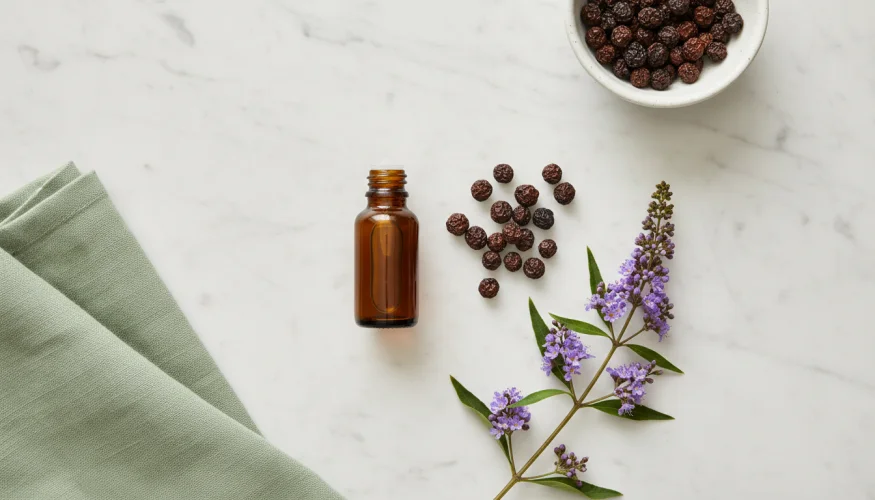
Chaste tree is available in several forms – as dried fruit, tea, tinctures or, most commonly today, as a standardized extract in capsules or tablets. Standardized extract is the most advantageous in terms of effectiveness because it contains a precisely defined amount of active substances and its dosage is predictable.
The recommended daily dose is usually around 20 to 40 mg of dry extract, and products available in pharmacies and online shops specializing in natural health generally come with precise dosage instructions. The herb is most often taken in the morning on an empty stomach, as prolactin levels are thought to be highest in the morning and a morning dose may therefore be most effective.
In terms of safety, chaste tree is among the relatively well-tolerated herbs. Side effects are rare and usually mild – they may include headaches, skin rash or digestive problems. However, pregnant women should not take it under any circumstances, as its effects on pregnancy have not been sufficiently studied. Caution is also warranted when taking hormonal contraception or medicines that affect the dopamine system – in such cases, it is always advisable to consult a doctor or pharmacist.
Chaste tree is also unsuitable for girls who have not yet started menstruating and is generally not recommended for children. By contrast, it appears to be potentially beneficial for women in perimenopause – the transitional period before menopause – although research in this area is still ongoing.
One of the most common mistakes when taking chaste tree is stopping the course after the first improvement, which may occur as early as four to six weeks. At this point, however, the body has not yet stabilized and symptoms may return. It is therefore recommended to continue taking it for the entire recommended period, ideally under the supervision of a professional.
Phytotherapy has experienced a renaissance in recent decades, and chaste tree is one of the best examples of how traditional knowledge can be confirmed by modern science. It is not a miracle cure that will solve all women’s health problems overnight. It is an herb that respects the body’s natural pace, gently supports it and gives it room to find its own balance. And in a world overwhelmed by quick fixes, that may be the most valuable thing it has to offer.
For women looking for a natural approach to caring for their cycles, chaste tree can be a first step on the path to greater well-being – little by little, month by month.