

# Sentences from parents that we unconsciously repeat to our children
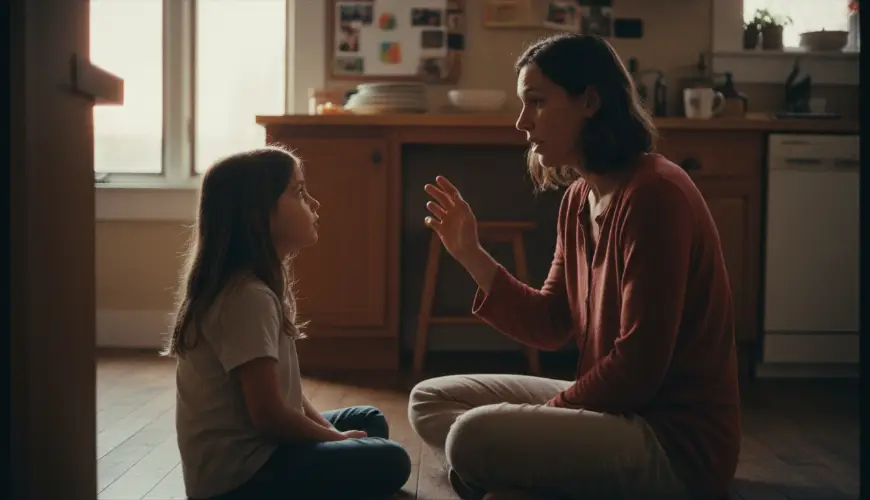
There is a moment that almost every parent knows. You stand over your child, who has just done something that has driven you to the brink of madness, and a sentence flies out of your mouth that stops you in your tracks. Not because it was wrong or cruel – but because you know it word for word. Every word. The intonation, the pause before that emphatic word, even the expression on your face. You heard it exactly like this thirty years ago. And it was your mum saying it. Or your dad. And back then you swore you would never say this to your own children.
This phenomenon is neither coincidental nor exceptional. It is deeply rooted in the way the human brain absorbs upbringing – and what it then does with it in moments of stress, fatigue or helplessness.
Try our natural products



Why we repeat our parents' words
Psychologists refer to this phenomenon as transgenerational transmission of behavioural patterns. Simply put: the ways in which our parents communicated with us are stored in memory as a kind of emotional template. It is not just about the words themselves, but about the entire context – the tone of voice, the situation in which they were spoken, and the feeling they evoked. These templates then function in adulthood as automatic responses, activated particularly when we are tired, under pressure or emotionally overwhelmed.
Research in developmental psychology shows that children remember the emotional charge of situations far more reliably than their content. In other words – a child does not remember the exact content of an argument, but remembers how they felt during it. And it is precisely these emotional imprints that shape how we ourselves will one day react in tense situations. It is therefore not surprising that the moment our own child pushes us to the edge of our patience, we reach for a pattern that has been stored within us for years as a tried-and-tested solution.
American psychologist Dr. Becky Kennedy, author of an approach focused on building a strong bond between parent and child, describes this dynamic aptly: "You are not a bad parent because you repeat your parents' phrases. You are a human whose nervous system is looking for shortcuts in moments of overload." This distinction is crucial – it is not a failure, but an understandable mechanism that can be consciously changed.
What is interesting is that this "switching" to parental autopilot does not happen uniformly. Research and everyday experience show that it most often occurs in situations that faithfully mirror scenarios from our own childhood. A child refuses to eat, does not respond to the first call, tells a small lie or fights with a sibling – and suddenly we are back in 1992 and our hand is gesturing in exactly the same way as our mother's hand did back then.
Phrases that survive generations
Some expressions have an almost timeless resilience. They survive decades; only the backdrop changes, while the words themselves remain surprisingly unchanged. Who does not know the classic "As long as you live under my roof, you'll do as I say"? Or "Because I said so, and that's enough"? Or the perennial "If I were your age, I'd be grateful for what you have."
These phrases share several common denominators. They are statements that close down dialogue rather than opening it up. They place the parent in the position of an infallible authority and the child in the role of a subordinate whose feelings and perspective are irrelevant. Paradoxically – precisely because we heard these phrases as children and did not like them – we should be the best equipped not to use them.
And yet we use them. Why?
The answer lies largely in what psychologists call "stress regression". When a person is under pressure, the brain switches to an economy mode and reaches for its most well-learned patterns. A new, considered response requires energy, creativity and emotional capacity – precisely what we have least of in the demanding moments of parenthood. The old pattern, by contrast, is available instantly, without effort.
Take a specific example: Lucie, a thirty-three-year-old mother of two from Brno, recalls how one evening, as she was getting ready for bed, her seven-year-old son announced that he needed to bring a carnival costume to school the next morning – and she had known absolutely nothing about it. At that precise moment, out came: "Do you think I'm a magician? That I just wave a wand and everything's done?" She stopped. Her mother used to say exactly that phrase – word for word. And Lucie, as a child, had not understood why her mum was angry when she simply needed help.
This moment of self-awareness – that flash when we realise we are speaking with someone else's voice – can be a very powerful impulse for change. But only if we do not let it pass unnoticed.

What can be done about it
Awareness is the first and most important step. Many parents describe how the very act of beginning to notice these automatic reactions gradually changes their behaviour. It does not happen overnight, and it certainly does not mean they will become perfect parents – but conscious attention paid to one's own words and reactions opens up space for choice.
Family therapy specialists recommend what is known as the "pause before reacting" – a deliberate slowing down at the moment we sense an automatic response approaching. A breath, a second of silence before we open our mouths. This technique is simple, but in practice it requires training, because it goes directly against instinct.
Another useful tool is post-situation reflection. Once the emotions have subsided, sit down and ask yourself: What did I actually want to say to my child? What was my real intention? And did my reaction help achieve that intention? This retrospective analysis helps gradually build new patterns – and importantly, it also serves as a model for the children themselves, who see that their parent thinks about their own behaviour and is capable of admitting a mistake.
Reading specialist literature or listening to podcasts focused on mindful parenting can also be very beneficial. For example, the approach known as "gentle parenting" – that is, kind but consistent parenting – offers concrete alternatives to traditional authoritative statements. Instead of "Because I said so," comes an explanation of the reason. Instead of "Stop crying," comes "I can see you're sad. Would you like to tell me about it?" The point is not to abandon boundaries or authority – it is to communicate them in a different way.
Resources such as Centrum pro rodinu a sociální péči and research published in the specialist journal Journal of Child Psychology and Psychiatry repeatedly confirm that the way parents communicate with their children has a direct impact on their emotional intelligence, self-esteem and ability to manage stress in adulthood. It is therefore not merely a matter of pleasant communication – it is about long-term effects on mental health.
It is also important not to succumb to excessive self-blame. Parenting is one of the most demanding tasks a person can undertake, and nobody begins it as a blank slate. Every parent carries their own history, their own wounds, their own unlearned lessons. The goal is not to be perfect – the goal is to be a little more aware than yesterday.
An interesting perspective is also offered by the children's own viewpoint. Research shows that children are far more forgiving towards their parents than parents tend to think – and especially so when they see that the parent is making an effort, apologises for mistakes and maintains a close relationship with them. Perfectionism in parenting is therefore not only unattainable, but to some extent unnecessary.
The phrases we say to our children are not merely words. They are messages about how we see the world, how we understand relationships and what value we place on the feelings of others. And because these messages come from the depths of our own upbringing, working with them is also work on ourselves – on understanding who we are and where we come from.
Next time a familiar-sounding phrase flies out of your mouth – do not stop at self-blame. Stop at curiosity instead. Who used to say it? In what situation? And what did you, as a child, need to hear instead? It is in that answer that the path lies towards a slightly different – perhaps better – version of parenting than the one we experienced ourselves. And that, in the end, is what most parents strive for: to give their children what they themselves lacked. Even if it means rewriting a few phrases that have survived entire generations.