
What Is the RPE Scale and How to Use It in Training
Training without a personal trainer is today's common reality for most people who engage in physical activity. But how do you know if you're training hard enough – or conversely, too hard? How do you set a load that will push your body forward without unnecessarily destroying it? The answer to these questions is offered by a tool used by athletes and physiotherapists around the world: the RPE scale.
The abbreviation RPE comes from the English Rate of Perceived Exertion, meaning the assessment of perceived effort. It's a simple scale that helps you subjectively evaluate how intensively your body is working – without a heart rate monitor, without an app, without a trainer standing next to you. All you need to do is pause, tune into your body, and assign a number to what you feel.
Try our natural products
What exactly the RPE scale measures and where it came from
The original version of the scale was developed in the 1960s by Swedish psychologist Gunnar Borg. His scale ran from 6 to 20 – a seemingly strange range that was actually based on average resting heart rate multiplied by ten. So if a person felt exertion at level 15, it corresponded roughly to a heart rate of 150 beats per minute. Borg's scale is still used today, particularly in clinical settings and rehabilitation.
For everyday athletes and fitness enthusiasts, however, a modified version gradually took hold – the RPE scale from 1 to 10, sometimes also referred to as CR10 or simply "modern RPE". On this scale, the number 1 means complete rest with no exertion, while the number 10 represents absolute maximum – an effort that cannot be sustained even a second longer. This version is now commonly used by strength coaches, CrossFit coaches, and sports science researchers. The American College of Sports Medicine (ACSM) recommends it as a reliable tool for monitoring training intensity across various populations.
Why is this so useful? Because the human body is a far more complex system than any device can capture. Heart rate can be skewed by stress, poor sleep, coffee, or heat. Performance with a barbell depends on how you slept, what you ate, and how you feel mentally. RPE, on the other hand, captures the complete picture – how you truly feel right now, in this specific training session.
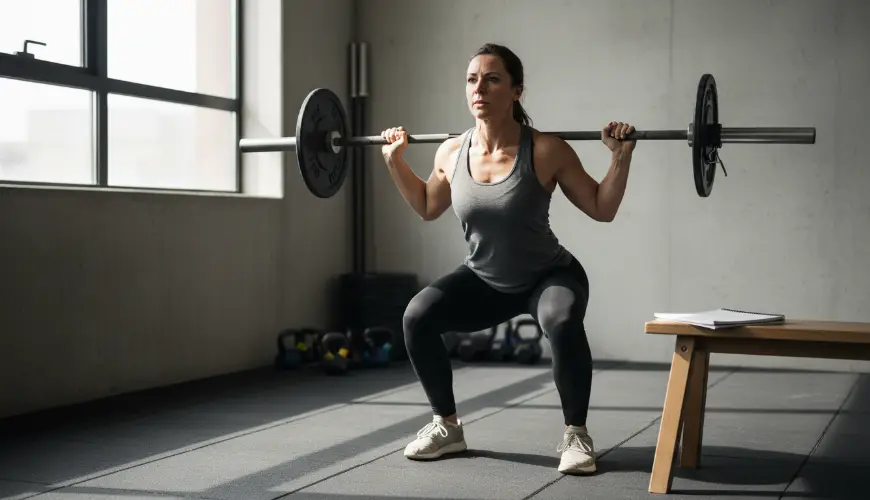
Let's take a practical example. Jana is a thirty-year-old woman who goes to the gym three times a week. Monday was demanding at work, she slept six hours, and didn't manage to have a proper lunch. On Wednesday, she woke up rested, well-fed, and in a good mood. If on both days she were guided only by the number on the barbell – say 50 kg on a squat – the results would be very different. On Monday it might be at the edge of her capabilities, while on Wednesday it would be a comfortable warm-up. RPE allows her to work with what her body can actually handle, rather than blindly following a table from the previous week.
How to correctly use the RPE scale in practice
Understanding the principle is one thing; using it correctly in real training is another. The most common mistake is confusing RPE with how you feel after a set or after an entire training session. RPE is assessed during performance or immediately after it ends – it's an immediate perception, not a retrospective evaluation.
In practice, it looks like this: you complete a set of eight squats and immediately ask yourself – how hard was that? Could you have added two or three more repetitions? Or did you finish right at the limit? Or did you still have plenty left? The answers to these questions lead you to a number on the scale. This very approach is the foundation of the RIR (Reps in Reserve) concept, which is closely related to RPE and was popularised in strength sports by coach Mike Tuchscherer.
An overview of values on the RPE scale:
- RPE 1–3: Very light activity, walking, warm-up, movement without significant effort
- RPE 4–5: Moderate exertion, can talk comfortably, breathing is slightly faster
- RPE 6–7: Moderate to higher intensity, talking is more difficult, the body is working but performance can be maintained for a longer period
- RPE 8: Hard work, approximately two to three repetitions or minutes remaining until failure
- RPE 9: Very hard, one repetition remaining, the limit is close
- RPE 10: Absolute maximum, no more is possible
For most training sessions focused on developing strength or endurance, it is recommended to stay within the RPE 6 to 8 range. This zone is sufficiently stimulating for physical development while not generating excessive fatigue that would complicate recovery. Training at RPE 9–10 has its place, but should be the exception rather than the rule – especially for beginners or people training without professional supervision.
Interesting in this regard is a quote from Greg Nuckols, one of the world's leading experts on strength training: "The ability to accurately estimate your own RPE is a skill that develops gradually – and it is precisely this skill that distinguishes an experienced athlete from a beginner." In other words, even the RPE scale requires practice. At first, it's normal to overestimate or underestimate your exertion. Over weeks and months, however, your self-perception becomes more refined and RPE becomes a reliable guide.
Why perceiving your own load is so important for health and results
Excessive dependence on external tools – watches, apps, tables – can paradoxically cause us to stop listening to our own bodies. And this is often the source of many injuries, overtraining, and psychological burnout from sport. Learning to perceive your own exertion is one of the most valuable skills an athlete can acquire.
Research repeatedly shows that subjective perception of exertion correlates well with objective physiological indicators, such as oxygen consumption or blood lactate levels. For example, a study published in the journal Sports Medicine confirmed that RPE is a reliable predictor of training intensity across different types of sports and populations. This means your body doesn't lie to you – if it feels like an eight, it probably really is an eight.
This approach is especially valuable for people who train alone, without a trainer or group. A personal trainer can see from the outside when someone is slowing their pace, when breathing changes, or when technique starts to break down under fatigue. Without this external perspective, you must be your own observer. The RPE scale gives you a language with which to communicate with your own body.
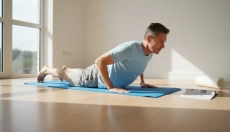
Interestingly, RPE works equally well for cardio training as for strength training. Runners use it to manage pace on long runs – maintaining RPE 6 during a two-hour run is a completely different challenge from maintaining RPE 6 during interval training. Swimmers, cyclists, and even practitioners of yoga or pilates can adapt the scale to their needs. It is, after all, a universal tool of perception that is not tied to any specific sport.
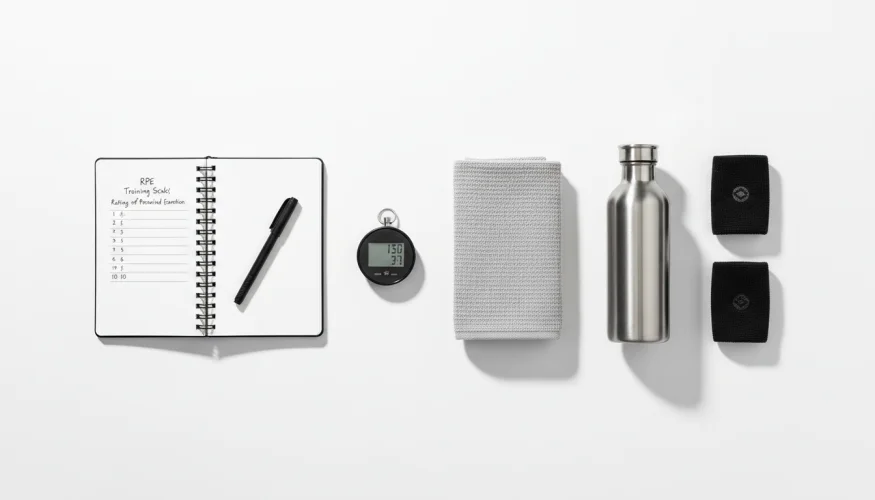
Another reason RPE deserves attention is its role in injury prevention. Many overuse injuries don't arise from a single extreme performance, but from the gradual accumulation of fatigue, when a person ignores the body's signals. Regularly monitoring RPE and recording it in a training journal – even just as a number after each set or training session – creates a valuable record of how your capacity changes over time. If you find that a workout that previously rated RPE 6 is suddenly at RPE 8, that's a clear signal: the body needs more rest, better nutrition, or simply less load.
To make RPE assessment as accurate as possible, it helps to ask yourself specific questions during training. How many more repetitions could I do before my technique would fail? How quickly is my breathing recovering? Do I feel burning or just fatigue? These nuances help refine the estimate, and over time you'll develop your own internal calibration that is tailored to your physiology, not to average values from a table.
The psychological dimension of the whole approach is also significant. People who learn to work with RPE report greater confidence during training and less anxiety about whether they're exercising "correctly". Instead of constantly comparing their performance to others or to arbitrary numbers, they begin to trust their own bodies. And that is a change that goes beyond the gym – it's a different way of being in touch with yourself.
If you're just starting with RPE, the simplest way is to add the assessment to the training you're already doing. After each set or each segment of cardio training, simply write down a number. Don't judge yourself for whether you've done it "correctly" – at first, it's about building a habit and gathering data. After a few weeks, you'll start to see patterns: when you're strongest, what affects your performance, how your body behaves after different types of rest. This data is yours and is more valuable than any generic training plan downloaded from the internet, because it reflects exactly what you need to know – how your specific body responds to a specific load.
The RPE scale is not a magic solution, nor a replacement for professional guidance. But it is a practical, scientifically grounded, and completely free tool that enables anyone to train smarter. In an age when we're overwhelmed with data from smartwatches and fitness apps, perhaps the most revolutionary step forward is learning to listen again to the most sophisticated measuring instrument we have available – our own body.